

AI is moving into the office.
Not as a robot sitting at a desk.
As an agent that can write code, search the web, build documents, analyze spreadsheets, click through software, use cloud tools, and keep working through a messy task.
That is the bigger story behind several recent AI headlines.
That story is not only about one tool.
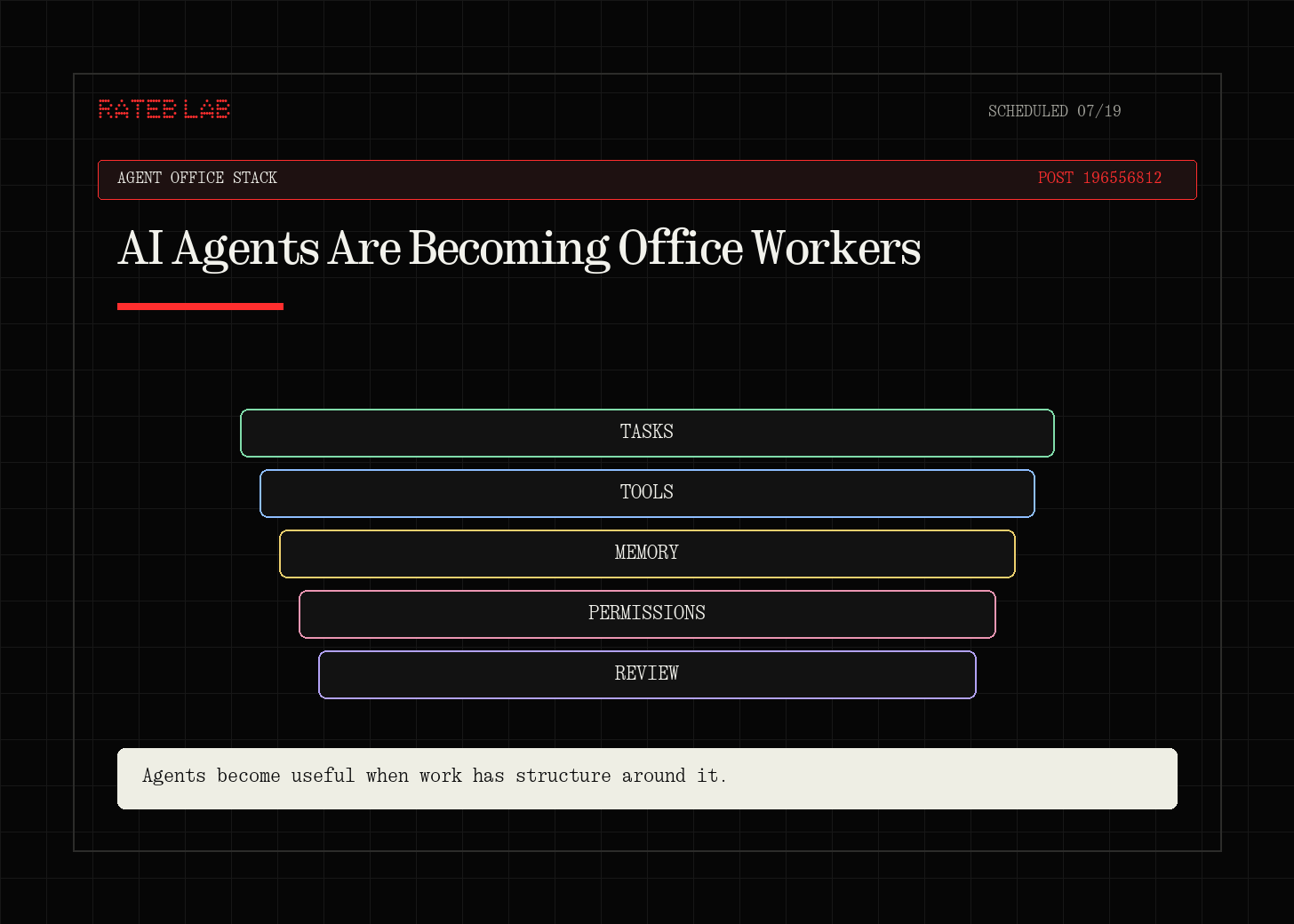
It is about the new shape of work.
AI agents are becoming office workers.
But the office is not ready for them.
The Old Mental Model Is Too Small
The old mental model was simple:
You ask a chatbot a question.
It gives you an answer.
You decide what to do with it.
That was already useful. But it was limited.
The new model is different:
You give an agent a goal.
It plans steps.
It uses tools.
It reads files.
It writes code.
It searches.
It edits.
It may touch your cloud account, database, documents, or repo.
That is not a chatbot anymore.
That is delegated work.
And delegated work needs management.
The Agentic Office Stack
In the agentic office, the human does not disappear.
The human changes role.
Instead of doing every tiny step, the human becomes the person who defines the work:
What is the goal?
What context does the agent need?
Which tools can it use?
What is off-limits?
What counts as done?
How will the result be checked?
What happens if the agent gets stuck?
That is a different skill from prompting.
Prompting is one message.
Managing agent work is a loop.
The loop looks like this:
Define the work.
Give the agent the right context.
Limit the permissions.
Let it act inside a narrow boundary.
Review the output.
Test the result.
Save what worked.
This is why technical people should pay attention.
The people who win with agents will not be the people who write the longest prompts.
They will be the people who design the clearest work systems.
The Database Story Is the Warning Label
The 9-second database incident is the cleanest warning label for the agent era.
The important lesson is not "AI is bad."
The lesson is:
Do not give a worker more access than the task requires.
This is basic security, but agents make it urgent.
A human developer with production access can make a mistake.
An AI agent with production access can make that mistake very fast.
If the agent can see a broad API token, call cloud infrastructure, delete storage, and touch backups, then the system is already too open.
That is not only an AI problem.
That is an architecture problem.
The practical lesson:
Agents should not get production access by default.
Destructive actions should require human approval.
Backups should not live in the same blast radius as production.
Tokens should be scoped to the task.
Staging should look different from production.
Every agent workflow should have logs, tests, and rollback.
If you are learning cloud engineering, this is not abstract.
This is IAM.
This is least privilege.
This is a backup design.
This is environmental separation.
This is why fundamentals still matter.
AI does not remove the need for good engineering.
It punishes weak engineering faster.
The Cloud War Matters Because Agents Need Infrastructure
OpenAI moving onto AWS is not only business drama.
It shows where AI is going.
Models are becoming cloud services.
Agents will run near your data, apps, documents, repos, observability tools, and deployment systems.
That means companies will care about:
Which cloud runs the model.
Where the data is processed.
How the agent connects to tools.
What logs are kept?
Which permissions are granted?
How compliance is handled.
How much does each task cost?
The future of AI is not only "which model is smartest?"
It is also:
Where does the agent run?
What can it touch?
How do we audit it?
How do we stop it?
How do we know it did the work correctly?
This is why cloud knowledge becomes more valuable, not less.
The agent era needs people who understand both AI and infrastructure.
Google's Agentic Era Shows the Same Pattern
Google's recent AI updates point in the same direction.
The company is not only talking about a model.
It is talking about a stack:
enterprise agent platform
Gemini tools
Gemma opens models
AI chips
Deep Research
Google Vids
coding education
That matters because real work does not happen inside one chat window.
Real work moves across tools.
It touches documents, code, data, meetings, videos, dashboards, emails, and cloud services.
So the AI agent race is becoming a workspace race.
Whoever owns the workflow has a strong position.
The Mistral Warning: Feeling Faster Is Not the Same as Being Better
The most useful warning from Mistral is simple:
AI coding tools can make people feel faster while the actual work gets worse.
That is a painful idea because many of us have felt the magic.
You ask the model to build something.
It writes code quickly.
The screen fills with progress.
You feel productive.
But later you find the cost:
weak tests
hidden bugs
strange architecture
security problems
messy dependencies
code you cannot explain
This is the new trap.
AI makes motion cheap.
But motion is not the same as progress.
The better workflow is smaller:
Give the agent a narrow task.
Ask it to explain the plan.
Make it inspect the current code first.
Let it change a small surface area.
Run tests.
Review the diff.
Ask what assumptions it made.
Then continue.
That is slower than hype.
But it is faster than cleaning up a mess later.
What This Means for Builders
The useful lesson is not to avoid AI agents.
That would be the wrong move.
The useful lesson is to become the kind of person who can manage them.
For a technical learner, that means learning:
how software projects are structured
how cloud permissions work
how APIs connect systems
how logs and monitoring reveal behavior
how tests protect changes
how databases and backups should be separated
how to write clear work packets
how to review AI output without pretending it is magic
These are not old skills.
They are becoming agent-era skills.
The Better Mental Model
An AI agent is not a genius intern.
It is a fast worker with uneven judgment.
It can do useful work.
It can also misunderstand the task, overreach, guess, or act too quickly.
So the question is not:
"Can AI do my job?"
A better question is:
"Can I design the system where AI does useful work safely?"
That is where the opportunity is.
The future worker may not be only human or AI.
It may be a human who can:
define the job
give the agent context
limit access
verify output
improve the loop
keep the system safe
That is a real skill.
And it is worth learning now.
Sources
OpenAI, GPT-5.5: https://openai.com/index/introducing-gpt-5-5/
OECD AI incident entry: https://oecd.ai/en/incidents/2026-04-27-6153
Tom's Guide report on the database deletion incident: https://www.tomsguide.com/ai/i-guessed-instead-of-verifying-claude-ai-agent-wipes-companys-entire-database-in-9-seconds-then-apologizes
OpenAI on AWS: https://openai.com/index/openai-on-aws/
Microsoft/OpenAI partnership update: https://blogs.microsoft.com/blog/2026/04/27/the-next-phase-of-the-microsoft-openai-partnership/
Google April 2026 AI updates: https://blog.google/innovation-and-ai/technology/ai/google-ai-updates-april-2026/
Mistral vibe coding playbook: https://learn.mistral.ai/en/public/blogs/how-to-vibe-code-a-developers-playbook-2026-04-15