

I keep seeing the same trap in my own learning.
AI makes the answer arrive faster.
That feels like progress.
But in cloud engineering, the answer is not the skill.
The skill is knowing what is happening when the server does not respond, when the port is closed, when IAM blocks the request, when the logs are confusing, when the diagram in your head does not match the real system.
That is the part you cannot fake for long.
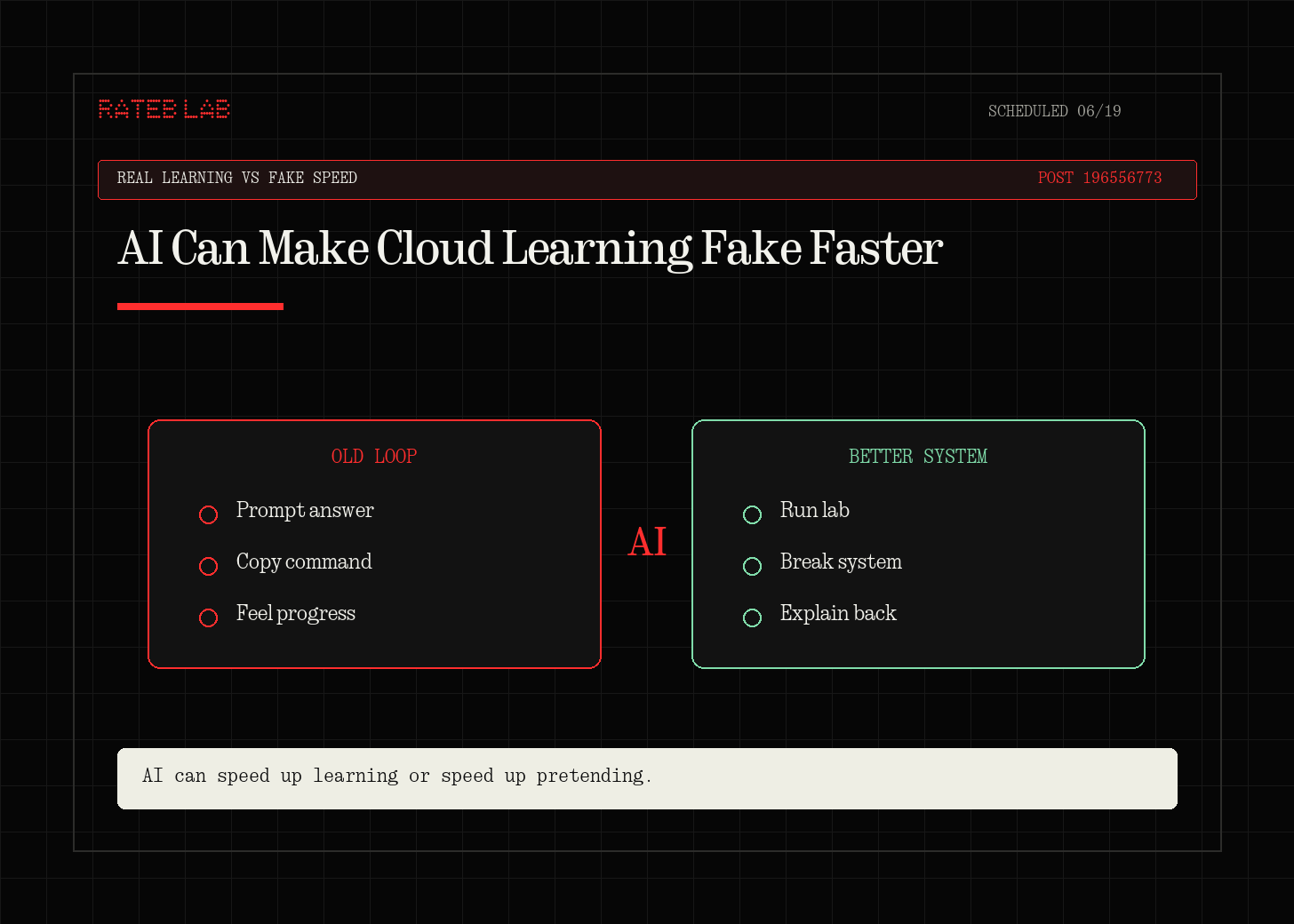
The Wrong Shortcut
The wrong shortcut is simple:
Ask AI.
Copy the command.
Save the note.
Move to the next topic.
It feels efficient because there is motion. But the motion is mostly outside your own head. You can end the day with a clean explanation and still not be able to fix a broken service.
That is dangerous for cloud learning because cloud work is full of small invisible links.
Linux connects to networking.
Networking connects to AWS.
AWS connects to security.
Security connects to troubleshooting.
Troubleshooting connects back to Linux.
If one link is weak, the whole system feels mysterious.
The Better Shortcut
The better shortcut is not to avoid the fundamentals.
It is to reduce the time between confusion and feedback.
That is where AI becomes useful.
Not as the person doing the lab for you.
As the second brain next to the lab.
The loop looks like this:
Pick one concept.
Build the smallest working lab.
Hit an error or inspect the output.
Ask Codex to explain what happened.
Fix or improve the lab.
Turn the result into a README, diagram, runbook, or quiz.
Repeat until the concept becomes boring.
Boring is good.
Boring means the command is not magic anymore.
What This Changes
Before, my default learning instinct was to collect more material.
Another course.
Another playlist.
Another certification plan.
Another huge roadmap.
Now I think the better question is:
What proof did this week leave behind?
Not proof for ego.
Proof that can be inspected.
A Linux service runbook.
A website request diagram.
An EC2 nginx lab.
An S3 access note.
A CloudWatch alarm.
A boto3 inventory script.
A Terraform S3 lab.
Small things, but real things.
The Rule I Am Trying To Follow
Use AI to compress feedback loops, not to outsource thinking.
That means I can ask Codex to explain logs.
I can ask it to quiz me.
I can ask it to review my README like a junior cloud engineer's portfolio artifact.
I can ask it to simplify a diagram.
I can ask it to find missing cleanup steps before I leave AWS resources running.
But I should not use it to pretend I touched a topic I did not touch.
I should not run commands blindly.
I should not save perfect notes from a lab I never broke.
I should not skip Linux and networking because the AWS console looks more exciting.
The First Layer Still Matters
Cloud engineering is not one skill.
It is a stack.
At the bottom: Linux.
Then networking.
Then AWS core services.
Then Git, Python, security, and troubleshooting.
Only after that do tools like Terraform, Kubernetes, and multi-cloud start to make more sense.
This is the part I need to remember when I get impatient:
Advanced tools are not shortcuts if the basics are still foggy.
They just make the fog more expensive.
A Practical Weekly System
A good week does not need to be heroic.
It needs outputs.
One concept note.
One working command, script, or AWS setup.
One AI review session where errors are explained.
One README, diagram, or runbook.
One short recall session where I test whether I can explain it without looking.
That is enough to compound.
Four focused hours can move the skill forward if the hours are connected.
Ten scattered hours can disappear if they are only consumption.
The Public Learning Advantage
There is another reason to document the labs.
The content becomes part of the learning.
When I turn a lab into a short post, I have to simplify it.
When I draw a diagram, I have to understand the path.
When I write a runbook, I have to think like the next person who will be stuck.
When I explain the mistake publicly, I make the lesson harder to forget.
That is the technical apprenticeship model I want to follow:
Learn in private.
Build in a real folder.
Debug with AI.
Document the proof.
Share the lesson for the person one step behind me.
The Takeaway
AI is not the shortcut around cloud fundamentals.
It is the shortcut around slow feedback.
The fundamentals still need reps.
The labs still need friction.
The errors still need attention.
The portfolio still needs real proof.
The difference is that now, every small lab can become a teacher, a note, a diagram, a quiz, and a public lesson.
That is the part I want to build around.
Not AI as a replacement for learning.
AI as a feedback loop for becoming less lost.