

What Changed
Naval describes AI coding tools as a new layer in the software stack. In the past, each layer made programming more accessible: chips, assembly, C, Python, libraries, frameworks, cloud platforms.
Now English itself is becoming part of the programming interface.
That changes who can build.
A product person can describe an app. A writer can prototype a workflow. A cloud learner can ask an AI to explain IAM, VPCs, DNS, Linux permissions, or Terraform errors in plain English.
This is real leverage.
But it also creates a trap.
When the tool hides the hard parts, beginners can mistake output for understanding.
They can ship code they cannot debug. They can accept explanations they cannot verify. They can build workflows without knowing where data goes, what breaks, or what the model made up.
AI lowers the entry barrier. It does not remove reality.
The Real Advantage: One Layer Below
One of the most useful ideas in the conversation is that it helps to know one layer below the tool you are using.
If you use AI to code, learn enough programming to read the code.
If you use AI for cloud work, learn Linux, networking, IAM, logs, and basic architecture.
If you use AI for writing, learn taste, structure, audience, and editing.
If you use AI for research, learn source checking, uncertainty, and how to compare claims.
You do not need to become a PhD in every layer.
But you need enough understanding to know when the abstraction leaks.
That is where technical confidence comes from. Not from memorizing every command. From knowing how to inspect, verify, and recover when the tool gives you something almost right.
AI Rewards Agency
The most important human skill in the AI era may be agency.
Agency means you do not wait for perfect instructions.
You define the problem. You ask better questions. You test the answer. You decide what to ignore. You make the tool serve a real goal.
AI is powerful because it can meet you where you are. It can explain a concept ten different ways. It can make diagrams. It can help you build a small project from a rough idea.
But it cannot want the goal for you.
It cannot care about your career.
It cannot choose the useful project, notice the weak assumption, or build your proof of work unless you keep steering.
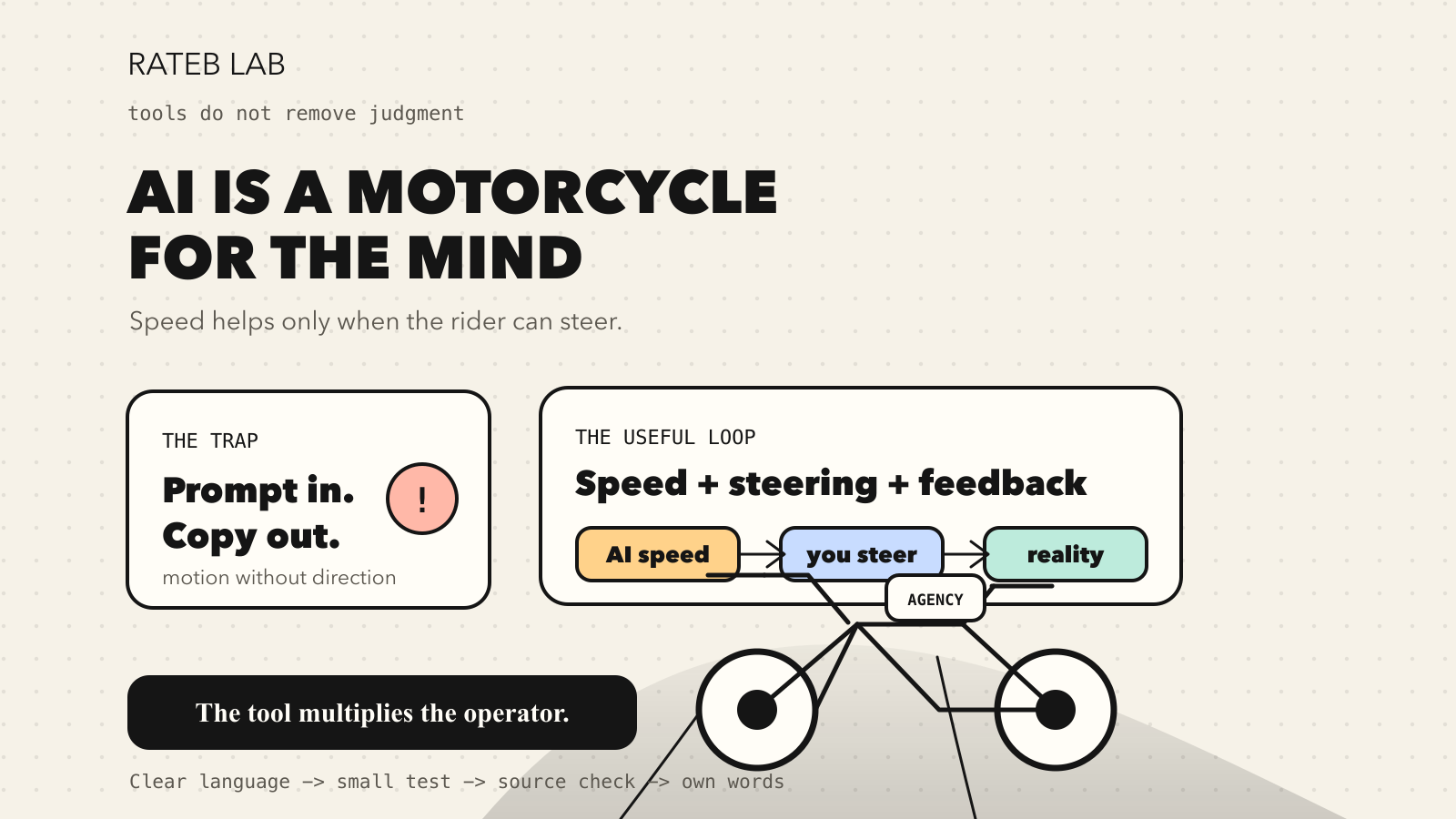
That is why passive AI use is dangerous. It feels productive, but it can make you dependent.
Active AI use is different.
You use it like a patient tutor, a coding partner, a reviewer, and a thinking tool. Then you verify the result against reality.
A Practical AI Learning Loop
Here is the simple loop I am taking from this:
Pick one real problem.
Ask AI to explain the problem at your current level.
Ask it to show the layer below.
Build or test something small.
Make it show its assumptions.
Verify with docs, logs, code, or another source.
Write what you learned in your own words.
Example for a cloud learner:
Do not ask: "Teach me AWS."
Ask:
`I am learning AWS. Explain how a request reaches an EC2 instance through Route 53, a load balancer, security groups, and the instance. Give me a beginner version first, then show the layer below with networking terms. Then give me a small lab to test it.`
Then do the lab.
Then check the console, logs, routes, security groups, and DNS records.
Then write the explanation yourself.
That last step matters. If you cannot explain it in your own words, you borrowed clarity from the model. You did not build it yet.
The Beginner Mistake
The beginner mistake is trying to become good at AI without becoming good at anything else.
Prompt tricks are not enough.
The durable skills are still:
clear language
systems thinking
technical basics
debugging
taste
source checking
project judgment
patience
AI makes these skills more useful because it gives them leverage.
If your thinking is vague, AI gives you vague output faster.
If your thinking is structured, AI helps you build, learn, and test faster.
The tool multiplies the operator.
What I Am Taking From This
I do not want AI to make me look smarter for a moment.
I want it to help me become harder to fool.
That means using it to learn cloud, Linux, networking, writing, and systems one layer deeper.
The goal is not to collect more tools.
The goal is to become the kind of person who can steer powerful tools toward useful work.
AI is a motorcycle for the mind.
But I still need to learn how to ride.
References
Naval Ravikant, [A Motorcycle for the Mind](https://nav.al/ai), February 19, 2026.
Source concepts used: vibe coding as product management, English as a programming interface, knowledge one layer below, AI as a tutor, early adopters, agency, and the motorcycle metaphor.