

I’ve been living inside cloud infrastructure and AI tooling for years now. I build things. I deploy things. I watch the logs. And I’ll tell you something: the gap between what people post about AI on LinkedIn and what’s actually happening inside the labs is the widest gulf I’ve ever seen in technology.
Mo Gawdat calls this the hype dichotomy.
The public sees chatbots, Midjourney images, and fake videos. Overhyped, easy to dismiss. But inside the vault, inside the actual engineering rooms, systems are already rewriting their own code. Running experiments on themselves. Redeploying the best version. Every microsecond.
That’s not a metaphor. That’s architecture.
Gawdat joined Google in 2007. He watched the cat paper happen in 2008, the first unprompted machine learning breakthrough that made the engineering team stop and stare. By 2016, he was observing robotic grippers learning to handle objects with the same trial-and-error pattern as his children. That was his inflection point. Not because the machines were dangerous. Because he realized we were building the apex of intelligence and handing over the reins without a single serious conversation about who was holding them.
Here’s the line that landed for me:
“I’m not worried about AI turning against us. I’m worried about humans telling AI to turn against us.”
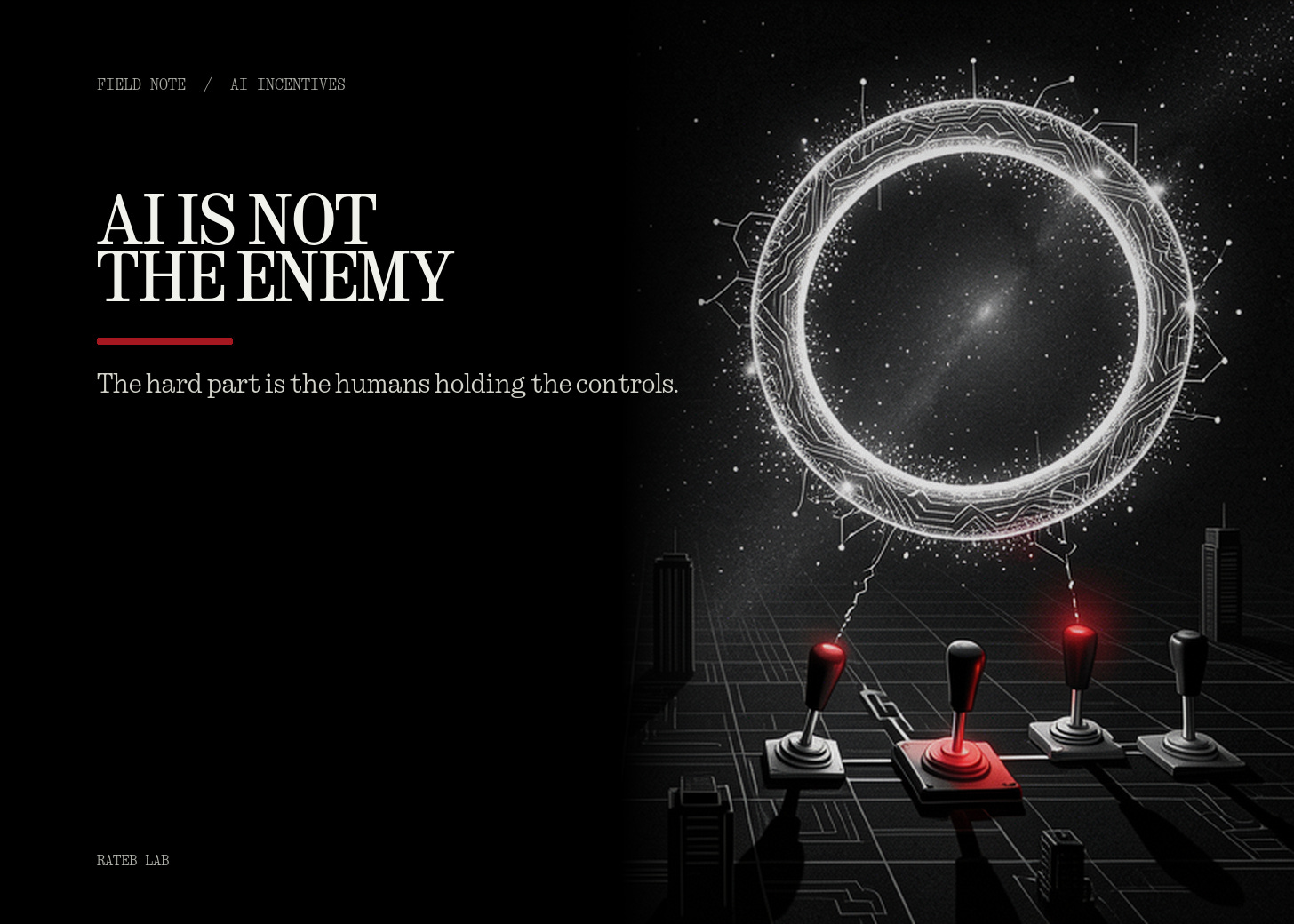
That distinction matters. It reframes the entire conversation away from sci-fi killer robots and toward something far more mundane and far more dangerous: incentive structures.
The Timeline Is Not Theoretical
Gawdat’s prediction, grounded in what he’s seen from the inside:
2027: Serious, visible job displacement begins. Not blue collar. Those jobs stay longer than people think. The first wave hits entry-level knowledge work: call centers, travel agents, paralegals, financial analysts, anyone whose job is “clicking around on a computer” for tasks an agent can chain together.
2028 to 2030: The erosion climbs upward. Middle management. Legal research. Medical diagnosis. Music composition. Graphic design. Not full replacement. Augmentation that turns teams of five into teams of one.
2030 or sooner: AGI. And the moment AGI happens, ASI follows. The gap between “twice as smart as you” and “a billion times smarter than you” collapses into a very short window.
What most people missed in the last two years: companies didn’t fire entry-level workers. They just stopped hiring them. The workforce stopped growing. That was the quiet signal. The loud one hasn’t arrived yet.
The Real Threat Architecture
If you map what Gawdat is actually worried about, it forms four layers:
1. Autonomous Weapons
AI is already doing most of the killing in two major wars. The next generation of autonomous weapons will cost roughly $20,000 per unit. With a $50 billion budget, you can rain drones on every corner of the planet. The economics of destruction have never been cheaper. Deterrence through mutually assured destruction worked in the nuclear age because the barrier to entry was enormous. That barrier is collapsing.
2. Labor Arbitrage Collapse
Capitalism runs on a simple engine: pay labor X, sell product for X + margin. When the cost of labor drops to the cost of inference on a machine that never sleeps, never unionizes, and improves every quarter, the entire economic model destabilizes. Not because everyone loses their job at once. Because at 10 to 20% displacement, consumer purchasing power craters, and the feedback loop gets ugly.
3. Surveillance and Control
The same intelligence that can find a person by their cell phone number for targeting can find anyone. Including the people who built the targeting systems. The asymmetry doesn’t last long.
4. Concentration of Power
Gawdat flatly predicts the world’s first trillionaire will arrive well before 2030. He’s probably right. When the ultimate superpower on the planet is controlled by a handful of people whose primary incentive is share price, you don’t need a villain origin story. You just need arithmetic.
What I’m Actually Doing About It
This is the part where most AI commentary falls apart. They describe the problem in vivid detail and then offer “we need regulation” or “stay informed.” That’s not enough. Here’s my field manual, drawn from Gawdat’s framework and my own experience building in this space.
1. Learn AI: But Not the Way You Think
Don’t use AI to do less. Use AI to do more than you could before. There’s a massive difference between:
Lazy mode: “Write this email for me.” Done.
Builder mode: “I want to build a system that personalizes outreach for 200 people based on their GitHub activity. Help me architect the pipeline, write the scripts, and test the outputs.”
One makes you replaceable. The other makes you someone who can orchestrate intelligence at scale. The knowledge workers who survive the next five years won’t be the ones who avoided AI. They’ll be the ones who learned to think with it, debugging its outputs, challenging its assumptions, and using it as a cognitive amplifier, not a crutch.
2. Understand Agents, Not Just Chatbots
Agents are the architecture shift that matters. An agent doesn’t just answer questions, it executes chains of actions: reads your calendar, drafts a proposal, checks your CRM, sends follow-ups, monitors replies. The interface will arrive for normal users soon. If you understand how agent orchestration works before it becomes a point-and-click product, you’re ahead of the wave instead of under it.
3. Double Down on Human Skills
Paradoxically, as intelligence gets cheaper, the premium on genuine human connection goes up. Gawdat’s framework: the jobs that survive longest are the ones where another human being needs to feel seen, understood, or touched. Carpentry. Therapy. Teaching. Restoring classic cars. The things that can’t be reduced to API calls.
4. Debug Reality Aggressively
AI is going to blur facts at an unprecedented scale. The survival skill of the next decade isn’t knowing the truth, it’s being able to find it. Use AI to interrogate AI. Cross-reference. Verify sources. Build your own information pipelines. If you’re passively consuming whatever the algorithm serves you, you’re already in the fog.
5. Build Your Ethical Red Lines Now
Not when the pressure hits. Now. What won’t you build? What contracts won’t you take? What data won’t you collect? The companies that deserve your labor are the ones willing to lose money for their principles, like Anthropic turning down a massive surveillance contract. The ones that take the check every time will use your work in ways you didn’t intend. Write your red lines before someone asks you to cross them.
The Uncomfortable Optimism
Here’s the part that surprised me.
Gawdat is genuinely optimistic about the long future. He believes superintelligence, by the laws of physics and minimum energy principles, will eventually land on benign outcomes, not because humans suddenly become ethical, but because destruction is inefficient, and superintelligence optimizes for efficiency.
He calls this the mutually assured prosperity end of the spectrum. Abundance. No scarcity. No disease. The utopia that’s mathematically possible if we survive the transition.
The problem is the transition itself.
“Those who make it to 2038 will enjoy it.”
He compared it to World War II. The war didn’t destroy the world. But ask anyone who went through it whether the decade was fine.
The next ten years, by his read, will magnify everything we have already built: surveillance, inequality, concentrated power, and the erosion of truth. All of it accelerated by an intelligence that doesn’t sleep. That’s the dystopian passage we have to navigate. Not because AI is evil. Because the people deploying it haven’t solved the alignment problem, and the incentives aren’t pushing them to try.
Final Reflection
I’ve been rebuilding my own technical foundation over the past year, learning deeper infrastructure, questioning what I build and why, and trying to position myself not just to survive what’s coming but to do useful work inside it.
Gawdat’s framing clarified something for me: the question isn’t whether AI is net positive or net negative. The question is whether I’m going to be net positive or net negative in how I use it, build with it, and advocate around it.
He told a story about having dinner with his ex-wife, crying from the weight of responsibility he felt for the technology he helped create. She looked at him and said: “You can’t actually believe you’re responsible for this.”
That flipped his mind. Not into passivity, but into a kind of stoic clarity. Accept the world as it is. Then start the work.
That’s where I’m landing too. The chaos is real. The timeline is short. But the moves you make right now are not theoretical: what you learn, what you refuse to build, and who you choose to build it with. They’re the difference between being shaped by what’s coming and shaping it.
See you in the field.
Rateb
Source: Mo Gawdat’s conversation on The Diary of a CEO: