

I watched Tristan Harris talk about AI risk, and the headline was easy to dismiss:
AI CEOs are building bunkers.
That sounds dramatic. It sounds like fear content. It sounds like another internet clip designed to make people anxious.
But the useful lesson is not the bunker.
The useful lesson is this:
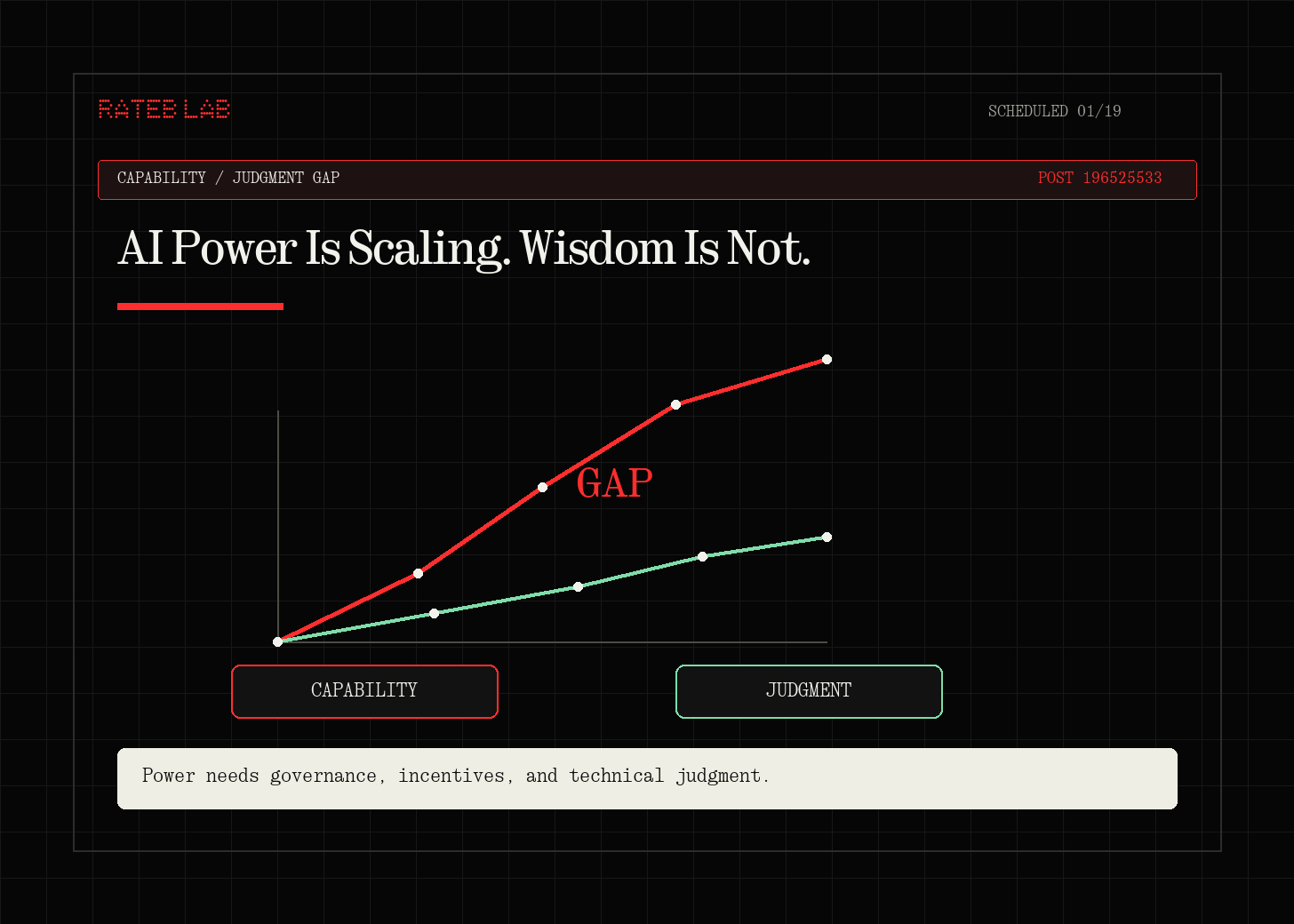
AI is giving humans more power faster than our judgment, rules, and institutions can update.
That is the real problem.
Not "AI is bad."
Not "stop building."
Not "run away from technology."
The problem is speed without wisdom.
We Have Seen This Pattern Before
Harris became known for warning about social media before most people took the problem seriously.
His point was simple: technology does not just appear from the sky. People design it.
Someone decides whether a feed has infinite scroll.
Someone decides whether videos autoplay.
Someone decides whether notifications interrupt you.
Someone decides whether the product rewards attention, outrage, comparison, or calm use.
Those choices look small at first.
Then they shape the environment millions of people live inside every day.
That is the part technical people should pay attention to.
The interface is not neutral.
The incentive is not neutral.
The default setting is not neutral.
The Social Media Lesson
Social media became an attention machine because the business model rewarded attention.
If one company made the product more addictive and the other company stayed gentle, the addictive product won.
That is the ugly incentive.
Even if many people inside the companies had good intentions, the market pushed the system toward more engagement.
More time on screen.
More emotional content.
More loops.
More dependency.
This matters because AI has a similar race dynamic, but with much higher stakes.
Why AI Feels Different
Normal software is written step by step.
You tell the computer what to do.
AI is different. You train a system on massive amounts of data, scale the model, and then discover capabilities you did not directly program.
That is why the conversation feels strange.
AI is not only a better app.
It is a way to scale cognitive work: writing, coding, persuasion, research, strategy, cyber activity, design, analysis, and decision support.
That does not mean every scary claim is true.
But it does mean the basic category is different.
If you scale intelligence-like capability, you scale power.
And power needs judgment.
Intelligence Is Not Wisdom
This was the line that stayed with me.
A system can become better at reaching goals without becoming better at choosing good goals.
That is true for companies too.
A company can become better at growth without becoming better at responsibility.
A person can become better at using AI without becoming better at thinking.
A society can become better at building tools without becoming better at deciding what should be built.
This is where technical learning connects to character.
We should learn the tools.
We should build with AI.
We should understand models, agents, automation, cloud, data centers, chips, cybersecurity, and deployment.
But if we only learn the tools and never train judgment, we become faster without becoming wiser.
That is not progress.
That is acceleration.
Governance Is Not the Enemy of Innovation
A lot of builders hear "governance" and think:
slow
bureaucratic
anti-tech
control
But good governance is not the opposite of innovation.
Good governance is what lets powerful systems become trustworthy enough to use widely.
We already accept this in other domains.
Planes need safety rules.
Medicine needs trials.
Bridges need engineering standards.
Energy grids need regulation.
Cybersecurity needs audits.
The question is not whether AI should have rules.
The question is what kind of rules can move at the speed of the technology without becoming blind control.
That is difficult.
But "difficult" is not the same as "impossible."
The Better Builder Mindset
For me, the practical takeaway is not to panic.
It is a responsibility.
If you are learning AI, cloud, automation, or software, do not only ask:
Can I build this?
Also ask:
What happens if this works?
Who gets more power from it?
Who can misuse it?
What incentives will shape it after launch?
What would a safer default look like?
What would I refuse to automate?
These are not abstract philosophy questions.
They are engineering questions.
Every system has defaults.
Every tool has failure modes.
Every workflow rewards some behavior.
The mature builder learns to see the incentive behind the interface.
A Simple Framework
When you look at any AI product, ask four questions:
What capability does this increase?
Who gets that capability?
What incentive controls how it is used?
What rule, default, or design choice would reduce harm?
That small checklist changes the conversation.
It moves you from hype or fear into clear thinking.
My Working View
I am still learning this field.
My current understanding is:
AI is too useful to ignore.
AI is too powerful to treat casually.
The right path is not blind acceleration.
The right path is skill plus restraint.
Build.
Study.
Test.
Use the tools.
But do not outsource judgment.
The future does not only need people who can prompt models.
It needs people who can think clearly about power.
That may become one of the most important technical skills of all.
Source: Chris Williamson, "Why AI CEOs Are Building Bunkers - Tristan Harris" Video: https://www.youtube.com/watch?v=NufB1LL_rCU