

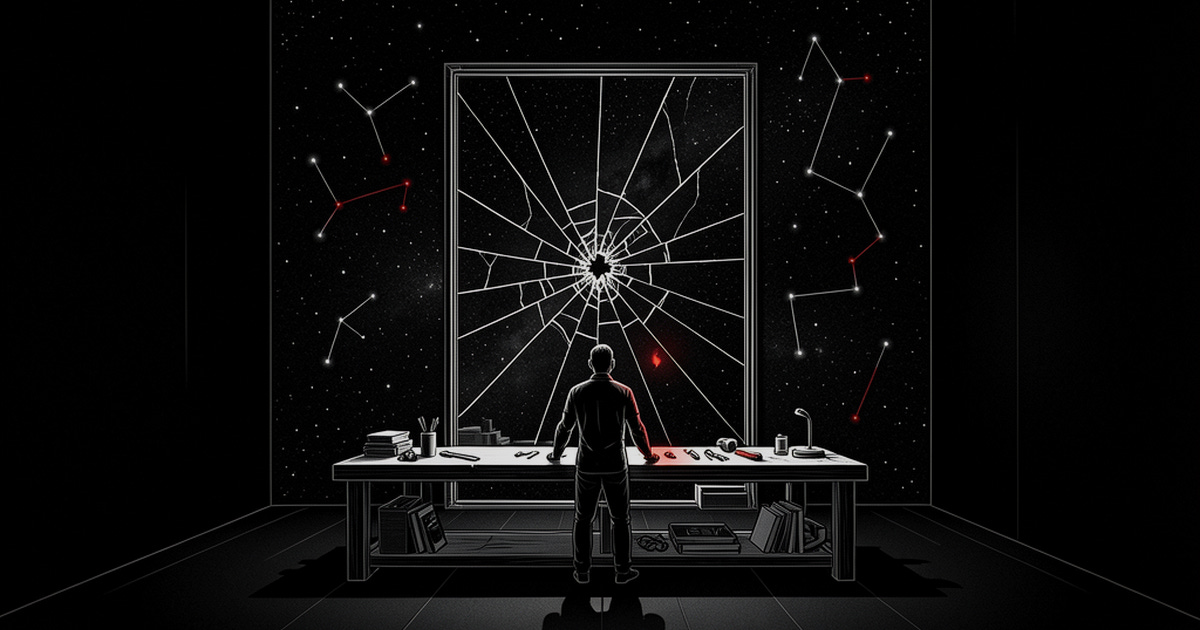
The feed is a bad mirror
I used to think attention was mostly a marketing problem. Now I think it is also an identity problem. When a person keeps checking who noticed him, who replied, who approved, who reacted, the score slowly moves outside his own hands. The danger is not only distraction. The danger is that attention starts to feel like evidence. It starts to feel like proof that you are becoming valuable. But attention is noisy. It can reward insecurity, exaggeration, display, and chaos. It can also ignore quiet skill for a long time.
The wrong scoreboard
The wrong scoreboard asks: Did they notice me today? Did the numbers move? Did someone validate my position? Did the room confirm my worth? That scoreboard is addictive because it updates quickly. It gives tiny hits of certainty. But it is also unstable. A stranger can move it. An algorithm can move it. A quiet week can make a disciplined person feel invisible.
The better scoreboard
The better scoreboard is slower, but it belongs to you. Did I train my body? Did I learn one hard thing? Did I write the idea clearly? Did I keep a promise? Did I repair a weak system? Did I make myself more useful than I was last month? This is less exciting than attention. It is also much harder to manipulate.
Why this matters for people rebuilding themselves
When you are rebuilding technical skill, career direction, health, or confidence, the early work is usually invisible. Linux notes do not clap. AWS labs do not flirt. A better routine does not always announce itself. But those quiet reps are where value is built. If you need the feed to tell you the work matters, you will abandon too much too early.
Why attention feels like truth
Attention feels convincing because it is immediate.
A like arrives now. A reply arrives now. A person notices you now. A number moves now. The nervous system loves that speed because it turns uncertainty into a tiny verdict.
Skill does not work that way.
Skill often gives delayed feedback. You can study a networking concept for three days and still feel clumsy. You can write ten notes before one sentence becomes clear. You can spend a month improving your health before anyone sees the difference. You can make your work more honest and get less attention at first because the older performance was easier to notice.
This is why attention can become such a believable lie.
It is not always false. Sometimes the room really is telling you something useful. But attention is too fast to be trusted as the deepest measure.
A technical self-rebuilder needs slower evidence.
Can I explain this idea without hiding behind jargon?
Can I repeat this habit when nobody is watching?
Can I debug the mistake instead of protecting my ego?
Can I build proof before asking the world to believe in me?
Those questions do not create the same emotional spike.
They create something better: self-trust.
How to use attention without being owned by it
The practical move is not to reject attention.
That can become another performance.
The move is to give attention a smaller job.
Let it show you what people respond to. Let it reveal language that lands. Let it point toward problems people feel but cannot explain yet. Let it help you test whether an idea has energy outside your own head.
But do not let it decide whether the work was worth doing.
That decision needs a deeper review.
After something gets attention, ask what the attention actually means. Did the idea help people, or did it only trigger them? Did the response point to a real problem, or just a dramatic angle? Did the piece reflect the person I am trying to become, or did I borrow a louder personality for the day?
After something gets ignored, ask a different set of questions. Was the idea unclear? Was the hook weak? Was the proof missing? Was it simply early? Was it a quiet rep that still built taste, clarity, or courage?
This gives attention a useful place in the system.
It becomes feedback.
Not identity.
A practical attention scorecard
I like this simple weekly check. One proof of skill. One proof of health. One proof of discipline. One proof of usefulness to another person. One proof of calmer judgment. If those five are improving, attention can be enjoyed without becoming the boss. If those five are weak, attention becomes a drug that hides the weakness.
The private work must become public proof
There is one more piece that matters.
Private standards should eventually produce visible proof.
Not performative proof. Not a constant need to announce every small improvement. But some artifact that shows the work escaped the private world of intention.
A clearer essay.
A better project.
A cleaner system.
A real application.
A repaired habit.
A technical note someone else can understand.
This is where the attention conversation gets more balanced.
If you only chase attention, you become dependent on the room.
If you hide forever in private work, you never let reality test you.
The healthier path is to build from an internal scorecard, then let selected work meet the world.
That way attention becomes feedback on proof, not a replacement for proof.
For someone rebuilding a technical life, this is practical. Do the quiet reps first. Then publish the map. Do the lab first. Then explain what broke. Build the skill first. Then let the work carry your name.
That order protects you.
It stops the feed from becoming your mirror, but it also stops privacy from becoming a hiding place.
The point is not to disappear.
The point is to make sure the thing being seen has roots.
The small rule I would use
Here is the smallest version of the practice.
Before checking the public scoreboard, create one piece of private evidence.
One paragraph. One command. One cleaned note. One workout. One useful message. One uncomfortable task moved forward.
Do not let the day begin with the question, “Did they notice me?”
Begin with the question, “What can I build before I ask the world to reflect me back?”
That shift sounds small, but it changes the order of the day.
Attention becomes something you review after proof, not something you need before proof.
This also makes publishing cleaner. You can still learn from what performs, but the public response is no longer your emotional fuel. The fuel was created first through the private rep. That order is what keeps a builder from becoming a performer with no foundation.
That is the difference between using attention as information and needing attention as permission. One keeps you awake. The other slowly hands your center away.
Final reflection
The goal is not to become invisible or pretend attention never matters. The goal is to stop confusing attention with value. Attention is weather. Value is climate. Build the climate.