

Most focus advice treats attention like a personality trait.
Some people have discipline. Some people do not. Some people can sit down and work. Some people are distracted.
I do not think that is the useful framing.
The lesson I pulled from The Art of Focus is this:
Focus is not a productivity trick. It is the architecture of attention around a useful project.
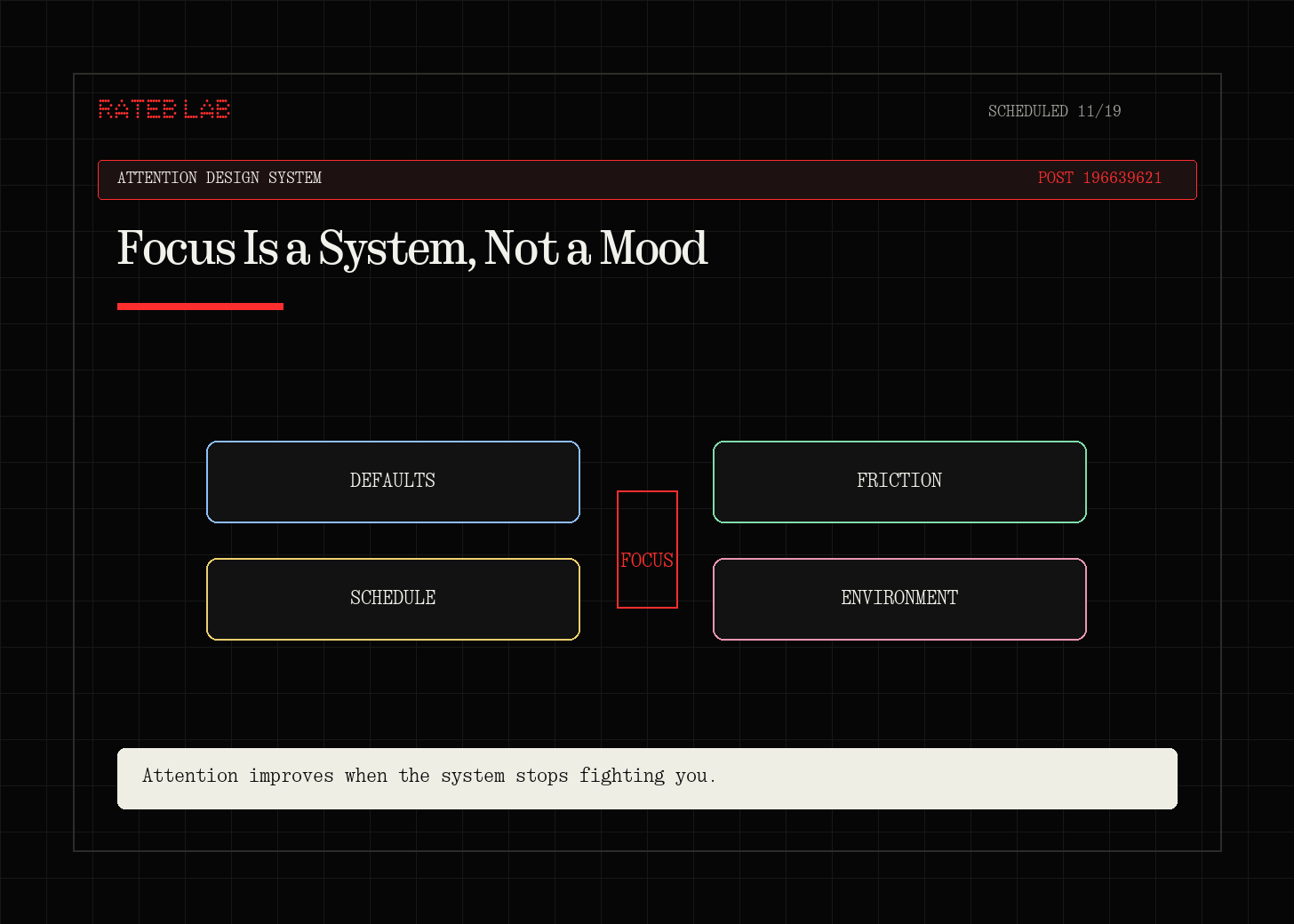
The Old Model
The old model is control.
Block apps. Add timers. Make stricter rules. Blame yourself when the rules collapse.
Those tools can help, but they are weak when the work itself is vague.
If your project is unclear, every distraction becomes more attractive.
If your next move is unclear, every tab looks useful.
If the reason behind the work is unclear, discipline has to carry too much weight.
The Better Model
Focus improves when attention has a structure.
That structure needs three things:
A meaningful project.
A clear next move.
A review loop that shows whether you are actually moving.
This is especially important in technical learning.
Cloud, Linux, AI, automation, networking, and security all punish vague studying. You can consume content forever and still avoid the part where understanding becomes visible.
The fix is not more motivation.
The fix is a project small enough to finish and hard enough to grow you.
Why AI Makes This More Important
AI reduces the cost of information.
That sounds good, and it is, but it creates a new problem: infinite helpfulness can become infinite avoidance.
You can ask for another roadmap.
Another explanation.
Another command.
Another tutorial.
Another summary.
At some point, the question changes from "Can I access the answer?" to "Can I turn attention into evidence?"
That evidence usually comes from a project.
The Focus Loop
Here is the loop I am using:
Choose one real problem.
Define the smallest useful outcome.
Build or test one piece.
Write what changed in plain language.
Review the result and choose the next constraint.
This loop makes focus less emotional.
You are not asking, "Do I feel focused today?"
You are asking, "What is the next visible move?"
A Practical Filter
Before starting a study session, ask which mode you are in:
Education: I need to understand the idea.
Execution: I need to build or test the idea.
Consistency: I need to repeat the useful behavior long enough for it to compound.
Most people mix these modes and call the confusion a focus problem.
If you are in education mode, take notes.
If you are in execution mode, make the thing work.
If you are in consistency mode, reduce the friction and repeat.
Try This
Pick one topic you are studying right now.
Write one sentence:
By the end of this session, I will produce __________.
Make the blank concrete:
a diagram
a working command
a lab screenshot
a troubleshooting note
a one-page explanation
a decision about what to study next
Focus gets easier when the mind can see the target.
The project fixes the attention.
Source
Inspired by Dan Koe's The Art of Focus and my separate study notes from the book.