
Germany Needs Industrial AI, Not a New Myth
The next machine gets built from the parts that still work: cars, machinery, and chemicals, connected to industrial AI.

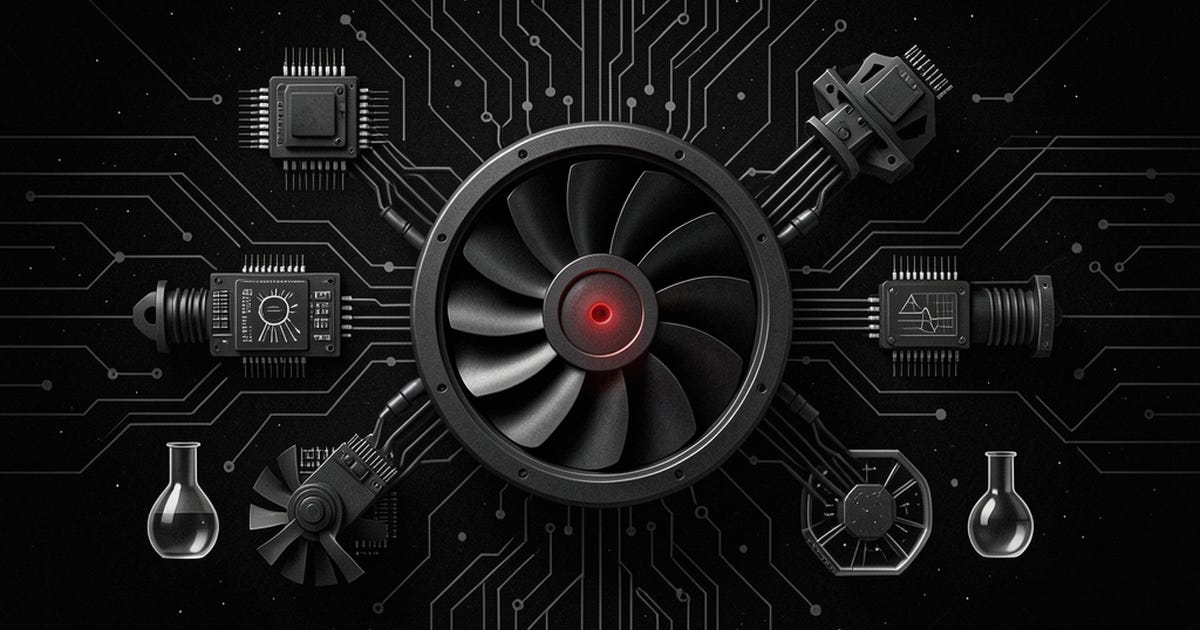
The old story is cracking
Germany has a strange problem right now.
On paper, some of the old industrial pillars still look strong. Cars. Machinery. Chemicals. The revenue numbers can still look impressive if you do not look too closely.
But revenue is not the same as strength.
If prices rise while output falls, the surface can look healthy while the machine underneath is losing force. A country can appear rich while its productive base is quietly getting thinner.
This is the part I keep thinking about because it is not only an economy story.
It is also a skill story.
It is a career story.
It is a warning for anyone trying to rebuild themselves in the AI age.
When the old advantage starts weakening, the first instinct is usually nostalgia. Protect the old thing. Defend the old identity. Hope the old market returns. Find one new trend that can replace everything.
But renewal almost never works like that.
The better question is not: what is the one new thing that saves us?
The better question is: what existing strength can be connected to the next technical layer?
The wrong map: find the next miracle industry
It is tempting to ask which industry will replace cars.
Defense? Chips? AI? Biotech? Energy systems? Robotics?
That question feels clean because it gives the mind a single target.
But single-answer thinking is usually too clean for the real world.
Defense matters, but it depends heavily on government spending and is not large enough to replace the old industrial pillars.
Cutting-edge AI chips are important, but Germany is not going to recreate Taiwan, Samsung, or the deepest parts of the American AI hardware stack from scratch just because it wants to.
Consumer AI is loud, but Germany’s stronger opening may not be another chatbot company. It may be industrial AI connected to real machines, real factories, real operational data, and real engineering problems.
Life sciences are promising, but biotech is becoming more competitive too.
The point is not that any of these paths are weak.
The point is that none of them are magic.
A country does not become future-proof by choosing a shiny word.
It becomes future-proof by building the conditions where several strengths can reinforce each other.
The better map: connect old strength to new layers
Germany’s best advantage may be less glamorous than people want.
It is not only the finished car.
It is not only the chemical plant.
It is not only the machine tool.
It is the deep, boring, hard-to-copy layer underneath: suppliers, standards, industrial process knowledge, trained workers, engineering habits, operational data, and the ability to make physical systems work reliably.
That is why industrial chips matter.
Not only the most advanced AI chips everyone talks about, but the less glamorous chips inside cars, trains, wind turbines, batteries, power systems, robotics, and factory equipment.
These are the chips that help physical systems sense, control, move, measure, and distribute energy.
That is also why industrial AI matters.
The most valuable AI for Germany may not be another consumer app. It may be software that helps factories reduce downtime, predict failures, improve energy use, simulate production, coordinate supply chains, and turn decades of operational knowledge into better decisions.
That is also why life sciences matter.
Pharma and medtech use research depth, precision manufacturing, patents, regulated quality, and scientific trust. They are not immune to global competition, but they fit a country that already knows how to build complex systems under strict constraints.
The future is not one industry.
It is a stack.
Hardware plus software.
Industrial data plus AI.
Power electronics plus energy systems.
Research plus manufacturing.
Engineering culture plus risk capital.
Factories plus a better digital nervous system.
The missing layer is not only technology
This is where the economic story becomes more uncomfortable.
A new engine does not run only on good ideas.
It needs energy that companies can afford.
It needs permission to build without drowning in slow process.
It needs capital that can tolerate uncertainty.
It needs talent that can move between old industries and new tools.
It needs institutions that can tell the difference between protecting quality and protecting delay.
Technology matters, but the environment around technology decides how much of it becomes real.
That is the part I see again and again in personal work too.
A person can have strong intentions and still fail because the environment keeps taxing the behavior he says he wants.
Too much friction kills renewal.
Too little discipline also kills it.
The art is to keep the standards high while making useful action easier to repeat.
That is true for a country trying to rebuild industrial strength.
It is also true for a person trying to rebuild technical skill.
The career lesson inside the economy lesson
This is where it becomes personal for me.
I am rebuilding my own path through cloud, Linux, AI, automation, writing, and systems. And the same mistake shows up at the individual level.
When people feel behind, they often try to become a completely new person overnight.
They jump from trend to trend.
They think the answer is one certificate, one tool, one course, one platform, one AI workflow, one perfect niche.
But the stronger move is usually recombination.
Take what you already know and connect it to the next useful layer.
If you worked in support, connect that to cloud troubleshooting, documentation, customer systems, and AI-assisted operations.
If you understand communication, connect that to technical writing, incident reports, learning notes, and explaining systems clearly.
If you have industry experience, connect it to automation and data instead of pretending your past has no value.
If you are learning Linux or AWS, do not treat the command line as a trophy. Treat it as a way to understand how real systems behave under pressure.
The future belongs less to people who chase every shiny tool and more to people who can connect layers.
Useful people become interfaces between worlds.
They connect old domain knowledge to new tools.
They connect messy human problems to clear systems.
They connect AI capability to judgment.
What recombination looks like in practice
Recombination sounds abstract until you make it concrete.
For Germany, it might look like industrial companies treating software and data as core production layers, not side projects. It might look like factories using AI to reduce waste, forecast maintenance, and make energy use less fragile. It might look like Mittelstand suppliers becoming more digital without losing the precision that made them valuable in the first place.
It might also look like universities, labs, manufacturers, and startups working with less suspicion and more speed. Not because startups are magic. Not because old companies are finished. Because the useful future is usually built between worlds.
That is the piece I find hopeful.
The old base is not worthless. The new layer is not enough by itself. The opportunity is in the connection.
That is also a good personal strategy. Do not throw away your past just because the market changed. Study it. Find the part that still carries load. Then connect it to a skill that makes it useful again.
What Germany needs is also what builders need
Germany needs lower energy costs, less red tape, deeper risk capital, faster decisions, and more room for new ideas.
Builders need their own version of the same thing.
Less friction.
Better inputs.
More practice.
Faster feedback.
More courage to ship proof before everything feels complete.
The old German model worked because it built deep capability over time. That part should not be discarded. But deep capability becomes fragile when it stops adapting.
The same is true for a person.
Your past is not automatically leverage.
Your past becomes leverage only when you connect it to a live problem.
That is the practical move I take from this.
Do not ask only: what is the next big thing?
Ask:
What existing strength do I have?
What technical layer makes that strength more valuable?
What real problem proves the connection?
What can I build, write, document, automate, or explain this week?
That question is smaller than a national strategy.
But it is also more useful.
A country and a person both need the same discipline here: stop worshipping the new layer and stop hiding inside the old one. The useful future is built where both are forced to work together.
That connection is where renewal starts to become practical instead of rhetorical.
Now.
Final reflection
Germany does not need to become a different country by pretending its old strengths never existed.
It needs to stop treating those strengths as finished products and start treating them as inputs for the next system.
Renewal is not always replacement.
Sometimes renewal is recombination.
A machine gets old.
Then someone opens it, studies what still works, removes what no longer carries load, and connects the remaining strength to a new engine.
That is true for countries.
It is true for companies.
And it is true for people trying to rebuild their work before the world finishes changing around them.