

Tech is not easy-mode anymore
The IT market in Germany is not dead.
But it is no longer easy-mode.
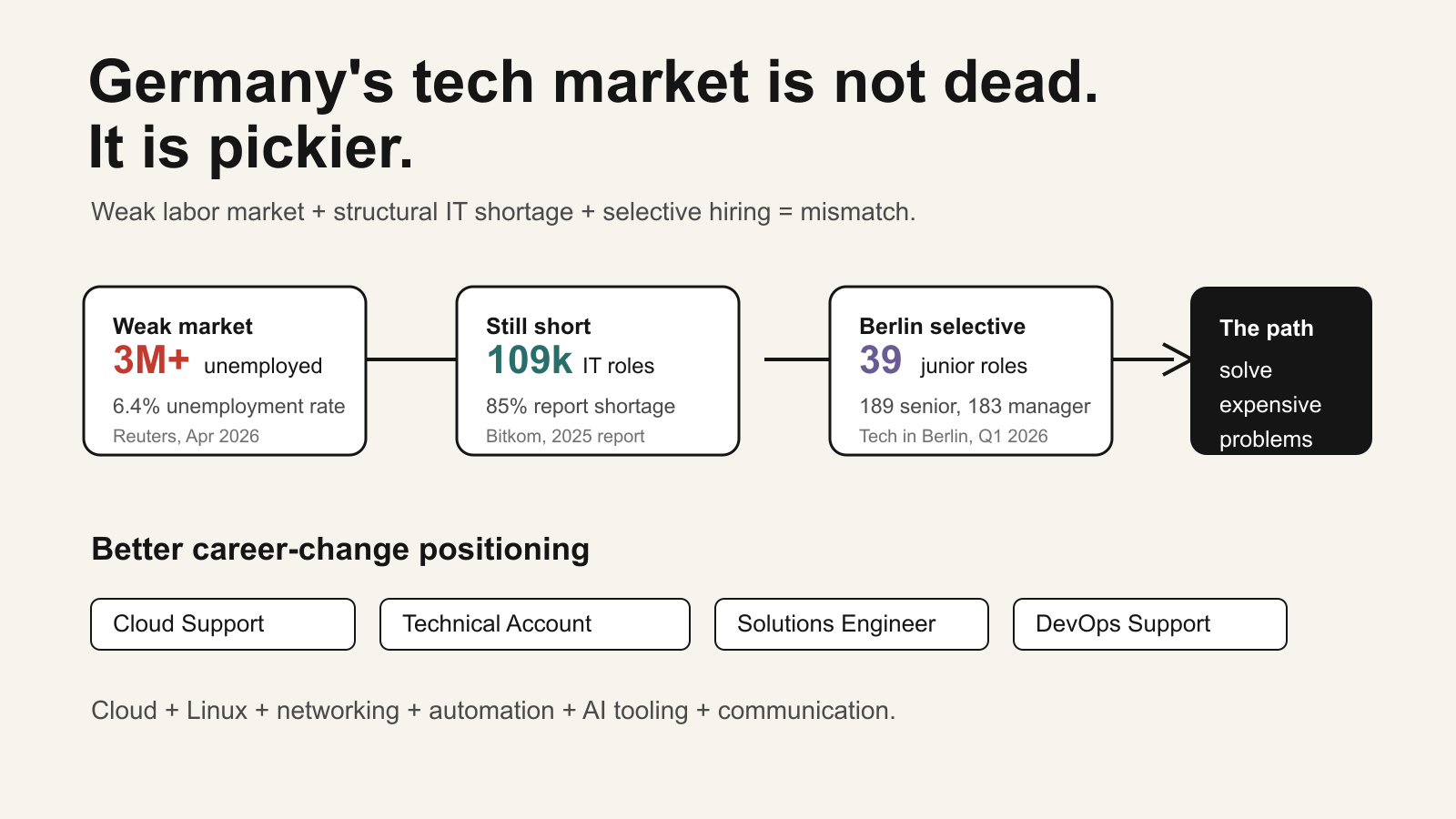
Bitkom's latest IT labor report says Germany is missing around **109,000 IT specialists**. **85% of companies** report an IT talent shortage, and **79% expect it to get worse**.
That sounds like good news for anyone trying to enter tech.
But there is a catch.
Companies do not just want a beginner with a certificate, a bootcamp project, and a weather app.
They want specific, useful skills.
Bitkom says the average IT vacancy takes **7.7 months** to fill. At the same time, **22% of companies** say applicants do not meet the specific requirements for new technologies.
Translation:
Jobs exist.
Many candidates are misaligned.
This is one of the most important career lessons in 2026:
Demand exists at the skill level, not at the identity level.
"I want to work in cloud" is not a skill.
"I can troubleshoot Linux permissions, explain DNS to a customer, read logs, open a useful ticket, automate a small workflow, and understand why the production system is down" is closer to a skill.
That difference matters.
AI is splitting the market
AI is making the job market stranger.
Bitkom says **27% of companies expect AI to reduce IT jobs**, while **42% expect AI to create additional demand for IT specialists**.
So AI is not simply "killing tech."
It is splitting the market.
On one side:
people who can use AI tools to work faster
people who can automate routine workflows
people who understand systems, cloud, security, data, and operations
people who can explain technical problems to non-technical people
On the other side:
pure ticket-takers
basic coders who only follow tutorials
candidates who cannot connect technical work to business value
people trying to enter tech with generic motivation and no proof
AI does not remove the need for technical people.
It removes tolerance for shallow technical work.
That is a very different problem.
Berlin is alive, but selective
Berlin is still hiring.
But the market has changed.
Tech in Berlin tracked **700+ startup jobs across 380+ startups in Q1 2026**.
Software engineering led with **155 roles**.
But sales was almost equal with **142 roles**.
That is a huge signal.
Berlin startups are not just building products anymore. They are trying to prove revenue.
The market has moved from:
"Grow fast and figure it out later."
to:
"Ship, sell, retain, survive."
This matters for anyone with sales, account management, customer support, or business experience.
Your background is not irrelevant.
It might be the thing that makes your technical transition more credible.
The brutal part is entry-level hiring.
Tech in Berlin found only **39 junior roles** across the entire first quarter of 2026.
Compare that with **189 senior roles** and **183 manager roles**.
Berlin is not a friendly entry-level playground right now.
It wants people who can deliver without much babysitting.
That does not mean beginners have no chance.
It means beginners need a better positioning strategy.
The junior software engineer path is crowded
The most crowded career-change story is:
"I am learning Python/JavaScript and want to become a junior software engineer."
There is nothing wrong with that path.
But it is crowded.
You are competing with:
computer science graduates
bootcamp graduates
laid-off engineers
international applicants
people with real production experience
AI tools that make basic coding easier
That is a hard arena.
Especially in Berlin, where the data shows far more senior and manager roles than junior roles.
So if you are transitioning into tech in Germany, the smarter question is not:
"How do I become a junior developer?"
The smarter question is:
"Where does my existing experience make me useful faster?"
That changes the whole strategy.
A better path for career changers
For Germany and Berlin in 2026, I would look seriously at these roles:
Cloud Support Engineer
Technical Account Manager
Solutions Engineer
Junior Cloud Engineer
DevOps Support
AI Support Specialist
Customer-facing Infrastructure Support
Why?
Because these roles reward a hybrid skill stack.
You do not need to pretend your previous experience did not happen.
If you have sales, account management, technical support, customer communication, operations, or business experience, you already have part of the stack.
Then you add:
AWS fundamentals
Linux
networking
DNS
HTTP
Docker basics
Terraform basics
log reading
incident thinking
AI tooling
documentation
Now you are not just another beginner.
You are someone who can talk to a customer, understand a business problem, debug a system, and communicate clearly.
That combination is valuable.
Especially in a market where startups are hiring sales almost as much as engineering.
Certificates are useful, but they are not proof
Certificates can help.
AWS Cloud Practitioner, Solutions Architect Associate, Linux, networking, security, Terraform, and similar credentials can give structure and credibility.
But they are not enough.
The market is not short of people collecting certificates.
It is short of people who can prove they can work.
Proof looks like:
a documented AWS troubleshooting lab
a Linux server you configured and explained
a small incident postmortem you wrote
a Terraform project with a clear README
a Dockerized app with logs and monitoring notes
a customer-support style technical case study
a diagram that explains a cloud architecture clearly
a short write-up on how you solved a real technical problem
This is why writing matters.
Writing is not just content.
Writing is proof of thinking.
If you can explain a technical problem clearly, you become easier to trust.
And trust matters when companies are becoming pickier.
The uncomfortable conclusion
Germany has rising unemployment and a tech shortage at the same time.
That sounds absurd, but it makes sense when you understand the mismatch.
Companies are not hiring every beginner just because the word "cloud" appears on a CV.
They are looking for people who can reduce risk, improve systems, support customers, automate work, protect infrastructure, and help the business survive.
That is the game.
So do not chase the generic tech dream.
Build a useful stack.
Cloud. Linux. Networking. Automation. AI tooling. Communication. Business understanding.
Not because it sounds impressive.
Because it maps to expensive problems.
And expensive problems are where the jobs are.
---
Sources:
Reuters: https://www.reuters.com/markets/europe/german-unemployment-rises-above-3-mln-mark-april-2026-04-30/
ifo Institute: https://www.ifo.de/en/facts/2026-04-29/job-cuts-intensify-germany-april-2026
DIHK: https://www.dihk.de/en/dihk-presents-skilled-labour-report-2025-2026-169106
Bitkom IT labor report: https://www.bitkom.org/sites/main/files/2026-01/bitkom-studienbericht-it-fachkraefte-2025.pdf
Tech in Berlin: https://www.techinberlin.com/news/berlin-tech-hiring-in-the-first-quarter-of-2026-what-the-numbers-show
Tech.eu: https://tech.eu/2026/05/01/berlin-tech-s-new-reality-ai-driven-output-stagnant-wages-and-a-workforce-on-the-move/