

Here is what the AWS DCO interview taught me about preparation, hardware, troubleshooting, and behavioral stories.
I did not get the job.
That is the honest first line.
I prepared seriously. I built Obsidian notes. I watched videos about data centers, server hardware, Linux, networking, and AWS interview structure. I wrote STAR stories late at night and tried to turn my support background into a clear argument for why I could do the job.
Then I sat in the interview.
I answered the questions.
A few days later, the rejection email arrived.
The familiar one. "After careful consideration..."
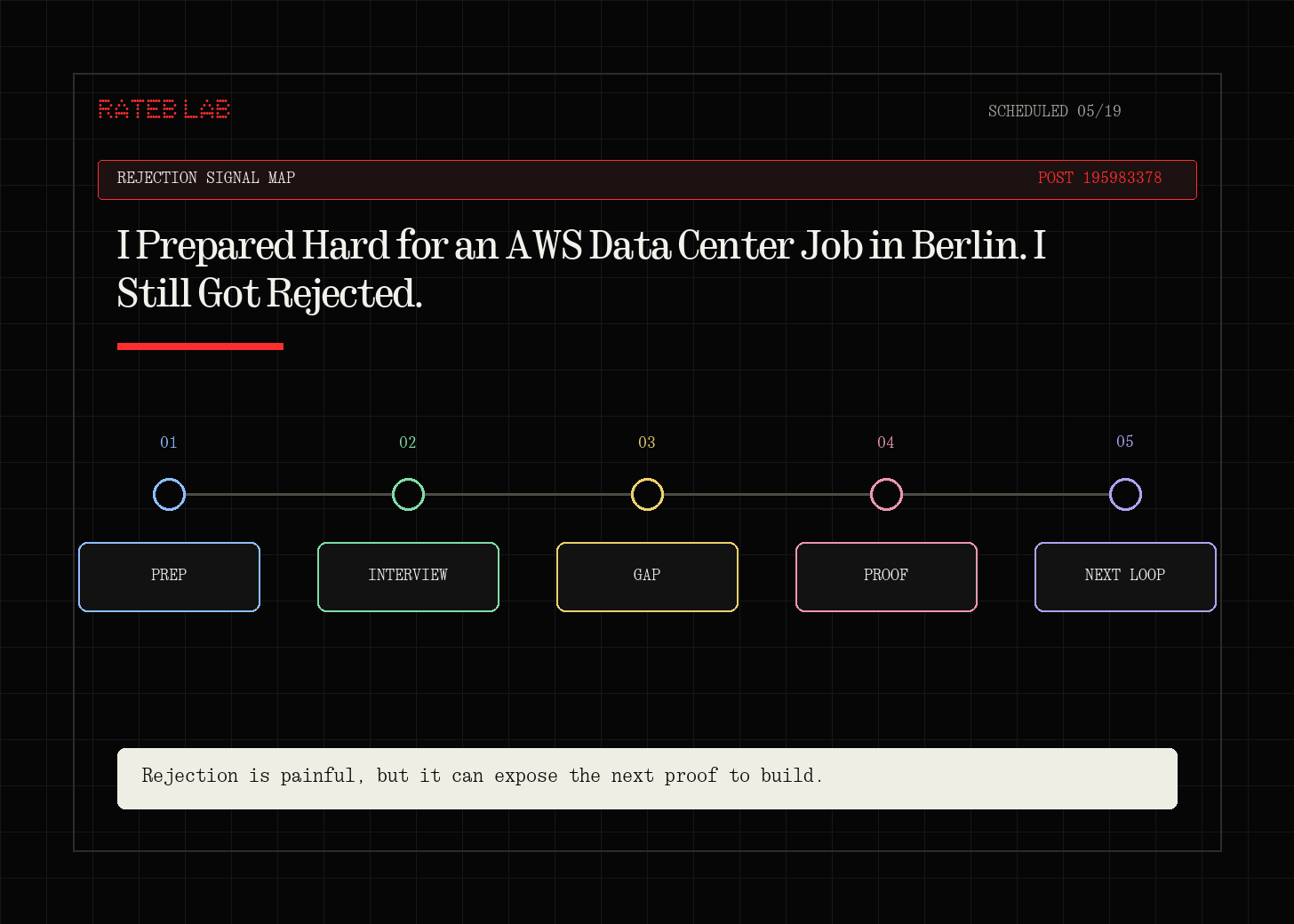
I am writing this because the failure was useful. I went through the process, I studied the role, I saw where my preparation was strong, and I also saw where it was weak.
This is the guide I wish I had before I started.
The role is not what many people imagine
The job I applied for was AWS Data Center Technician Operations, usually shortened to DCO.
It is not a cloud engineering role where you sit behind a dashboard all day.
It is physical infrastructure work.
You are inside the data center. You follow runbooks. You replace failed parts. You troubleshoot servers and network paths. You document every step. You escalate when the issue is outside your scope. You work in a shift-based environment where safety, process, and clean handoffs matter.
That last part is important.
In a data center, your notes are not just admin work. They are part of the operation. The next person may inherit your ticket during another shift. If your notes are vague, you create risk for them.
That is why DCO is not only a hardware job.
It is a hardware, safety, process, and communication job.
Why I applied
My background is technical support and customer-facing troubleshooting.
I have spent years diagnosing issues, handling pressure, writing tickets, escalating with evidence, and staying calm when the situation is not clean.
What I did not have was direct data center experience.
No professional server repair background.
No fiber work.
No shift work inside a 24/7 infrastructure environment.
But I had transferable skills. I knew how to follow a process. I knew how to document. I knew how to speak to people when something was broken and expectations were high.
So my pitch was simple:
I understand support, troubleshooting, tickets, and ownership. I want to move closer to the physical layer of the cloud. DCO looks like the bridge.
Looking back, that pitch was reasonable.
The problem was not the direction.
The problem was how I prepared.
The interview is mostly behavioral
This surprised me more than anything else.
I expected a heavier technical interview.
There were technical questions. You still need to know server hardware, OSI layers, basic Linux commands, IPMI/BMC, ESD, and how to troubleshoot from the physical layer upward.
But the real weight was behavioral.
My estimate, based on the process I went through:
20 to 30 percent technical. 70 to 80 percent behavioral.
That matters because many technical learners prepare for the wrong interview.
They study RAID, BIOS, POST, IP addresses, fiber types, and Linux commands. That is useful. But then they walk into an Amazon interview where the interviewer is collecting evidence against Leadership Principles.
Amazon does not score vague confidence.
They score behavior.
What did you personally do?
What was the situation?
What was your responsibility?
What action did you take?
What changed because of it?
If your answer sounds good but does not contain evidence, it is weak.
If you say "we" too much, it is weak.
If the result is vague, it is weak.
That is where I lost points.
What you should know technically
You do not need to become a hardware engineer before the interview.
But you should understand the basics clearly enough to explain them under pressure.
Start with server fundamentals:
BIOS and UEFI: firmware that starts before the operating system
POST: the startup self-test that checks core hardware
CPU, RAM, DIMMs, motherboard, PSU: what each part does
HDD, SSD, and NVMe: the basic storage differences
RAID: the idea of redundancy across disks
IPMI and BMC: out-of-band server management
ESD: why static electricity can damage components
Then learn networking from the bottom up:
Layer 1: cables, ports, link lights, NICs, optics
Layer 2: MAC addresses, switch ports, VLANs
Layer 3: IP addresses, routing, gateway, DNS
You should also know basic Linux troubleshooting commands:
pingip addrip routetraceroutedigornslookupjournalctldmesgsystemctllsblk
Do not memorize these like flashcards only.
Practice saying what you would use each command for.
For example:
"I would start with
ip addrto confirm the interface has the expected IP. Then I would checkip routeto confirm the default gateway. If local config looks right, I would test reachability withping, then usetracerouteto see where the path fails."
That sounds different from listing commands.
It shows thinking.
The troubleshooting formula matters
If you remember only one technical thing, remember this:
Start physical. Move upward. Change one variable at a time.
A clean DCO troubleshooting answer sounds like this:
Clarify the symptom and scope from the ticket.
Check impact: one host, one rack, or wider service?
Follow safety rules and approved procedure.
Start at Layer 1: power, cable, port, link light, seating.
Check one variable at a time.
Follow the runbook.
Verify the fix.
Document what you checked, what you found, and what changed.
Escalate with clean evidence if the issue is outside your scope.
That formula protects you from guessing.
It also shows the interviewer that you understand the environment.
In a data center, speed matters. But uncontrolled speed creates risk. The goal is not to look like a hero. The goal is to fix the right thing safely and leave a clear trail.
The behavioral section is the real interview
This is where I underperformed.
Not because I ignored it.
I knew about Amazon's Leadership Principles. I had STAR stories. I had written notes.
The problem was that my stories were not sharp enough when spoken out loud.
The actions were not always specific enough.
The results were too soft.
And sometimes I said "we" when I should have said "I."
For this kind of interview, that matters.
Amazon interviewers are not just asking for a nice story. They are collecting evidence.
For a DCO role, I would focus especially on these principles:
Ownership
Dive Deep
Bias for Action
Earn Trust
Customer Obsession
Insist on the Highest Standards
Learn and Be Curious
Deliver Results
You do not need one story for every principle.
But you do need enough real stories that you can answer from memory without sounding scripted.
STAR is simple, but not easy
STAR means:
Situation: what was happening?
Task: what were you responsible for?
Action: what did you personally do?
Result: what changed?
Most people spend too much time on the situation.
I did that too.
The interviewer does not need five minutes of background. They need enough context to understand the problem, then they need your action and result.
A strong answer has a clear landing.
Weak result:
"The issue was resolved and the customer was happy."
Stronger result:
"The customer was back online the same day, the ticket had a clean handoff for the next shift, and I changed my process so I now confirm any client-facing technical advice before I give it when the cost or downtime impact is high."
That result shows impact, documentation, and learning.
It gives the interviewer something to score.
My specific mistakes
The useful part of rejection is the error log.
Here is mine.
I started too late
I started serious preparation about four days before the interview.
That was not enough.
Four days can help you review hardware and commands.
It is not enough time to build, test, and speak strong behavioral stories.
For this interview, I would start at least two weeks before.
I prepared stories on paper, not in my mouth
My notes looked better than my spoken answers.
That is a real problem.
Reading a STAR story and speaking it under pressure are different skills.
If you only read your notes, you may think you are ready. Then the interviewer asks one follow-up question and the story starts to loosen.
Practice out loud.
Use a timer.
Record yourself if you can handle the discomfort.
Aim for 90 to 120 seconds per answer.
My results were not concrete enough
This was probably my biggest weakness.
I had real stories. But some of the endings were too soft.
For example, I had a story about giving incorrect advice to a client in a previous job and causing them to pay more than they should have.
That is a strong Earn Trust story because it includes a real mistake.
But the result needs to land clearly:
What was corrected?
How fast?
What did the customer experience?
What did I change afterward?
Without that, the story sounds honest but unfinished.
I used AI for structure, but relied on it too much
AI helped me format stories.
That was useful.
But when a story is too shaped by AI, you feel it under pressure. The words may be clean, but the memory is not deep enough.
Use AI to organize your thinking.
Do not let it replace the real memory.
You need to know your own story well enough to defend it from any angle.
I weighted technical prep too heavily
I spent too much time on technical material compared with behavioral practice.
If I did it again, I would reverse it.
I would still study the technical basics. But I would spend more time building ten real stories, practicing them out loud, and making every result specific.
A better two-week preparation plan
If I could prepare again, this is the plan I would follow.
Week 1
Read the job description line by line.
Highlight every behavior and technical skill they mention.
Write ten real stories from your work history.
Map each story to one or two Leadership Principles.
Draft each story in STAR format.
Write the result first, then build the story around it.
Week 2
Practice every story out loud.
Time each answer.
Cut background that does not help.
Replace "we" with the exact thing you did.
Review hardware, networking, Linux, IPMI, ESD, and fiber basics.
Practice five troubleshooting scenarios from Layer 1 upward.
Prepare questions to ask the interviewer.
The day before
Do not try to learn a new topic.
Review story titles and key results.
Test your camera, microphone, and internet if the interview is remote.
Sleep.
The day before is not for panic learning.
It is for making your thinking easy to access.
Questions I would ask next time
Do not skip the question section.
Good questions show that you understand the work.
I would ask:
What does success look like for a new DCO technician in the first three to six months?
What ticket types should a new technician master first?
How does the team balance speed, SLA pressure, and safety?
What mistakes do new technicians make most often?
What does great ticket documentation look like on this team?
What separates a good technician from a great one after the first year?
These questions are simple, but they point at the real job.
They also help you decide whether the role fits you.
What not to say
Some answers sound harmless, but they signal the wrong thing.
Do not say:
"I just escalated it."
Say:
"I escalated with the symptoms, scope, tests already completed, results, timestamps, and the next recommended step."
Do not say:
"I would try parts until it works."
Say:
"I would isolate one variable at a time, follow the runbook, and verify each change before moving on."
Do not say:
"That is not my job."
Say:
"If another team owns the fix, I still own the quality of the handoff."
Do not say:
"I do not know."
Say:
"I do not know that yet. I would check the approved documentation, ask a senior technician if needed, and make sure I understand the procedure before acting."
The difference is not word games.
The difference is ownership.
The honest summary
I got rejected.
That is uncomfortable to write publicly.
But the process taught me something useful.
The AWS DCO interview is not mysterious. It rewards preparation that is specific, spoken, and evidence-based.
Know the technical basics.
Practice troubleshooting from the physical layer upward.
But do not treat the behavioral section like a side task.
That section is the interview.
If you are applying for this role, start early. Build real stories. Practice them out loud. Make every result concrete. Show ownership. Show safety. Show documentation discipline. Show that you can learn without pretending to know everything.
The rejection hurt.
But it also gave me a clearer map.
If this helps the next person prepare better than I did, then the failure was not wasted.