

I used to think the next productivity jump would come from better prompts.
A cleaner instruction. A stronger role. A longer context window. A sharper template.
That helped for a while. But after enough time working with AI agents, the same problem kept showing up in a different form: the model was not always the bottleneck. My context was.
I would ask an agent to help me write, plan, code, or decide something. Then I would realize I was feeding it a tiny slice of the real situation. The useful material was scattered elsewhere: a saved video lesson, a private note, a previous draft, a command output, a book idea, a project decision, a mistake I had already made once.
So the agent produced something polished, but not deeply useful.
Not because the model was stupid.
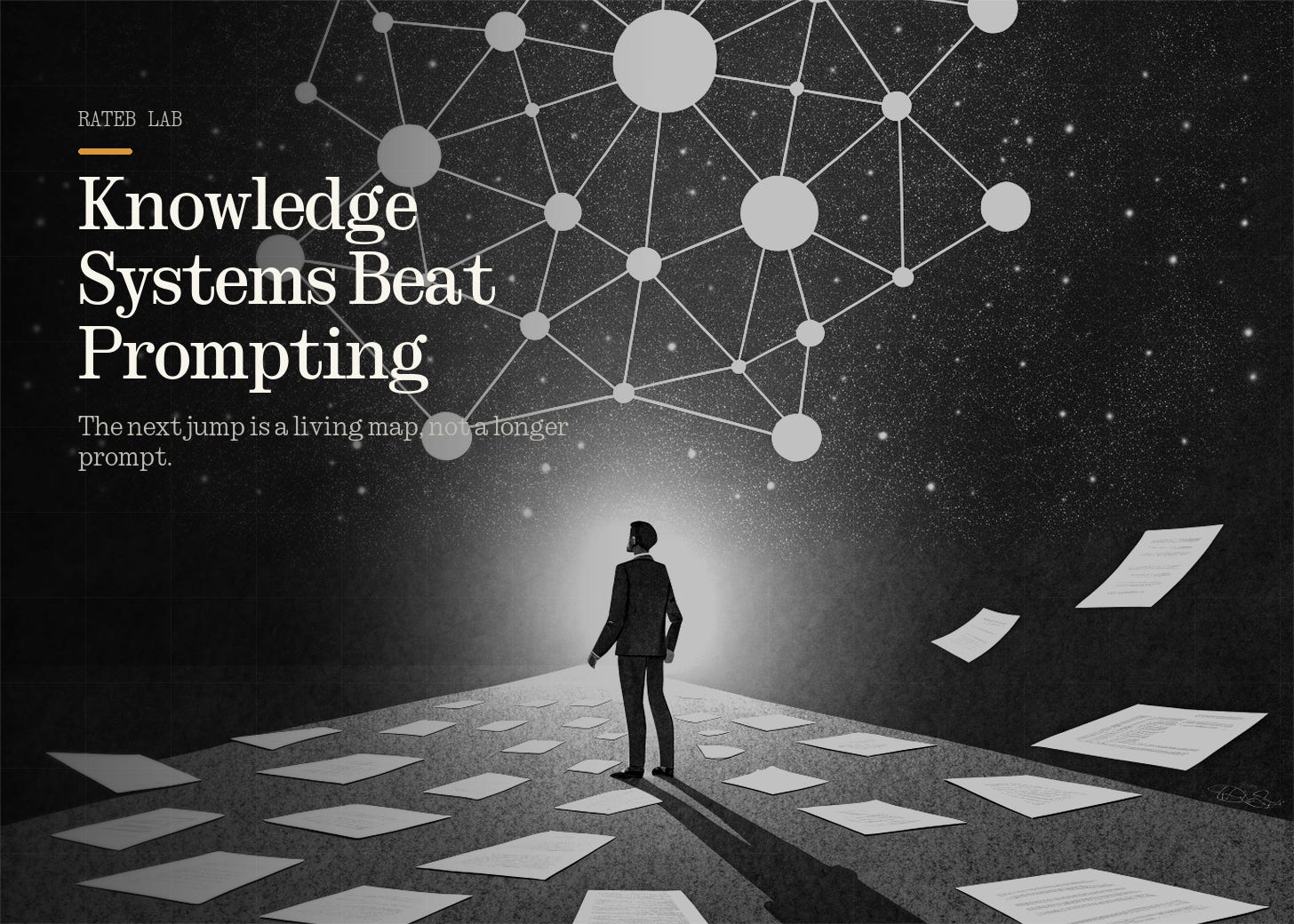
Because I gave it no map.
The wrong map: prompt engineering as the whole game
Prompting matters. Clear instructions still matter.
But prompt engineering becomes weak when it is treated as the entire operating system.
The wrong model says: if the output is shallow, the prompt must be bad.
Sometimes that is true. But often the deeper issue is this: the agent has no access to the relationships that make your work meaningful.
It does not know which ideas you have already tested. It does not know which examples belong to your audience. It does not know which sources are strong and which ones are just noise. It does not know the difference between a random saved link and a source that changed how you think.
So you keep adding instructions:
write in my voice
use my framework
connect it to my project
make it more practical
add depth
be less generic
But those instructions are trying to compensate for missing architecture.
A prompt is a request. A knowledge system is a memory with structure.
The better map: agents need a knowledge substrate
The useful shift is to stop thinking of AI as a prompt box and start thinking of it as an operator on top of a knowledge substrate.
That sounds abstract. The simple version is this:
Your saved material should not sit as dead storage. It should become a map.
A source should not only be saved. It should be extracted.
An idea should not only be highlighted. It should be connected.
A raw lesson should not only be archived. It should reveal claims, mechanisms, examples, contradictions, and next actions.
A project note should not only record what happened. It should tell the next agent what was decided, what failed, what worked, and what should not be repeated.
When that map exists, the agent can do more than respond to a prompt. It can retrieve, compare, connect, and act.
That is the difference between asking:
“Write me a post about AI productivity.”
And asking:
“Use my notes on cloud learning, my last three content packages, the source brief from this video, my writing rules, and the open blockers in this project. Then draft a piece that connects knowledge systems to technical self-rebuilding.”
Same model. Different ground.
The mechanism: capture, extract, tag, link, query, act
A useful knowledge system does not need to start as a huge graph.
It starts as a loop.
1. Capture the source.
Save the video, article, lab, conversation, book excerpt, command output, or project note.
2. Extract the useful claims.
What is actually being said? What changed? What mechanism is being shown? What mistake does this help prevent?
3. Tag the mechanisms.
Not only broad tags like “AI” or “productivity.” Use functional tags: retrieval, context, workflow, agent handoff, quality control, Linux troubleshooting, career proof, writing system.
4. Link related ideas.
Connect this source to older notes, projects, drafts, mistakes, or frameworks. The value is often in the bridge, not the isolated note.
5. Create one next action.
A note without a next action is often just intellectual decoration. What should this source change in your work?
6. Let the agent query the map before creating.
Before drafting, coding, or planning, make the agent inspect the relevant notes instead of guessing from generic knowledge.
This is where output quality starts to change.
The agent is no longer improvising from a prompt. It is operating from a working memory.
My field note: this is where a local knowledge base becomes more than storage
This is why I keep my notes local, linked, and searchable.
Not because a note-taking app is magic. It is not.
But because a structured knowledge base gives AI agents a better starting point than a blank chat window.
When I leave my notes as scattered fragments, the agent behaves like a smart stranger. It can help, but it does not really know the terrain.
When I structure the work notes, draft goals, status, blockers, evidence, and links, the agent has something closer to a project memory.
It can see the difference between a public draft and private context. It can see the current state. It can see what is scheduled. It can see what was held. It can avoid repeating the same mistake.
That is not just productivity. That is quality control.
And in the AI age, quality control may matter more than raw generation.
Why this matters for technical self-rebuilders
If you are rebuilding your technical life -- learning cloud, Linux, AI, automation, writing, systems -- you are collecting more material than you can hold in your head.
Courses. Commands. Videos. Prompts. Errors. Notes. Articles. Job advice. Portfolio ideas. Tools. Frameworks.
At some point, the problem is no longer access to information.
The problem is returning to the right information at the right moment and turning it into proof.
A knowledge system helps you do that.
It turns learning into reusable context.
It turns mistakes into future instructions.
It turns saved sources into working material.
It turns scattered effort into visible progress.
And it gives your agents a way to support your actual path instead of producing generic advice for a generic person.
A practical first move
Do not try to build the perfect second brain this week.
Build one useful loop.
Pick one source you already saved but never used.
Then create a simple note with these headings:
What problem does this source solve?
What is the main claim?
What mechanism explains it?
What example makes it real?
What does this connect to in my current work?
What should I do next because of it?
What should an AI agent know before using this source?
That last question is the bridge.
You are not only writing notes for yourself anymore. You are writing notes for future collaboration between you and your tools.
Final reflection
The easy mistake is to chase the next prompt trick.
The harder, more useful move is to build the context layer that makes every future prompt smarter.
A better prompt can improve one answer.
A better knowledge system can improve the way you think, write, build, and delegate for months.
That is the shift I care about now.
Not AI as a magic box.
AI as an operator on top of a memory you deliberately built.