

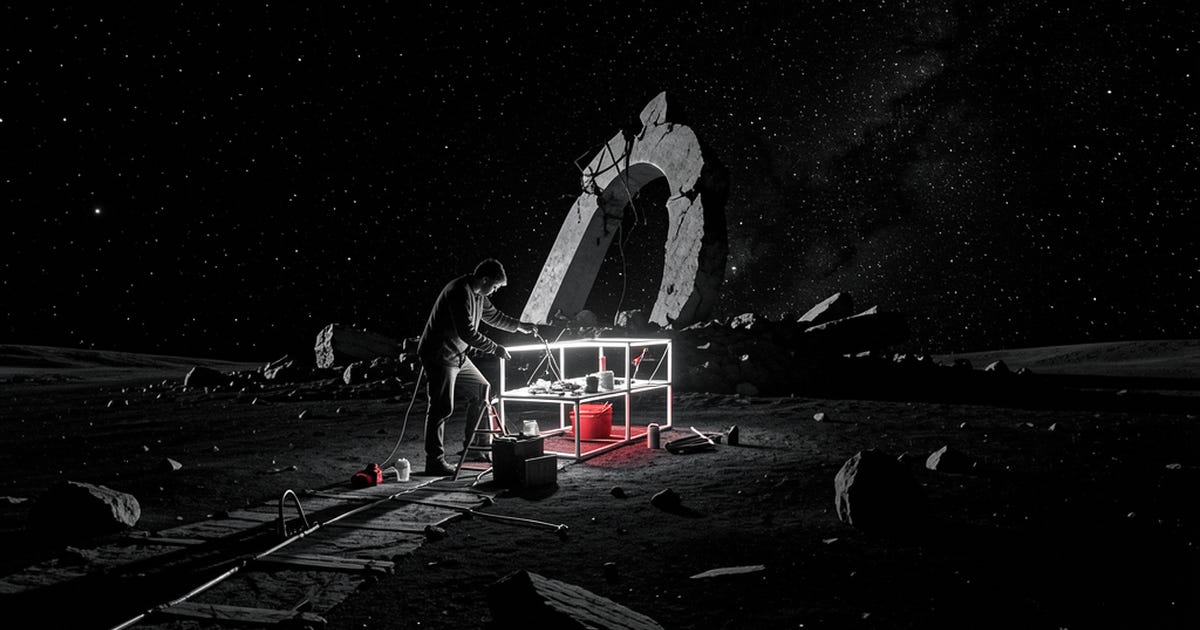
There is a painful moment when an old certainty stops working.
It can be religious certainty. Career certainty. Identity certainty. Relationship certainty. The certainty that a plan will save you. The certainty that if you do the right things, the world will respond in a clean way.
When that certainty disappears, the first feeling is often emptiness.
Not because life has no meaning, but because the old container for meaning broke.
A lot of people try to solve that by finding a new guarantee as fast as possible.
A new ideology. A new productivity system. A new identity. A new plan. A new person to become.
I understand that impulse. It is human.
But I think there is another path.
Meaning can be built as a system, not discovered as a permanent mood.
The wrong map: wait until life feels certain again
The wrong map says you need certainty before you can move.
You need to know your purpose. You need to feel motivated. You need to believe completely. You need to understand where your life is going. You need to solve the big question before you can take the small step.
That sounds deep, but it can become a trap.
Because certainty is not always available.
Some seasons do not give you a clean answer. Some transitions do not give you a stable identity. Some losses do not come with a perfect replacement belief.
If movement depends on certainty, then uncertainty becomes paralysis.
You wait for the emotional weather to clear before you do anything that could actually rebuild trust in your life.
The better map: meaning can be maintained
The better map is less dramatic and more practical.
Meaning is not only something you find. It is something you maintain.
You maintain it through commitments. Through relationships. Through craft. Through service. Through prayer or reflection if that is part of your life. Through work that makes you more useful. Through small promises you keep when your mood is not impressive.
This does not make meaning shallow.
It makes meaning more honest.
A meaningful life is not meaningful because every day feels profound. It is meaningful because some actions still matter when the feeling is missing.
The mechanism: commitments carry what moods cannot
A mood is unstable.
It rises, falls, disappears, returns, exaggerates, and lies.
A commitment is different.
A commitment creates a line of continuity between the person you were yesterday and the person you are trying to become tomorrow.
That is why small commitments matter after certainty disappears.
They give your life a structure that does not require perfect emotion.
Write the note. Do the walk. Study the lab. Call the person. Pray. Clean the room. Keep the promise. Finish the small piece of work.
None of these actions answer every cosmic question.
But they protect you from becoming a person who only moves when life feels fully explained.
The field note: technical work taught me something about meaning
This may sound strange, but learning technical work made this idea clearer for me.
A system does not become reliable because one part feels inspired.
It becomes reliable because the parts connect, the failure points are understood, the process is repeated, and the weak signals are noticed early.
Meaning has a similar practical layer.
If the only thing holding your life together is a big feeling, then the system is fragile.
But if meaning is supported by repeated actions, people you care about, work that builds skill, spiritual practice, health, and honest reflection, then one bad emotional day does not destroy the whole structure.
This is not about becoming robotic.
It is about not asking emotion to carry a weight it was never meant to carry alone.
The danger of outsourcing meaning to intensity
One reason meaning becomes fragile is that we confuse it with intensity.
If the emotion is strong, the thing must be meaningful. If the motivation is high, the path must be right. If the identity feels exciting, the decision must be true.
But intensity is not always wisdom.
Sometimes intensity is novelty. Sometimes it is fear. Sometimes it is escape. Sometimes it is the relief of becoming someone new for a few hours.
A built meaning system needs a slower test.
Does this commitment still make sense when the emotion calms down? Does it make me more honest? Does it make me more useful? Does it connect me to people, craft, faith, health, or responsibility in a way I can respect later?
Those questions are less exciting than a dramatic breakthrough.
But they are more reliable.
A small meaning system
Choose one commitment that remains valid even when you are uncertain. It should be small enough to repeat and real enough to matter.
Connect it to a value outside your mood. A person, a craft, a duty, a faith practice, a body of work, or a future you still respect.
Make the action concrete. Not become healthier. Walk for twenty minutes. Not become technical. Finish one lab note. Not become a writer. Publish one honest field note.
Review it weekly. Ask what gave energy, what drained energy, what still felt meaningful, and what needs to be repaired.
Do not demand that the system solve your whole life. Let it hold the next honest step.
Final reflection
Certainty disappearing is painful.
But it is not the same as meaning disappearing.
Sometimes it only means the old shortcut stopped working.
The deeper version of meaning may be less shiny. It may be built from small commitments, repeated practices, honest relationships, and work that makes you more useful.
That kind of meaning does not need to pretend the universe gave you a permanent guarantee.
It asks for something simpler and harder.
Build what still matters. Then keep repairing it.