

Most people understand Meta through whatever Mark Zuckerberg is announcing that year.
Facebook.
Instagram.
WhatsApp.
The metaverse.
Ray-Ban glasses.
AI assistants.
Superintelligence labs.
It looks like a company constantly changing its identity.
But the simpler view is this:
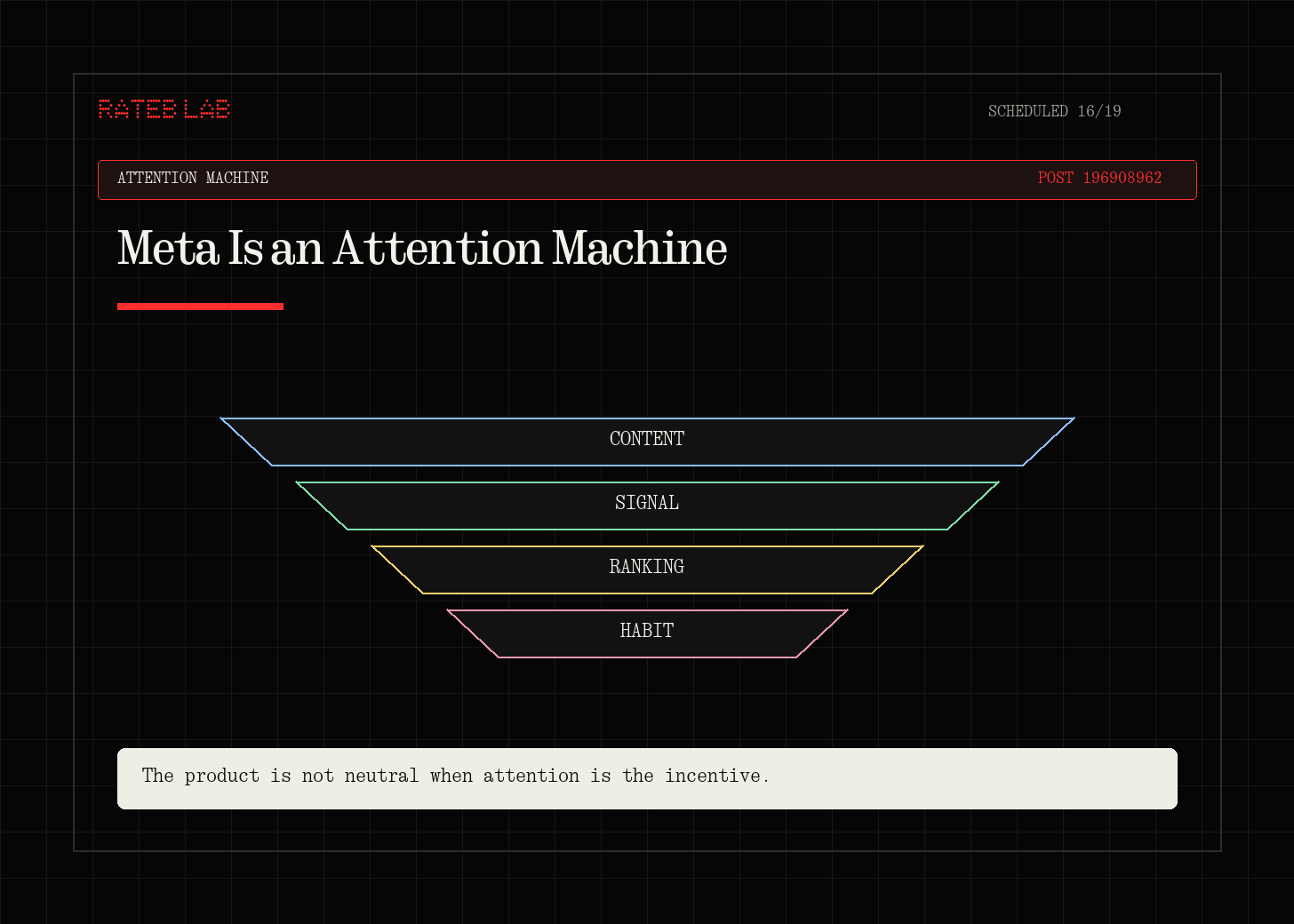
Meta captures attention, sells ads against that attention, and uses the cash to protect the next place attention might move.
That sentence explains more than the rebrand did.
It explains why Facebook could become Meta without Facebook disappearing.
It explains why the metaverse could lose tens of billions of dollars and still not destroy the company.
It explains why AI is now treated like an existential race, not a side project.
And it explains why smart glasses matter even if most people still do not want to live inside a headset.
The Business Did Not Rebrand
Facebook became Meta in 2021.
The name changed because the company had become bigger than one app. It owned Facebook, Instagram, WhatsApp, Messenger, and Oculus. A holding-company name made sense.
But the money still came from the same basic machine.
People spend time inside Meta’s apps.
Meta learns what holds that attention.
Advertisers pay to reach people with more precision.
Meta turns that into revenue.
In 2025, Meta reported $200.97 billion in revenue. The Family of Apps segment still carried the business. Reality Labs was still a long-term bet with heavy losses.
That is the first useful lesson.
A company can change the story it tells the market without changing the engine that pays the bills.
The Simple Loop
Meta’s core loop looks like this:
Build or buy apps where people spend time.
Measure what people watch, tap, pause on, share, and ignore.
Use machine learning to make the feed and ad system better.
Sell better targeting and better outcomes to advertisers.
Use the cash to fund the next platform bet.
That next platform bet used to be VR.
Now it is AI.
The loop matters because it removes some of the mystery.
Meta does not need every new product to make money immediately. It needs the core ad machine to stay strong enough to fund experiments until one of them becomes the next interface.
This is why the metaverse failure did not end the company.
It was expensive. It was embarrassing. It became a symbol of Silicon Valley excess.
But it was paid for by one of the most profitable attention systems in history.
The Metaverse Was the Wrong Interface
The metaverse pitch was simple:
The next internet would feel embodied. You would not only scroll through apps. You would enter digital spaces.
That idea was not crazy.
The problem was the interface.
Most people did not want to put on a headset for normal digital life.
Headsets add friction. They are expensive. They can feel isolating. They ask the user to change behavior before the value is obvious.
So Meta spent heavily, but the market did not move fast enough.
Reality Labs kept burning money. Meta kept saying the long-term bet was alive. But the center of gravity shifted.
AI became the new race.
AI Is Not a Feature for Meta
It is tempting to think of AI as another feature inside Instagram or WhatsApp.
That is too small.
For Meta, AI is infrastructure, distribution, product, and defense at the same time.
AI improves ads.
AI improves recommendations.
AI creates assistants.
AI creates synthetic content.
AI helps brands make campaigns.
AI may power future glasses, agents, and interfaces.
Most important: AI may become the layer users go through before they reach apps.
That is the part Meta cannot ignore.
Facebook struggled for years with Apple and Google because those companies controlled the mobile operating systems and app stores. If AI becomes the next control layer, Meta does not want to depend on someone else’s model in the same way.
That is why the spending makes sense.
Meta is not only chasing hype.
It is trying to avoid being trapped below the next platform owner.
The New Interface May Be on Your Face
VR asked people to enter a separate world.
Smart glasses ask for something easier:
Wear normal-looking glasses and let AI ride along with your day.
That is a much more dangerous and interesting interface.
It has less friction than a headset.
It can capture voice, image, location, memory, context, and social situations.
It can also create serious privacy questions.
The same company that built one of the best attention-measurement systems on the internet is now working on devices that can see and hear from the user’s point of view.
That does not mean every use is bad.
Music, translation, accessibility, navigation, hands-free capture, and personal assistance can all be useful.
But the incentive is worth watching.
If the business is built around attention, then every new interface becomes a question:
What new signal can be measured?
What new behavior can be predicted?
What new ad or product path can be sold?
The Real Lesson for Technical Learners
Meta is not only a story about one company.
It is a map of how modern technology power works.
The visible product is the app.
The real system is deeper:
data
distribution
compute
machine learning
ad markets
hardware
regulation
user behavior
capital allocation
If you are learning cloud, AI, Linux, networking, or software, this is the level worth studying.
Do not only ask:
What did Meta launch?
Ask:
What infrastructure does it need?
What behavior does it measure?
What business model funds it?
What platform risk is it trying to escape?
What new dependency is it trying to control?
That is how you move from consumer understanding to systems understanding.
The Pattern
The pattern is not complicated.
Facebook captured social attention.
Instagram captured visual attention.
WhatsApp captured communication.
The metaverse tried to capture immersive presence.
Smart glasses try to capture first-person context.
AI tries to become the thinking layer between the user and the internet.
Different products.
Same strategic fear:
Do not lose the interface.
Because whoever owns the interface shapes the behavior.
And whoever shapes the behavior can shape the market.
The Takeaway
Meta is not confusing because it does too many things.
It is confusing because the public story changes faster than the business engine.
The engine is still attention.
The fuel is still advertising.
The new battlefield is AI.
The next interface may be glasses, agents, feeds, or something we do not see yet.
But the useful question stays the same:
Who controls where attention goes next?
That is the company Meta is trying to remain.