

This week, the real update is not only what I learned.
It is how my learning system is changing.
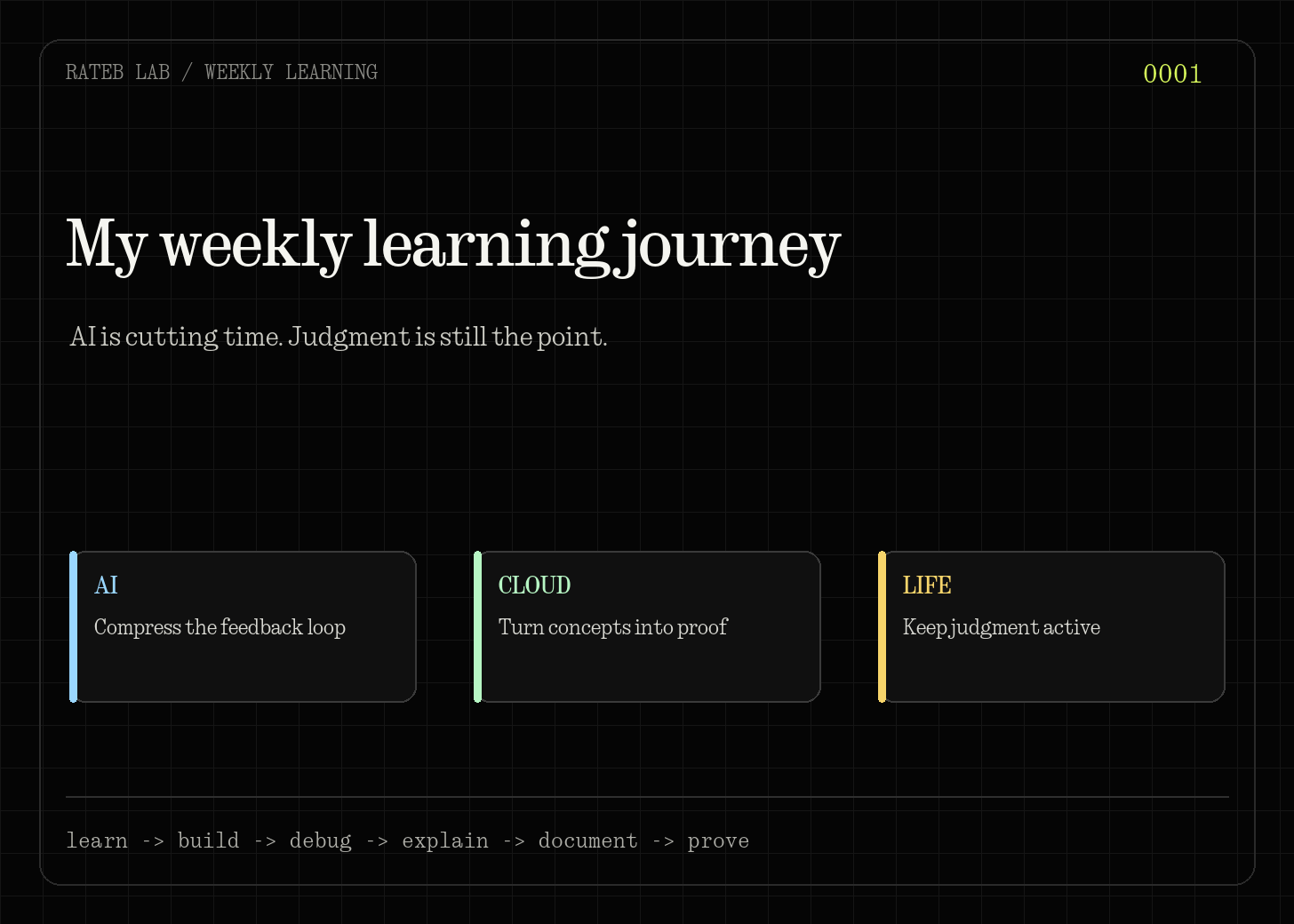
I am learning cloud engineering, AWS, networking, Python, writing, and AI workflows at the same time. That can easily become chaos. More courses. More notes. More tabs. More saved videos. More plans.
But the point of using AI in learning is not to collect more information faster.
The point is to shorten the distance between confusion and useful output.
If I learn something about AWS networking, I do not want it to stay as a passive note. I want it to become a diagram, a lab, a table, a self-quiz, a README, or a simple explanation I can publish.
That is the shift I am trying to make.
AI is useful when it helps me move through this loop:
learn -> build -> debug -> explain -> document -> prove
It is dangerous when it replaces the loop.
What I learned this week
The main technical focus was cloud fundamentals.
I have been organizing my AWS and Network+ learning around one question:
Can I explain the path of a basic web request through the cloud?
Not in a fancy way. In a real beginner-useful way.
Something like:
User -> DNS -> internet -> VPC -> public subnet -> route table -> EC2 -> security group -> response
That one path forces me to connect a lot of scattered ideas:
why DNS matters
what a public subnet is
why a server can be running but unreachable
how security groups differ from network ACLs
why Route 53, CloudFront, and Global Accelerator are not the same thing
why networking is not a side topic in cloud learning
I also moved deeper into AWS storage:
EC2 instance store vs EBS
EBS snapshots
S3 object storage
durability, versioning, and basic security controls
And in parallel, I kept the wider foundation alive:
Network+ concepts like OSI layers, physical layer, topology, ports, routing, and firewalls
CS50 and CS50P basics like functions, variables, conditionals, lists, strings, debugging, and how programs represent information
AI-assisted software workflow through Codex, localhost, GitHub, Firebase, Vercel, Electron, and Swift/iOS notes
The pattern is becoming clearer:
Cloud engineering is not one subject.
It is a stack of fundamentals that meet under pressure.
Linux teaches you how machines behave. Networking teaches you why things can or cannot reach each other. AWS gives those ideas managed forms. Python gives you a way to automate. Git gives you memory. Writing gives you proof. AI gives you faster feedback.
But none of these replace judgment.
The plan update
My May plan is now more focused.
The goal for the rest of the month is not to finish every course.
The goal is to consolidate AWS networking, strengthen the Network+ concepts behind it, keep Python practical, and avoid spreading my attention across too many tracks.
The priority order is:
AWS Cloud Practitioner Essentials
CompTIA Network+
CS50P / practical Python
AWS Solutions Architect Associate as light reference
CS50x as optional review
The current target is simple:
By May 31, I want to have a clear explanation of a basic AWS web request, a security group vs network ACL comparison, a Route 53 vs CloudFront vs Global Accelerator comparison, a useful Network+ review note, one small Python script, and a short self-quiz.
That is a better plan than “study cloud.”
It creates outputs.
How AI is cutting time
The best use of AI in my learning is not asking it to give me final answers.
The best use is asking it to make every learning loop tighter.
For example:
Turn a rough note into a clear Obsidian structure.
Convert a course topic into a simple lab.
Ask me questions after I study.
Explain errors from logs or terminal output.
Compare two concepts in a table.
Review whether my explanation is actually understandable.
Turn a lab into a README, diagram, and public post.
That saves time because the slow part is often not the information itself.
The slow part is friction:
deciding what to do next
turning notes into action
finding the hole in your understanding
cleaning messy thoughts
documenting what you did
creating proof that someone else can inspect
AI can compress that.
But it cannot remove the need to do real work.
The market does not care how long I stared at a course.
The market cares what value I can bring to the table.
Can I explain the system? Can I troubleshoot the problem? Can I build the small thing? Can I document it? Can I communicate it clearly? Can I use AI without becoming dependent on it?
That is the real test.
The personal layer
This week also reminded me that learning is not separate from life.
I tested a voice-journal workflow where I speak naturally, including in Arabic, and then use AI to turn that raw material into structured Obsidian notes.
That matters more than it sounds.
Most useful thoughts do not arrive as polished essays.
They arrive as fragments. Mixed language. Emotion. Memory. Pressure. A question you barely know how to ask.
If the system can only handle clean English prompts, it is not really a personal knowledge system.
It has to capture real life before it becomes clean.
The tool I am testing for this is Voicenotes. I use it as a capture layer before the thoughts become structured enough for Obsidian.
That same idea showed up in a more personal way when I thought about my Dubai restart.
I am treating that story carefully because some parts are personal and some parts are interpretation. But the public-safe lesson is clear:
A fresh start does not automatically fix the hidden games inside a new environment.
Changing cities can change your options.
It does not automatically change incentives, culture, trust, or power dynamics.
The important lesson for me was not “Dubai is good” or “Dubai is bad.”
The lesson was:
Trust is a leading indicator.
When trust collapses, your health, focus, and performance usually follow.
That connects directly to learning and career rebuilding.
If I am trying to rebuild my life through technical skill, I cannot only optimize courses and tools.
I also need better judgment about environments.
Where am I learning? Who am I trusting? What incentives are around me? What red flags am I ignoring because I want the fresh start story to be true?
That is also part of becoming useful in the AI age.
Not just knowing tools.
Knowing when not to outsource your judgment.
A small movie lesson
I also watched Project Hail Mary, and one small thing about it clicked for me.
The reason was not complicated.
A simple premise can hold attention when the problem is clear and the pressure is real.
One person wakes up far from home. Earth is in danger. The mission is uncertain. He has to understand the situation, work with what is available, and solve problems step by step.
That is why the story works.
Trailer:
And weirdly, that is also how good learning works.
You do not need a dramatic identity every day.
You need a clear problem, a constrained environment, feedback from reality, and the patience to keep solving.
The real weekly lesson
This week taught me that AI-assisted learning is not about speed alone.
Speed without proof is just faster self-deception.
The better question is:
What did this tool help me understand, build, explain, or decide?
If AI helps me turn AWS networking into a clean diagram, that is useful.
If it helps me inspect a command before I run it, that is useful.
If it helps me turn a voice journal into a clear reflection, that is useful.
If it helps me publish a weekly learning update that connects cloud, writing, personal judgment, and career rebuilding, that is useful.
But if I use it to skip the uncomfortable part, then I am only automating weakness.
So the direction for next week is simple:
More labs. More proof. More careful judgment. Less passive learning. Less tool collecting.
The goal is not to look like I am learning fast.
The goal is to become someone who can bring value to the table.