

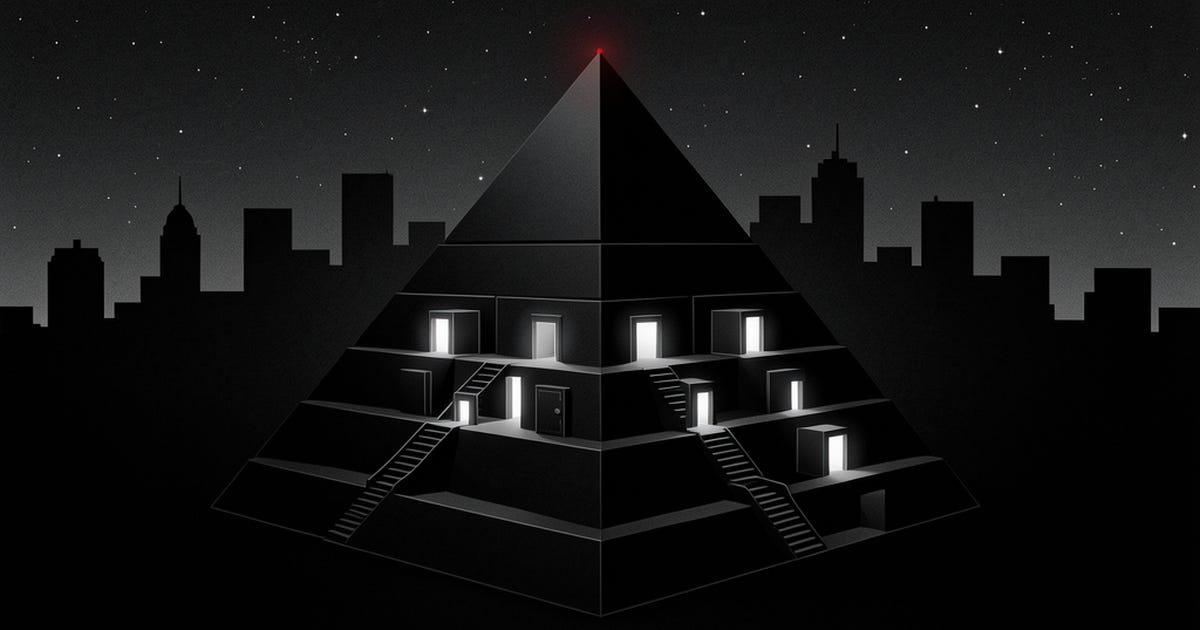
Billionaires are easy to see. The system that protects them is not.
A billionaire in a photo op.
A CEO calling a politician.
A private jet parked beside a public problem.
That picture is not wrong. It is just too small.
The more useful way to see oligarchy is not as a person. It is as a system for defending wealth.
Not only earning money.
Not only having money.
Defending money from taxes, public pressure, regulation, scrutiny, and the normal rules everyone else has to live inside.
That is the part that changes the whole frame.
Because if oligarchy were only a few bad characters, the solution would be simple. Replace the characters. Shame them. Vote them out. Wait for better people.
But if oligarchy is infrastructure, the problem is deeper.
Infrastructure does not need to look evil to be powerful. It can look boring. It can look like paperwork. It can look like a trust, a shell company, a tax strategy, a law firm, a bank account, a lobbying meeting, a court decision, or a line in a constitution that most people never read.
The most important power is often the least cinematic.
The visible face is not the system
A useful mental model from technology is the difference between the interface and the architecture.
The interface is what you see.
The architecture is what decides what is possible.
A normal user sees a clean app screen. An engineer asks about permissions, databases, APIs, routing, failure modes, and who controls the infrastructure underneath.
Politics and wealth work in a similar way.
The visible interface is easy to argue about. Famous billionaires. Campaign donations. A scandal. A speech. A viral clip. A name everyone already knows.
The architecture is harder to see.
Who owns the asset?
Where is it registered?
Which jurisdiction protects it?
Which lawyer structured it?
Which accountant reduced the liability?
Which lobbyist shaped the rule?
Which court decision made the rule harder to change?
Which ordinary professional is paid to keep the machine running?
Once you start asking those questions, oligarchy stops looking like a cartoon villain and starts looking like a stack.
There is a presentation layer at the top.
There is a legal layer underneath.
There is a financial layer underneath that.
There is a professional services layer maintaining the structure.
And below all of it, there is a political design layer deciding how hard it is for ordinary people to change the system.
That is the real lesson.
Power compounds when it becomes architecture.
Wealth defense is the missing phrase
Most people understand wealth creation.
Someone builds a company, sells a product, owns an asset, gets lucky, takes risk, captures a market, or inherits capital.
But wealth defense is different.
Wealth defense is what happens after enough money has been collected.
At that level, the question changes from:
How do I make more money?
To:
How do I protect this money from the rules that apply to everyone else?
That is where the invisible machinery begins.
Shell companies.
Trusts.
Tax havens.
Complex ownership chains.
Private banks.
Law firms.
Accounting teams.
Policy influence.
Jurisdiction shopping.
The average person cannot buy this maze. They do not have enough money to need it, and they do not have enough money to access it.
That is why extreme wealth is not only a larger number. At a certain scale, it becomes a different operating environment.
A person with normal income plays the default game.
A person with extreme wealth can pay people to redesign the game around them.
That is the line.
The army does not look like an army
When people imagine power, they usually imagine force.
Police. Guards. Weapons. Men in rooms making decisions.
Modern wealth defense often looks much quieter.
It looks like smart graduates going into elite law, finance, consulting, tax, compliance, private banking, and corporate structuring.
Most of them do not wake up thinking they are protecting oligarchy.
They wake up thinking they have a job.
They have student debt, ambition, rent, family pressure, career goals, and a desire for stability. They are good at reading documents, solving puzzles, reducing risk, and serving clients.
That is what makes the system so durable.
It does not depend on every participant being evil.
It depends on the incentives being clear.
If the highest rewards go to the people who help extreme wealth become harder to tax, harder to trace, and harder to challenge, then talent will flow in that direction.
The machine recruits intelligence.
Then intelligence makes the machine harder to understand.
That pattern matters far beyond politics.
Every system reveals its values by what it rewards.
If a company rewards speed without reliability, people will ship fragile systems.
If a platform rewards outrage, people will become better at outrage.
If a career market rewards credential theater, people will optimize for signals instead of competence.
If an economy rewards wealth defense more than public usefulness, brilliant people will become maintainers of the maze.
The capacity is the power
One of the hardest ideas here is that power does not have to be used every day to be real.
A person with extreme wealth might not buy an election.
They might not lobby aggressively.
They might not hide money offshore.
But if they can do those things whenever they choose, they live in a different category from everyone else.
Capacity matters.
In technical work, we understand this. A root account does not need to run a destructive command every day to be powerful. The power is in the permission level. The danger is in what the account can do when activated.
Extreme wealth works like a social root account.
It gives access to legal talent, political channels, media influence, private security, tax planning, jurisdiction choice, and time.
Most people have opinions.
Some people have access.
A much smaller group has the ability to turn access into durable structure.
That is why the conversation should not stop at whether one rich person seems nice, generous, innovative, or personally ethical.
Personal morality matters, but architecture matters more.
A good person with root access still has root access.
A society has to decide how much root access any private actor should have.
Democracy and oligarchy can coexist
The uncomfortable part is that a society can have elections and still carry oligarchic design inside it.
That sounds contradictory only if democracy is treated like a switch.
On or off.
Democratic or not democratic.
Real systems are messier.
A country can have voting, speech, parties, courts, and public debate while also having structures that protect elite power from majority pressure.
Some decisions are made directly by voters.
Some are filtered through institutions.
Some are shaped by courts.
Some are influenced by money.
Some are made so complex that only specialists can participate.
Again, the useful question is architectural.
Where can ordinary people apply pressure?
Where is pressure absorbed?
Where are rules easy to change?
Where are they almost impossible to change?
Where does money become speech, access, delay, complexity, or veto power?
If we only ask whether democracy exists, we miss the better question.
What kind of democracy is this system allowed to become?
The lesson for builders
I do not want to turn this into a simple political slogan.
The deeper lesson for me is systems literacy.
If you are learning cloud, Linux, AI, automation, writing, or any technical craft, you are already training the habit this topic requires.
You learn not to stop at the interface.
You ask what is underneath.
What runs when I click this?
What permission does this process have?
Where does the data go?
What breaks under load?
Who owns the dependency?
What invisible default is shaping the result?
That habit is not only useful for servers and software.
It is useful for reading the world.
When something looks unfair, do not only ask who benefited.
Ask what system made the benefit repeatable.
Who maintains the system?
Who profits from its complexity?
Who is paid to explain that nothing can change?
Who gets access to exceptions?
Who carries the cost when the structure works exactly as designed?
That is where agency starts.
Not with outrage alone.
With better diagnosis.
A practical diagnostic
When you are trying to understand any power structure, use this simple map.
First, name the visible outcome.
What keeps happening that feels unfair, confusing, or impossible to change?
Second, identify the defense layer.
What protects the outcome from normal pressure?
It could be law, money, complexity, credentials, platform rules, social status, bureaucracy, network effects, or fear.
Third, find the maintainers.
Who gets paid, promoted, protected, or respected for keeping the system running?
Fourth, find the chokepoint.
Where could a small change create a large change in behavior?
Fifth, separate moral anger from structural understanding.
Anger can give energy. Understanding gives aim.
That last line matters.
A lot of people stay trapped because they are right about the problem but vague about the mechanism.
They know something is wrong.
They can name the villain.
They cannot yet name the architecture.
Final reflection
The most dangerous systems are not always hidden because nobody can see them.
They are hidden because seeing them takes patience.
They are boring before they are shocking.
They are technical before they are emotional.
They are maintained by normal work before they become public crisis.
That is why I keep coming back to this idea:
Power is usually below the interface.
If we want more agency in the AI age, in work, in learning, in politics, and in our own lives, we have to become better readers of systems.
Not just better critics of people.
Better readers of incentives, permissions, defaults, and defense layers.
Because the thing that controls the outcome is often not the face at the top.
It is the architecture underneath.