

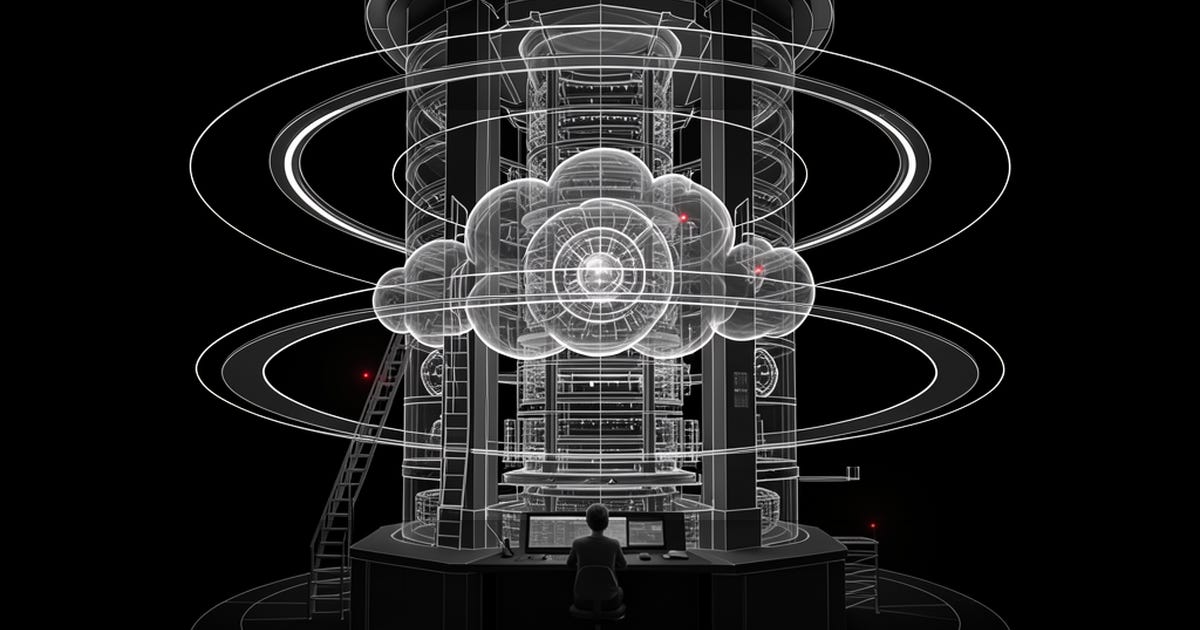
I keep noticing the same pattern in different places.
AI companies talk about safety.
Governments talk about control.
Markets talk about trillion dollar valuations.
Ordinary people talk about feeling stuck.
At first, these look like separate stories. One is about Anthropic and trust. One is about SpaceX and paper wealth. One is about who gets access to private companies before they become public giants. One is about geopolitical deals and large institutions moving pieces on a board most people cannot see.
But the deeper pattern is simpler.
The new divide is not only rich versus poor.
It is people who can build, own, audit, or steer productive machines versus people who are managed by machines they do not understand.
That sounds dramatic, but it is already normal.
A social feed is a machine for attention.
A cloud platform is a machine for computation.
A model provider is a machine for intelligence distribution.
A rocket company is a machine for physical capability.
A government agency is a machine for permission.
A capital market is a machine for ownership access.
The question is not whether machines are good or bad. That is too easy. The real question is who gets agency inside them.
Safety can become a centralization language
Safety is necessary. Nobody serious wants powerful AI systems, financial systems, or infrastructure systems to run without constraints.
But safety language has a shadow.
It can become a polite way to concentrate power.
A company can say, “Only we are responsible enough.”
A government can say, “Only approved actors should have access.”
A platform can say, “Only this route is safe.”
A market can say, “Only certain investors can participate early.”
Each sentence may contain a real concern. But together they create a world where fewer people touch the real machinery.
That is the part that matters for builders and learners.
If every powerful system becomes something you can only consume, rent, or ask permission to use, your skill ceiling changes. You become a passenger. You may still use the tool, but you do not understand the engine. You may still get output, but you cannot inspect the process. You may still have access, but only until the gate changes.
This is why technical literacy matters now.
Not because everyone needs to become an AI researcher.
Not because everyone needs to build rockets.
But because a person with no map of the system becomes easy to manage.
Paper wealth is not the same as productive machinery
The trillionaire conversation is easy to misunderstand.
People see a number and react to the number.
But paper wealth is not a pile of cash sitting in a room. It is a market’s estimate of ownership in a productive machine.
That does not mean inequality is fake. It does not mean all wealth is automatically virtuous. It does not mean markets are always fair.
It means the useful question is deeper than “how much money does one person have?”
The better question is:
What machine produced this value?
Who built it?
Who owns it?
Who got access before the public did?
Who is locked out until the value is already obvious?
This is where the ownership question becomes practical.
If the best productive machines stay private for longer, ordinary people meet them late. They can use the product. They can admire the founder. They can argue about the valuation. But they do not get the same ownership path.
That is a strange kind of modern dependency.
You live inside the outputs of powerful companies, but you do not participate in the upside until the game is mostly priced.
For technical self-rebuilders, this has a personal version too.
If you only consume tools, you are late.
If you learn how the tools work, you are earlier.
If you build workflows with them, you are earlier.
If you turn those workflows into proof, distribution, services, products, or judgment, you are earlier.
Most people think ownership only means equity.
Equity matters. But ownership also means having a working relationship with the machine.
You know how it fails.
You know what it costs.
You know what it can replace.
You know what still needs human judgment.
You can explain it to someone else.
That kind of ownership starts before money enters the conversation.
Learned helplessness is the hidden tax
The worst part of centralization is not only that power moves upward.
It is that people slowly stop imagining they can act.
They outsource judgment to the feed.
They outsource memory to the platform.
They outsource learning to summaries.
They outsource taste to the algorithm.
They outsource career direction to whatever job market panic is loud this week.
Then they call the result realism.
But it is often learned helplessness wearing mature language.
The AI age will reward people who do the opposite.
Not loud optimism.
Not hustle theatre.
Not “everyone can be a founder” nonsense.
The opposite is quieter.
It is learning how systems work.
It is building small proof instead of waiting for permission.
It is asking better questions before adopting a tool.
It is knowing when safety is real and when safety is a moat.
It is knowing when centralization creates reliability and when it creates dependency.
It is knowing when a company is creating value and when it is just controlling access.
This is the practical middle path.
You do not need to worship the new oligarchs.
You also do not need to pretend that resentment is a strategy.
You need to understand the machines.
The AI trust problem is also an architecture problem
The Anthropic part of the conversation is interesting because it points to a deeper AI question.
People keep asking whether we can trust AI companies.
That is not the wrong question. But it is incomplete.
Trust should not depend only on the virtue of a company.
Trust should come from architecture.
Can the system be audited?
Can important decisions be explained?
Can users move if access changes?
Can smaller builders compete?
Can governments make narrow rules instead of broad control moves?
Can safety research happen without turning into a permission cartel?
A healthy AI ecosystem needs more than one trusted priesthood.
It needs competition.
It needs open evaluation.
It needs export rules that are specific enough to protect real risks without freezing the whole field into a few approved giants.
It needs builders who can work at different levels of the stack.
Some people will use AI through polished apps.
Some will build workflows.
Some will run local models.
Some will manage cloud inference.
Some will evaluate outputs.
Some will create education, documentation, and operating systems around the tools.
Each layer matters because agency is not one thing. It is a ladder.
The problem is when the ladder gets removed and replaced with a subscription button.
The practical test
When I look at any powerful system now, I try to ask five questions.
First, what machine is actually producing the value?
Not the headline. Not the personality. Not the culture war around it. The machine.
Second, who owns the machine?
That includes equity, access, distribution, infrastructure, data, and regulatory permission.
Third, who can inspect the machine?
If nobody outside the owner can understand the system, trust becomes a brand promise.
Fourth, who can build near the machine?
A healthy system creates apprentices, suppliers, extensions, critics, educators, and competitors. A closed system creates dependents.
Fifth, what skill gives an ordinary person more agency around it?
That is the question I care about most.
For AI, the skill may be prompt judgment, workflow design, evaluation, Python, cloud, Linux, data handling, documentation, or product thinking.
For capital, it may be understanding ownership, incentives, private markets, risk, and compounding.
For media, it may be writing, source checking, attention control, and direct audience trust.
For career, it may be turning learning into visible proof instead of collecting invisible certificates.
The skill changes by domain.
The agency pattern stays the same.
The point for technical self-rebuilders
If you are rebuilding your technical life right now, it is easy to feel late.
The companies are huge.
The models are huge.
The valuations are huge.
The politics are huge.
But “huge” is not the same as “closed forever.”
Every big machine creates edges.
It creates maintenance work.
It creates translation work.
It creates trust problems.
It creates integration problems.
It creates education gaps.
It creates people who need someone to explain what is happening in plain English.
That is where a learner can start.
Not by pretending to be above the machine.
Not by becoming a passive consumer inside it.
But by learning one layer deeply enough to become useful.
Cloud is a layer.
Linux is a layer.
AI workflows are a layer.
Writing is a layer.
Automation is a layer.
Evaluation is a layer.
Documentation is a layer.
Distribution is a layer.
The future will not be kind to people who only react to systems. But it will keep creating room for people who can understand systems, explain them, improve them, and help others use them with more agency.
That is the real lesson for me.
Do not only ask who is becoming powerful.
Ask what machine they control.
Ask who gets access.
Ask what can be audited.
Ask what can be learned.
Ask where a small builder can still move.
Because the new divide is not just between rich and poor.
It is between people who understand productive machines and people who are quietly managed by them.
The first step is not to own the giant system.
The first step is to stop being mystified by it.