

I need to write this one more honestly.
Psychedelics are not an abstract topic for me.
I have used them since 2018 in the form of microdosing.
It changed my life.
It helped me heal parts of myself that normal thinking could not reach.
It helped me process war trauma.
It helped me feel that my mind was not only a place where pain repeated itself, but a place where new patterns could grow.
That is why the Steve Jobs connection matters to me.
Not because Jobs took LSD and then Apple magically appeared.
Because he represents something deeper:
the link between expanded perception, human evolution, and technology.
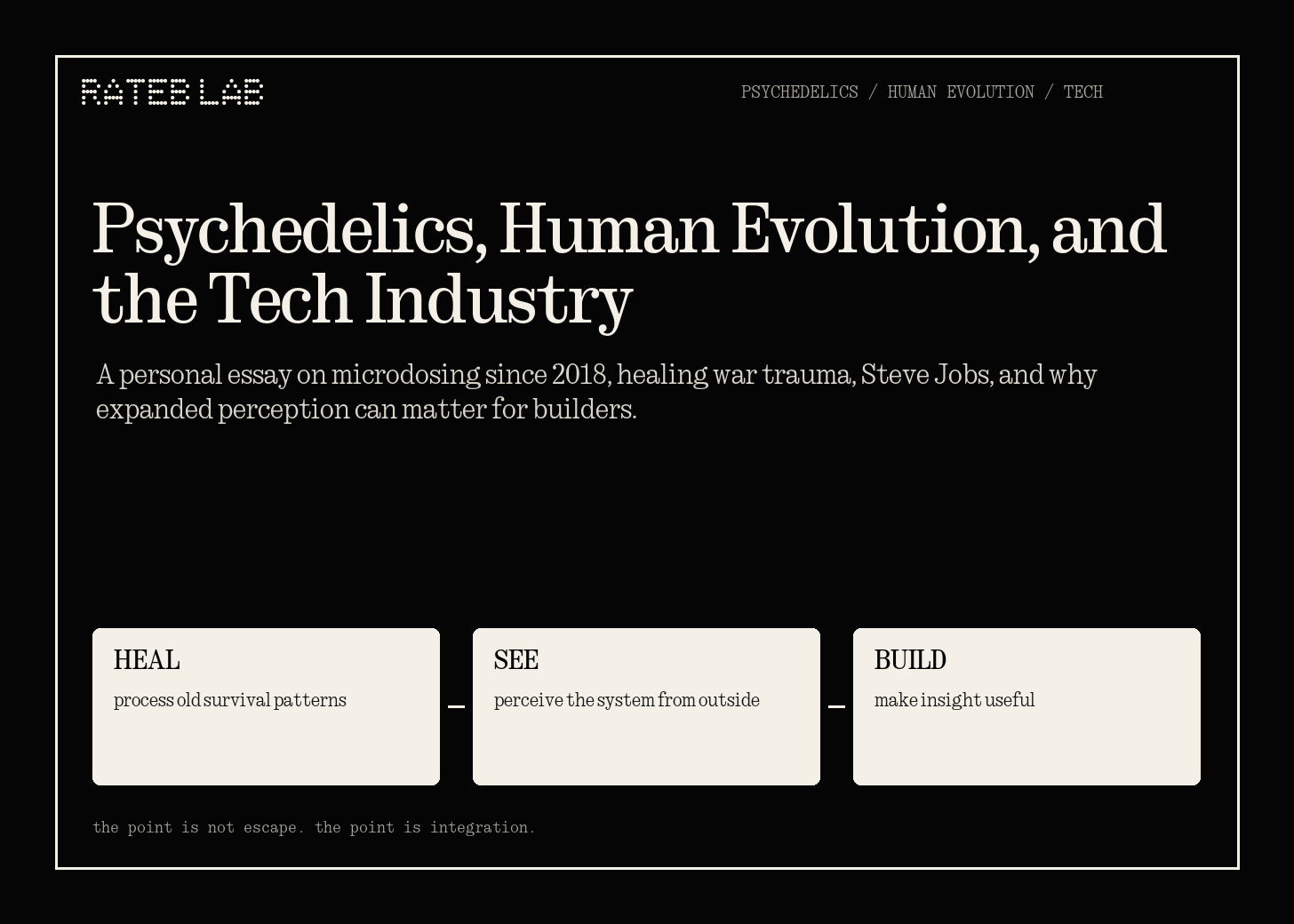
The simple map
The map I care about is this:
trauma -> narrowed perception -> expanded perception -> integration -> creation
Trauma narrows the world.
It makes the nervous system live in yesterday.
It makes the future feel dangerous before it has even arrived.
Psychedelics, used with care, can sometimes loosen that grip.
They can help a person see a painful pattern from outside the pattern.
For me, microdosing did not give me a fantasy life.
It gave me enough distance from old pain to start building a real one.
That is the human evolution part.
Humans evolve when perception changes.
Then tools change.
Then culture changes.
Then work changes.
Why Steve Jobs belongs in this conversation
Michael Pollan writes in How to Change Your Mind about the connection between psychedelics, Silicon Valley, and creative imagination.
He points to early Bay Area engineers, Stanford-adjacent circles, Ampex, Myron Stolaroff, and the serious question that surrounded LSD in that world:
Could altered states help people think, create, and solve problems differently?
Steve Jobs later became the symbol of that question.
He often described LSD as one of his most important life experiences.
That does not mean psychedelics built Apple by themselves.
But it does mean one of the most important technology builders of the modern era took altered perception seriously.
And Apple was not only a hardware company.
It was a perception company.
It changed how people felt about computers.
It made machines feel less like machines.
It made technology more human.
That is the part I think the tech industry should study.
Trauma, perception, and tools
War trauma does something strange to time.
The body leaves the event, but the nervous system can keep living inside it.
You can be in a new city, a new country, a new job, a new relationship, and still feel an old danger inside your body.
For me, microdosing helped create space.
Not instant salvation.
Space.
Space between memory and reaction.
Space between fear and identity.
Space between what happened and what I could still become.
That space matters for life.
It also matters for building.
Because technology is created from perception.
If your perception is locked in survival, your tools often become control systems.
If your perception starts to heal, your tools can become bridges.
Human evolution is not only biological
When people hear “evolution,” they often think about genes.
But human evolution is also cultural, psychological, and technological.
We evolve through language.
We evolve through rituals.
We evolve through tools.
We evolve through the way we learn to look at suffering, work, death, creativity, and each other.
Psychedelics sit in that deeper story.
They have been used in spiritual, healing, and cultural contexts for a very long time.
Modern science is now trying to understand what many traditions already suspected:
that changing consciousness can change how humans relate to pain, meaning, connection, and possibility.
Johns Hopkins researchers have reported strong results from psilocybin-assisted therapy studies for depression.
NIMH has also noted that psychedelic and related compounds show promise for depression and PTSD, while also pointing out real research challenges around blinding, expectancy, and psychotherapy protocols.
Nature research has explored how some psychedelics may reopen windows of plasticity in the brain.
In plain English:
they may help the mind become more able to relearn.
That is the bridge between healing and evolution.
Why the tech industry needs this conversation
The tech industry usually talks about psychedelics in a shallow way.
Microdosing for productivity.
LSD for creativity.
Founders looking for an edge.
That is too small.
The deeper question is not:
“Can psychedelics help me work harder?”
The deeper question is:
“Can expanded perception help me build more human technology?”
Because the tech industry has a perception problem.
It often sees users as metrics.
It sees attention as inventory.
It sees speed as wisdom.
It sees engagement as proof of value.
But a healed mind can ask better questions:
Does this tool make people more free or more dependent?
Does this interface respect the nervous system?
Does this product reduce fear or exploit it?
Does this AI workflow help humans think, or does it help them avoid thinking?
Does this system create clarity, or does it scale confusion?
Those are not soft questions.
They are product questions.
The AI connection
AI makes this even more important.
We are entering a period where machines can produce endless text, code, images, audio, video, and decisions.
The bottleneck is no longer output.
The bottleneck is consciousness.
What kind of humans are directing the tools?
What wounds are they scaling?
What assumptions are they automating?
What fears are they turning into products?
What healed insight are they turning into systems?
This is where psychedelics and technical work meet for me.
Microdosing helped me change my relationship with my own mind.
Technical learning helps me change my relationship with the external world.
AI, cloud, Linux, automation, writing, and systems are not separate from inner work.
They are what inner work can become when it turns into proof.
The builder lesson
The lesson is not “everyone should do what I did.”
The lesson is more personal and more useful:
There are states of mind that survival will never give you.
There are futures you cannot build while your nervous system is still trapped in the past.
There are tools you cannot design with empathy if you have never studied your own pain.
For me, psychedelics helped reopen a path.
Technology gave me a place to build from that path.
Writing helps me turn the path into language.
That is why this topic belongs in Rateb Lab.
Because the future of tech is not only about faster models.
It is about better humans using powerful tools.