

Opening
Most people meet AI through a text box.
They ask ChatGPT to summarize, write, explain, code, plan, translate, or brainstorm. So the surface-level story becomes easy to believe:
AI progress is about prompts.
But Parmy Olson's `Supremacy: AI, ChatGPT, and the Race That Will Change the World` points to a more useful reading of the AI race:
frontier AI is not only a software story.
It is an infrastructure story.
It is about compute, capital, cloud platforms, public demos, institutional incentives, and the companies that can afford to turn research into default behavior for millions of people.
That matters if you are learning cloud, Linux, AWS, automation, or technical operations.
Because the future of AI will not be built only by people who know how to ask a chatbot questions. It will be built and shaped by people who understand the systems underneath it.
A Better Way To Read The AI Race
The book's most useful idea is not gossip about founders.
The useful idea is the structure.
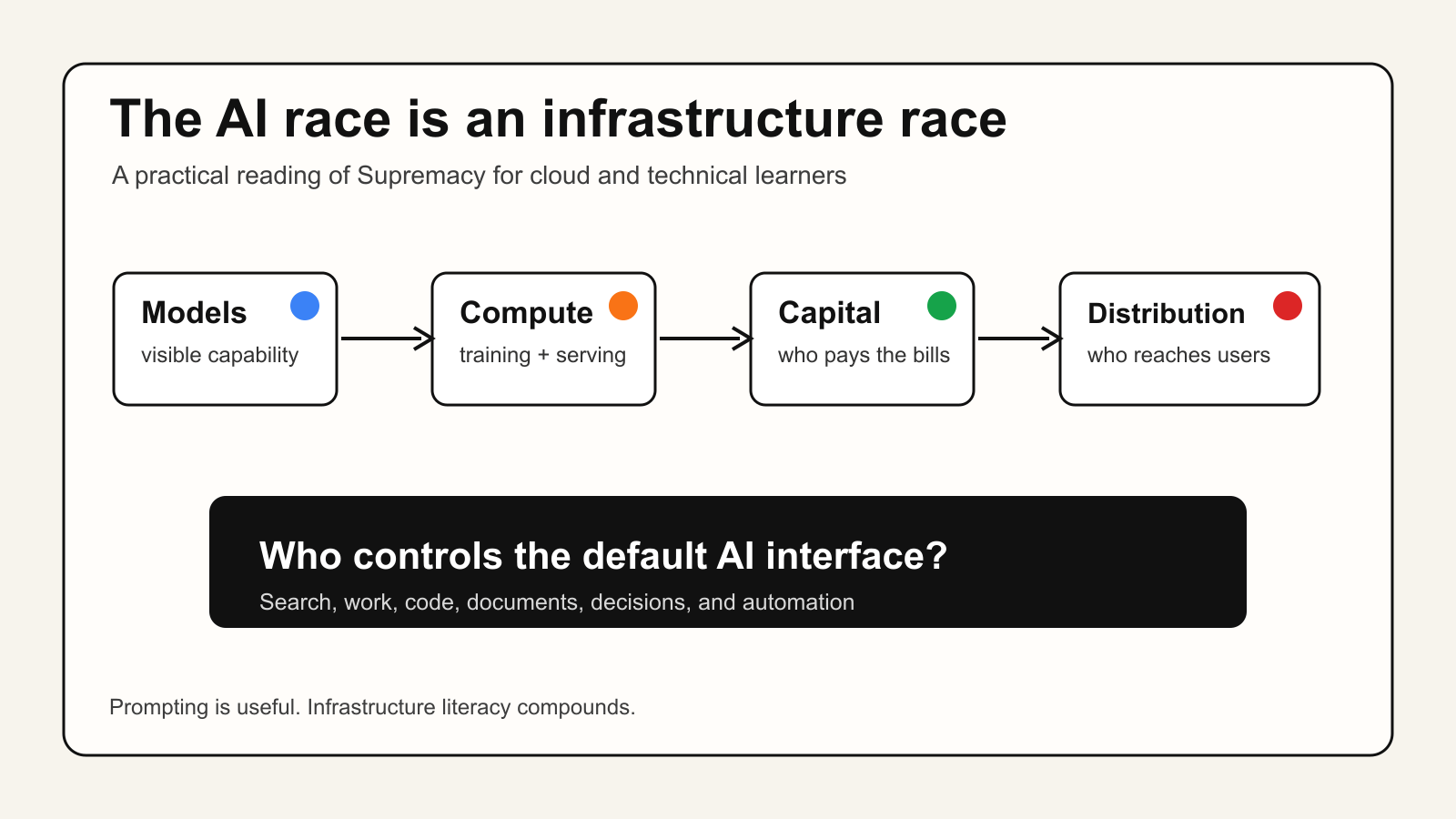
You can read the AI race through five layers:
Models: the visible capability.
Compute: the training and inference engine.
Capital: the money required to keep scaling.
Distribution: the product channels that reach users.
Governance: the rules, incentives, and safety claims around deployment.
Most public conversation gets stuck on layer one.
Which model is smarter?
Which chatbot writes better?
Which tool should I use this week?
Those questions matter, but they do not explain who gets durable power.
Power comes from the layers underneath: who can buy chips, run data centers, negotiate cloud partnerships, absorb losses, serve enterprise customers, and place AI inside products people already use.
Why ChatGPT Was A Product Earthquake
OpenAI launched ChatGPT on November 30, 2022 as a research preview. The model was important, but the interface was the shock.
Before ChatGPT, AI felt distant to most people. It lived inside research papers, recommendation systems, enterprise tools, and invisible product features.
After ChatGPT, AI became a direct experience.
You could type into a box and get something back.
That changed user expectations. It changed investor urgency. It changed Big Tech strategy. It made AI feel less like a lab topic and more like the next computing platform.
The lesson for builders:
technical capability becomes market pressure when it becomes usable.
The text box turned AI into a public product.
Compute Is Not A Side Detail
One of the strongest ideas from the book notes is simple:
compute is strategic power.
Frontier AI needs expensive infrastructure. Training and serving advanced models requires chips, data centers, energy, networking, reliability engineering, software platforms, and operational discipline.
That is why cloud partnerships matter.
OpenAI needed massive compute. Microsoft had cloud infrastructure, enterprise reach, capital, and distribution.
Google and DeepMind had another version of the same power: research depth, infrastructure, distribution, and a search business that could be threatened by conversational AI.
If you are learning cloud, this is where the story becomes practical.
AI is not floating above infrastructure. AI is becoming one of the biggest reasons infrastructure matters.
The Mission Drift Problem
Another reusable idea from the notes is mission drift.
AI labs often begin with public-benefit language. They talk about safety, humanity, openness, scientific progress, and broad access.
But frontier AI is expensive.
Once a lab needs billions in compute and must compete for talent, customers, chips, cloud capacity, and market share, the mission has to survive contact with business reality.
That does not automatically mean the mission is fake.
It means the mission is incomplete evidence.
To understand an AI company, compare its stated mission with:
governance
ownership
funding
cloud dependency
product strategy
enterprise incentives
release pressure
regulatory position
This is where the current OpenAI nonprofit/for-profit dispute becomes more than a legal drama. It is a public version of the same tension: can a frontier AI organization keep a public-good mission while depending on private-scale capital and infrastructure?
What Technical Learners Should Take From This
If you are trying to build a career around AI, cloud, Linux, AWS, automation, or data center operations, do not reduce AI literacy to prompt tricks.
Learn the stack around AI:
Linux because servers still run the world.
Networking because distributed systems need reliable paths.
Cloud because AI needs scalable infrastructure.
Security because AI increases access, data, and automation risk.
Automation because manual operations do not scale.
Technical writing because complex systems need clear explanations.
Systems thinking because hype hides dependencies.
Prompting is useful.
But infrastructure literacy compounds.
When a new AI product launches, you will see more than the demo. You will ask:
What infrastructure makes this possible?
Who pays for inference?
Where does the data flow?
What cloud dependency exists?
What business model supports it?
What breaks when usage grows?
Who controls the interface?
That is a better career skill than chasing every new tool.
A Simple Framework
When you see an AI headline, map it this way:
| Question | What It Reveals | |---|---| | What changed? | Product, model, policy, partnership, pricing, or capability | | Who pays? | Capital structure and infrastructure pressure | | Who distributes? | User access and market control | | Who depends on whom? | Cloud, chips, data, talent, and platform power | | Who benefits? | Business incentives | | Who carries the risk? | Users, workers, developers, regulators, or society |
This turns AI news from noise into a learning system.
Close
The AI race is not only about who builds the best model.
It is about who controls the layer between humans and software.
Search was one layer.
Mobile apps were another.
AI assistants may become the next one.
That is why `Supremacy` is useful reading for technical learners. It makes AI feel less like magic and more like a system of incentives, infrastructure, and control.
And once you can see the system, you can learn with better judgment.
Sources
Macmillan book page for `Supremacy`: https://us.macmillan.com/books/9781250337740
OpenAI ChatGPT launch post, November 30, 2022: https://openai.com/blog/chatgpt/
OpenAI LP capped-profit announcement, March 11, 2019: https://openai.com/blog/openai-lp
AP coverage of Musk/OpenAI trial, April 30, 2026: https://apnews.com/article/bdbe85d62c2b678458fe68148eb6fba5