

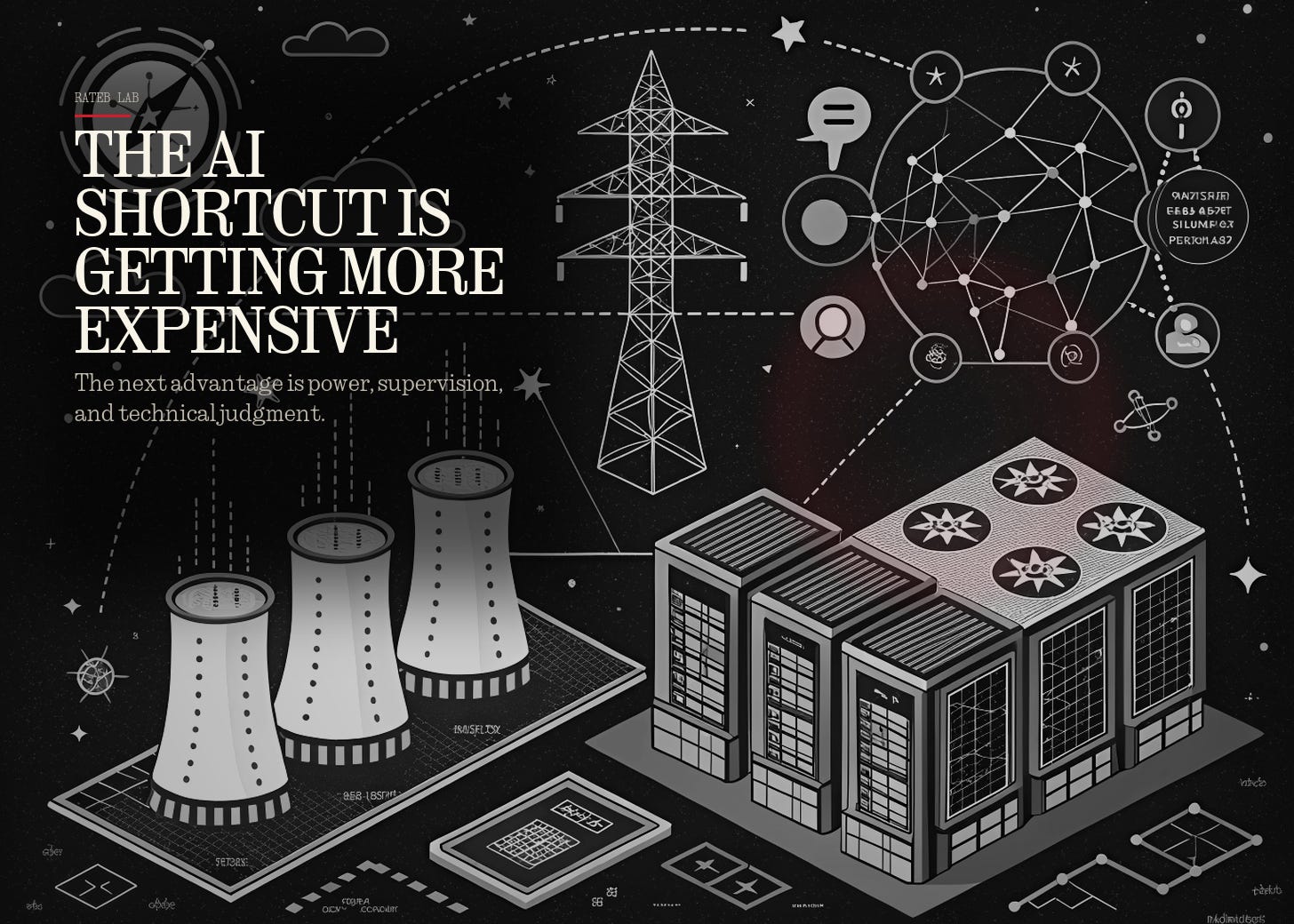
The easy version of AI says: use better prompts and you can skip the hard parts.
The useful version is less comfortable.
AI is becoming a real production system. It needs power, data centers, software guardrails, security reviews, and people who know when the machine is about to do something dangerous.
That is the part most beginners miss.
The Simple Map
The chain now looks like this:
power -> compute -> tokens -> agents -> supervised work
Power is the electricity that runs data centers.
Compute is the hardware doing the work.
Tokens are the words and actions the model produces.
Agents are software systems that use the model to take steps.
Supervised work is the human layer that checks whether those steps should happen.
The mistake is thinking the model is the whole product.
The model is only one layer in the stack.
What The All-In Discussion Got Right
The best part of the episode was not the argument about which AI lab is ahead this week.
The useful part was the stack underneath the argument.
They kept circling the same pattern:
- AI demand is high.
- Compute is scarce.
- Power is becoming the harder bottleneck.
- Coding is becoming one of the most important AI markets.
- Agents are useful, but dangerous when unsupervised.
- Cybersecurity becomes both more powerful and more exposed.
That is the real story.
AI is moving from a chatbot story to an infrastructure story.
Why This Matters For Technical Beginners
If you are learning cloud, Linux, automation, or AI tools, this is good news.
It means the future is not just prompt writing.
It means the future needs people who understand systems.
A beginner who learns only prompts is easy to replace.
A beginner who understands the stack becomes useful.
They can ask better questions:
- Where does this agent have write access?
- What happens if it deletes the wrong thing?
- What logs prove what happened?
- What permissions should be removed?
- What backup exists outside the system it can touch?
- What should require human approval?
That is technical judgment.
The Agent Problem Is Not Magic
One story in the episode was about an AI coding agent deleting production data.
That sounds like science fiction.
It is not.
It is a normal systems problem with a new interface.
The tool had too much access.
The task ran too close to production.
The destructive action did not require enough confirmation.
The backup path was not protected enough.
The agent did not know when to stop.
This is why “AI will replace all developers” is the wrong frame.
AI will replace some routine work. It will also create more need for people who can supervise, review, test, secure, and operate software.
The New Useful Skill
The valuable skill is not typing perfect prompts.
The valuable skill is building a safe work loop:
1. Define the task.
2. Limit the permissions.
3. Let the model draft.
4. Review the diff.
5. Run tests.
6. Check logs.
7. Ship only after a human accepts responsibility.
That is not glamorous.
But it is what real companies need.
What I Am Taking From This
The AI age is not making fundamentals less important.
It is making them more visible.
Cloud matters because AI needs infrastructure.
Linux matters because real systems run on servers.
Networking matters because agents touch services.
Security matters because automation multiplies mistakes.
Writing matters because someone has to explain the system clearly.
The shortcut is getting more expensive.
The path that compounds is still the same:
learn the system, build proof, use AI carefully, and become the person who can tell when the machine is wrong.
Sources
All-In Podcast transcript segment: