

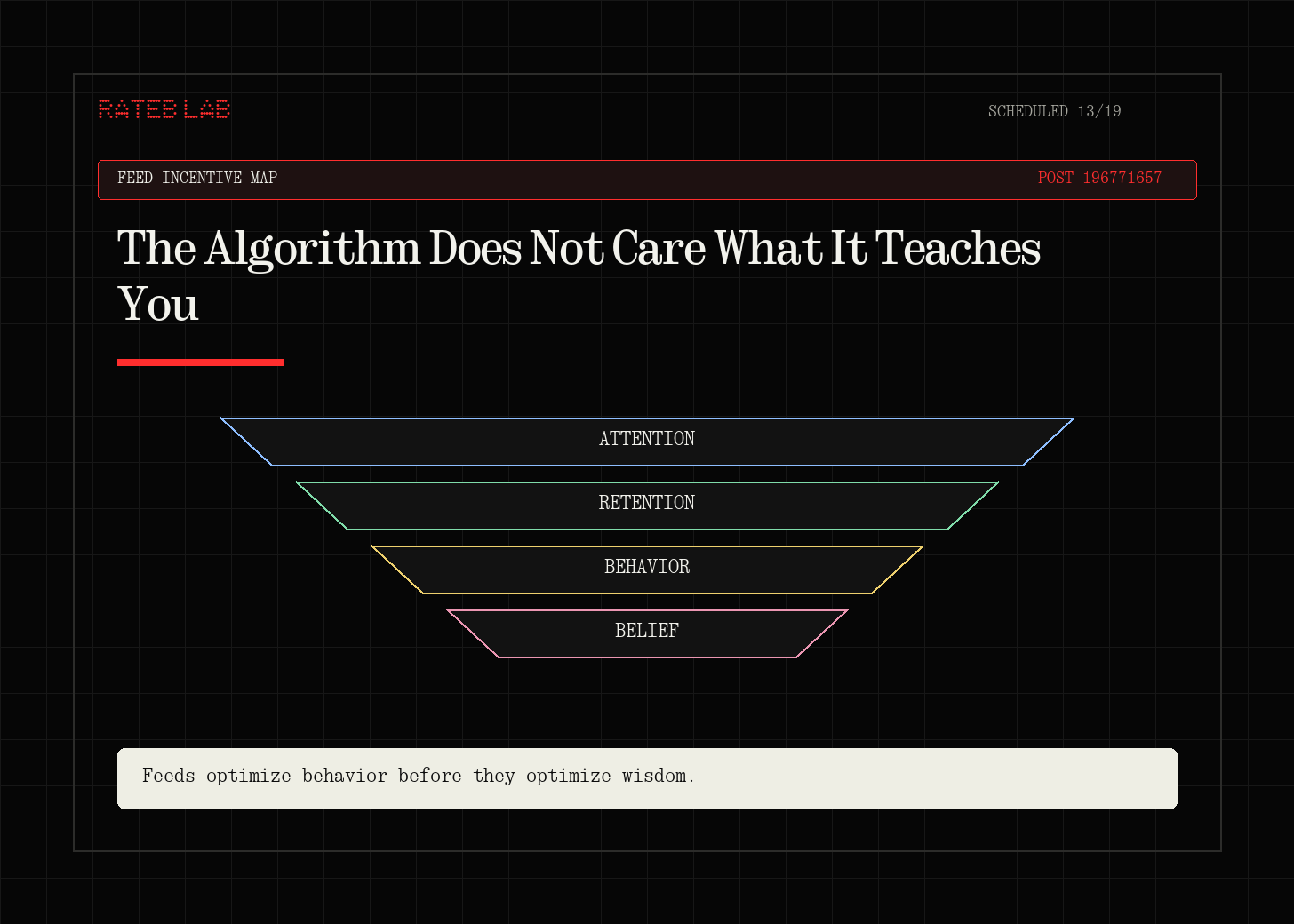
What looks like entertainment can become a quiet education system.
Every few seconds, someone opens a feed to relax.
Not to make a life decision. Not to rewire their taste. Not to learn what attraction, intimacy, or human value should look like.
Just to scroll.
But the feed is not passive.
It watches what you pause on. It measures what you replay. It learns what makes your attention stay one second longer.
And over time, it teaches you back.
That is the part most people miss.
Porn is no longer only a website you visit in private. It has leaked into the texture of normal internet life. Fitness posts. Dance trends. Music videos. Fashion content. Creator thumbnails. Dating culture. Memes. The content often stays just below the line of what platforms call explicit, but close enough to pull the eye.
This is not only a sex problem.
It is an attention problem.
It is also an incentive problem.
The Old Model Was Simple
For most of history, sexual material had friction.
You had to find it. Buy it. Hide it. Wait for it. Carry some social risk around it.
That friction mattered.
A Playboy magazine on a shelf was different from a phone in your pocket. A VHS tape was different from a recommendation engine. A late-night TV channel was different from a feed that learns your impulses in real time.
The internet removed the friction.
Then social media removed the border.
The old model was:
Porn is a separate category.
The new model is:
Pornographic incentives are mixed into everyday content.
That does not mean every attractive person online is doing something wrong. That is too simple, and it misses the bigger point.
The real issue is the system around them.
When platforms reward attention, creators learn what gets attention. When sexual signals increase engagement, the system quietly pushes more of them. Then the public adapts. What once felt extreme starts to feel ordinary.
That is normalization.
Not one speech. Not one law. Not one villain.
Just millions of small signals repeated until the culture changes shape.
The Loop
The machine is not complicated.
It works like this:
A person posts something slightly more provocative.
The post gets more views, likes, comments, saves, or watch time.
The platform reads that as success.
The algorithm shows it to more people.
Other creators notice the pattern.
The baseline shifts.
The audience becomes harder to shock.
The content moves one step further.
Nobody has to announce the rule.
The numbers announce it.
This is why the sentence "everybody does it" can be dangerous. Sometimes it means a behavior is harmless. Sometimes it means the system has trained enough people that harm starts looking normal.
The Algorithm Has No Wisdom
Recommendation systems are good at one thing:
predicting what keeps you engaged.
They are not parents. They are not teachers. They are not spiritual guides. They are not thinking about your future marriage, your self-respect, your focus, your nervous system, your teenage son, your daughter, or the person on the other side of the screen.
They do not ask:
Will this make people more connected?
They ask:
Will this make people stay?
That difference is the whole essay.
Because if sexualized content keeps people watching, the system has a reason to keep testing it.
Not because the system is evil in a cartoon way.
Because the system is blind in a profitable way.
The Human Cost Is Not Always Visible
One of the most dangerous parts of internet content is that it hides the full story.
The viewer sees the frame. The performer lives the aftermath. The platform sees the metric.
Those are three different realities.
A clip can look confident, playful, free, and profitable from the outside. That does not tell us what pressure, regret, coercion, comparison, addiction, money stress, or self-worth problems exist behind it.
It also does not tell us what is happening to the viewer.
Some people can move on with no obvious issue.
Others slowly train their desire around novelty, escalation, and distance. Real intimacy starts to feel too slow. Real people feel less stimulating than infinite strangers on a screen. The ordinary becomes harder to appreciate.
That is not a moral insult.
It is a design warning.
If you repeatedly pair arousal with endless novelty, your brain learns the pairing.
If you repeatedly pair boredom with opening a feed, your brain learns the pairing.
If you repeatedly pair loneliness with a screen, your brain learns the pairing.
The brain is not stupid.
It is adaptive.
That is exactly why we have to be careful about what we adapt to.
The Empowerment Story Is Too Thin
A lot of modern sexual content is sold with a simple story:
This is freedom.
Sometimes, for some adults, that may be how it feels.
But a serious culture has to ask a harder question:
Freedom for whom, and freedom from what?
If a young person grows up seeing attention, money, beauty, status, and sexual exposure tied together every day, is that freedom?
If a creator feels pushed to reveal more because the previous line no longer performs, is that freedom?
If a teenage audience learns intimacy from content optimized for clicks, is that freedom?
If the platform profits either way, is that freedom?
The answer cannot be a slogan.
Empowerment that depends on an attention machine is unstable. The machine does not love the creator. It does not love the viewer. It loves retention.
What This Has To Do With Technical Leverage
This may seem far from cloud, AI, Linux, and technical skill.
It is not.
The same pattern shows up everywhere in the AI age:
The tool is not neutral once incentives shape how it is used.
A recommendation system is technical infrastructure.
It decides what gets distributed. It changes what creators make. It changes what users expect. It changes the culture without asking permission.
That is why technical literacy matters.
Not because everyone needs to become a machine learning engineer.
Because everyone now lives inside systems built by engineers, product teams, growth teams, advertisers, and investors.
If you do not understand the system, you blame only yourself.
If you do understand the system, you can start making better choices.
A Small Operating System For Taking Attention Back
You do not need a dramatic identity change.
Start with friction.
Remove the easiest triggers.
Unfollow accounts that keep pulling you into the same loop. Mute words. Clear watch history where possible. Reset recommendations when the platform allows it.
Stop feeding the model.
Do not pause on content you do not want more of. Do not hate-watch. Do not open comment sections just to feel annoyed. The system counts attention before it counts intention.
Replace the loop, do not only resist it.
Boredom will ask for its old reward. Give it a better path. Walk. Read. Train. Build a lab. Call someone. Write a note. Work on a skill that makes you more useful.
Make real life more available.
Porn and feeds win when real connection feels distant, awkward, or unavailable. The answer is not only blocking content. It is rebuilding a life where the screen is not the easiest source of stimulation.
Be honest without hating yourself.
Shame can keep people trapped. Clarity gets people moving.
The question is not:
Am I a bad person?
The better question is:
What is training me, and do I consent to being trained by it?
The Better Question
The most important question is not whether you have seen sexualized content online.
Most people have.
The better question is:
Has the internet changed what you now consider normal?
That is where the work begins.
Because the algorithm does not care what it teaches you.
So you have to care.