

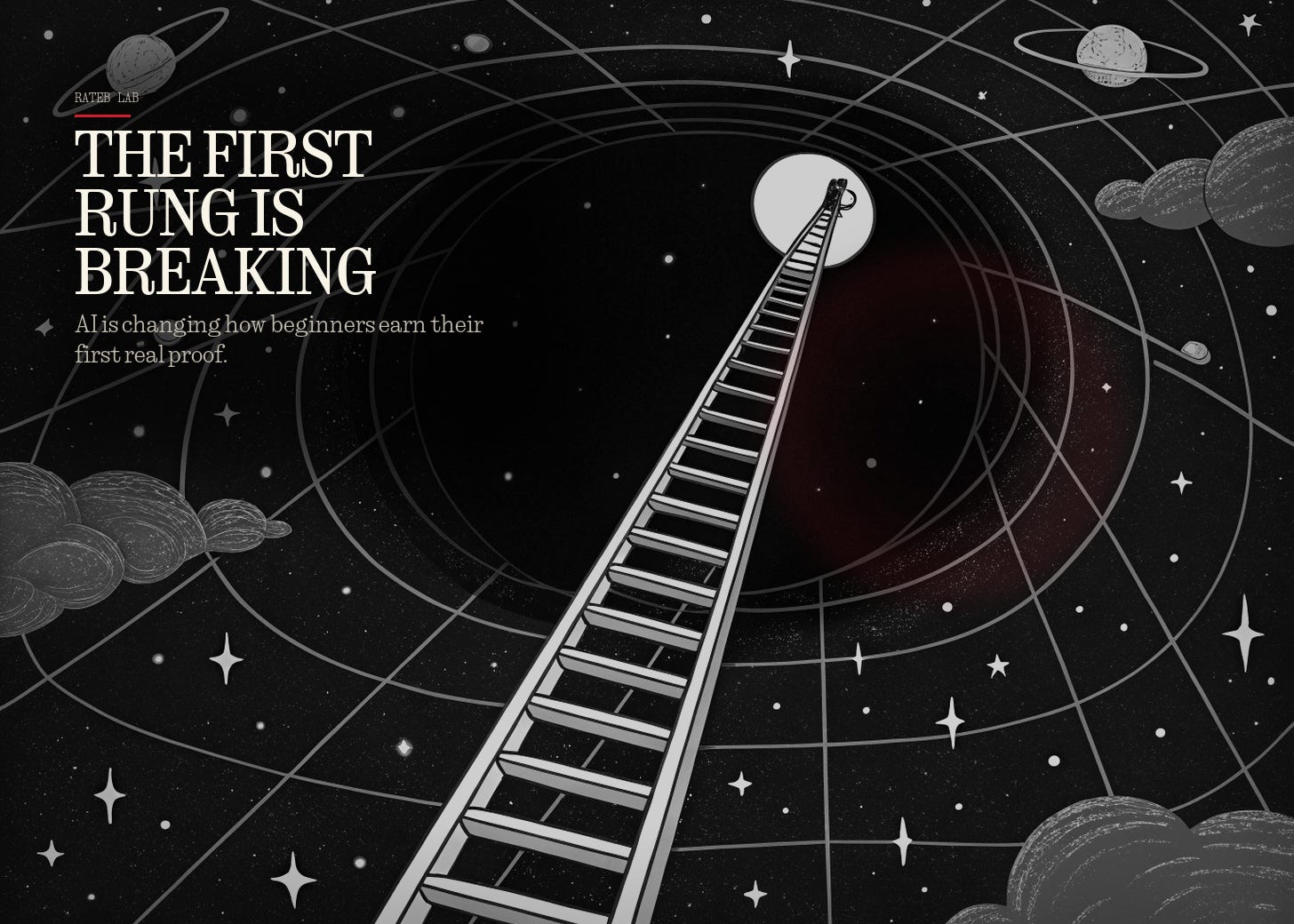
A lot of young people are not lazy.
They are looking at the world and asking a fair question:
What exactly am I supposed to climb?
The old deal was simple. Study. Get an entry-level job. Do the basic work. Learn from people above you. Slowly build judgment. Move up.
That path was never easy, but at least it had a shape.
Now the first rung is getting weaker.
AI is very good at the kind of clean implementation work that young workers often do first: writing drafts, answering simple customer questions, creating basic code, summarizing documents, preparing admin work, and turning instructions into output.
That does not mean all jobs disappear.
It means the training ground changes.
The Old Ladder
The old ladder looked like this:
school knowledge -> entry-level work -> tacit knowledge -> judgment -> leadership
School gave you book knowledge.
The first job gave you contact with reality.
You learned what clients actually mean.
You learned which details matter.
You learned how teams make decisions when the answer is not clean.
You learned the local context that never shows up in a textbook.
That is tacit knowledge: the kind of knowledge you build by doing real work around real people with real constraints.
The AI Problem
AI overlaps most with the first part of that ladder.
A Stanford Digital Economy Lab researcher described evidence that young workers in jobs more exposed to AI are seeing slower employment growth. The headline number from the interview was 16% slower employment growth for young workers in those more exposed jobs.
The important part is not the exact number.
The important part is the pattern.
Young workers often start with tasks that are easier to describe:
write this
summarize this
answer this
update this
implement this
make a first draft
follow this process
Those tasks are easier for AI to touch.
Senior workers often do more work that is harder to describe:
deciding what matters
reading the room
knowing when the process is wrong
handling messy context
managing tradeoffs
guiding people
judging whether the output is good
AI can help with pieces of that work, but it does not replace the whole human situation as easily.
So the risk is not only unemployment.
The risk is a broken apprenticeship system.
If companies hire fewer beginners because AI can do more beginner tasks, where do beginners learn the judgment that makes them valuable later?
The Normal Technology Trap
There is another mistake on the other side.
Some people talk as if AI will replace everything quickly.
That is too simple.
AI may be powerful, but power is not the same as workplace adoption.
A tool can be capable and still not be reliable enough for a customer, patient, bank, airline, or legal process. Companies still have to deal with liability, regulation, messy data, old systems, managers, budgets, and trust.
This is why “AI can do the task” does not automatically mean “AI replaces the worker.”
The better question is:
What part of the work moves up a level?
In many fields, people will spend less time doing the first draft and more time deciding what should be done, checking the work, guiding tools, and taking responsibility for outcomes.
That is good news for people who build judgment.
It is bad news for people who only wait for instructions.
The Career Lattice
The career ladder assumes one path upward.
The career lattice assumes movement:
learn -> build -> prove -> adapt -> move sideways -> move up -> repeat
This matters because AI may make career switching easier and more necessary at the same time.
If demand changes, the person who can learn fast, build small proof, explain clearly, and use AI well has more options.
That is the practical path I see for young workers and career rebuilders.
Do not only ask, “What job is safe?”
Ask better questions:
What can I build that proves I can learn?
What messy problem can I understand better than a tool?
What domain can I combine with AI, cloud, automation, writing, or operations?
What proof can I create this month?
What human judgment am I practicing?
The goal is not to beat AI at implementation.
The goal is to become the person who knows what to implement, why it matters, how to check it, and how to explain it.
The New Entry-Level Skill Stack
Here is the simple stack I would teach a young worker now.
First: tool fluency.
Use AI tools often enough that they stop feeling magical. Learn where they help. Learn where they fail. Learn how to ask better questions. Learn how to verify.
Second: technical usefulness.
Pick a practical domain: cloud, Linux, automation, data, cybersecurity, operations, sales systems, finance workflows, healthcare admin, logistics, or another field with real problems.
Do not only collect courses.
Build small useful things.
Third: public proof.
Turn learning into visible artifacts:
a small project
a diagram
a case study
a before-and-after workflow
a troubleshooting note
a short explanation for someone one step behind you
Fourth: judgment.
Practice deciding what matters.
This is the skill AI makes more important. When output gets cheaper, taste, context, and responsibility become more valuable.
Fifth: resilience.
Young people are dealing with real pressure: housing, food, debt, weak institutions, noisy media, and the fear that the game is already full.
So the answer cannot only be “learn Python.”
The answer also includes financial literacy, frugality, emotional support, mentors, family runway when possible, and learning how to live without being captured by consumer pressure.
What Parents and Mentors Can Do
If you are helping someone younger, the first job is not to shame them for being worried.
Some of the worry is rational.
But worry without action becomes a trap.
The useful support is practical:
listen before giving advice
help them build a small project
teach budgeting and debt basics
create room for low-paid early experience if you can
introduce them to serious adults
reward effort, not status
help them publish proof instead of only chasing credentials
The point is not to protect them from reality.
The point is to help them meet reality with better tools.
My Working Rule
I am using this rule for myself:
Do not build a career around tasks AI can do from a clean prompt.
Build around the work before and after the prompt.
Before the prompt:
choose the problem
understand the context
decide what matters
define the constraints
After the prompt:
verify the output
improve the system
explain the tradeoff
take responsibility
turn the lesson into proof
That is where the human work is moving.
The Next Rung
The future is not clear enough for simple predictions.
AI may move slowly in some places because organizations are slow.
It may move brutally fast in others because the task is easy to automate.
Both can be true.
So the practical move is not panic.
It is to stop depending on the old ladder as the only path.
Build the lattice.
Learn the tools.
Develop judgment.
Create visible proof.
Keep your cost of living sane.
Find people who are actually building.
The first rung may be breaking.
That does not mean there is nowhere to climb.
It means the climb now has to be designed.