

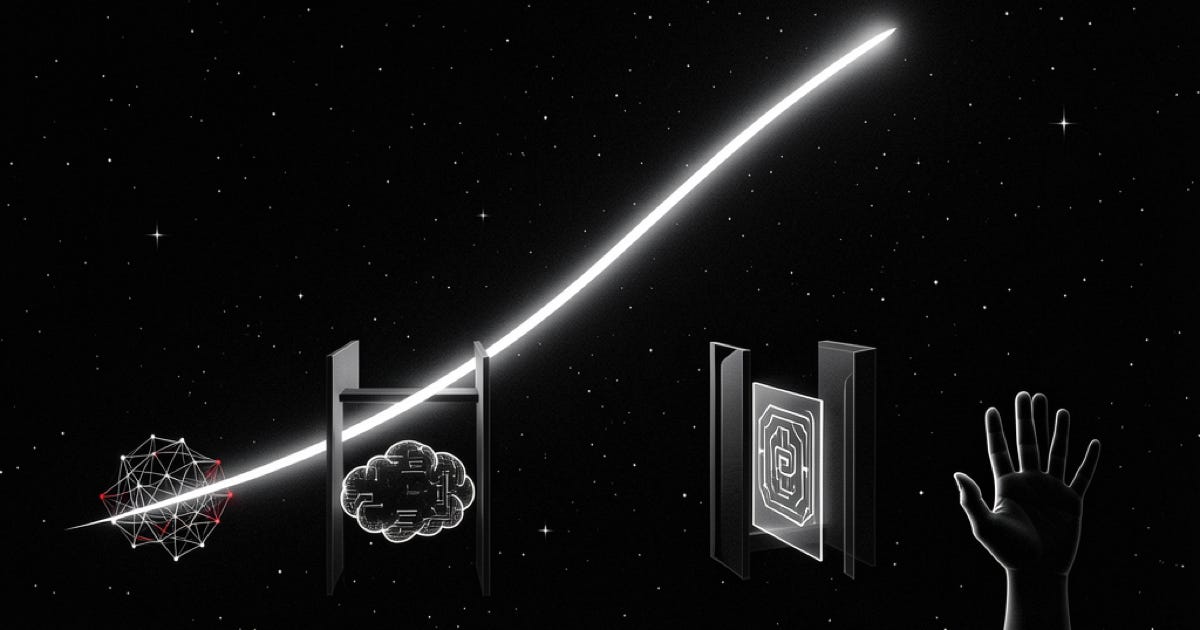
I have become more suspicious of confident dates.
Not because forecasting is useless. Because dates make the future feel cleaner than it is.
They turn a system into a countdown. They make us ask whether a prediction landed on Tuesday instead of asking what was actually changing underneath it.
That is a bad way to read technology.
The future rarely arrives as one machine walking through the door. It arrives when a few ordinary things become cheap, connected, capable, and reliable at the same time.
A computer gets small enough to stay in your pocket. Networks get fast enough to feel invisible. Cameras become good enough to replace a separate device. Storage becomes cheap enough to keep everything. Software becomes useful enough that people reorganize their lives around it.
Then one day we call it a smartphone and pretend it was obvious.
It was not obvious while the pieces were still separate.
That is the part I keep thinking about while learning AI now. The most important question is not whether a model can do an impressive thing in a demo. It is whether the surrounding system has crossed the threshold that makes the capability dependable in real work.
Can it access the right information? Can it act within the right permissions? Can someone evaluate the output? Can the result be corrected when it fails? Can a real person explain who owns the consequence?
Without those answers, a capability is still only a possibility.
The curve is real. The calendar is fragile.
There is a useful difference between a direction and a deadline. A direction says that computing, networks, translation, accessibility tools, digital media, and machine assistance are becoming more available. A deadline says that all of the hard parts will be solved by a particular date. That requires much more humility. The first kind of forecast notices a system. The second often mistakes a story for evidence.
We are living through this distinction now. AI can write, translate, search, summarize, code, and generate images at a level that would have seemed unreal only a few years ago. But a model being fluent is not the same as a system being reliable. The curve can be real while the calendar remains fragile.
What actually compounds
The easiest version of the AI story is that models get smarter and humans get replaced. The more useful version is that several loops are becoming cheaper at once. Compute gets more capable. Models get better. Tools become easier to connect. Data becomes easier to search. Interfaces become less technical. A small team can test more ideas before lunch than a larger team could test in a month.
But cheap generation is not the same as good judgment. A model can create twenty options. It cannot tell you which option fits your life without someone having designed a way to evaluate those things.
I think this is where the human role becomes clearer, not smaller. The work moves away from producing the first draft of everything toward choosing the problem, setting the constraints, checking the result, noticing the failure, and deciding what should happen next.
The bottleneck is part of the forecast
Every serious forecast needs a bottleneck. If you only name the capability that is improving, you are describing a wish. AI can get better while the real limitation is bad data. A cloud workflow can be elegant while permissions are messy. The bottleneck may be energy, cost, regulation, safety, adoption, trust, training, or the simple fact that the physical world does not update at software speed.
This matters because it protects us from two opposite mistakes. The first is complacency. We look at a rough early version and assume it will stay rough forever. The second is prophecy. We see a powerful demo and assume every missing piece will solve itself on schedule. Both mistakes come from looking at one part of the system.
A better way to read the next big claim
When I hear a new prediction about AI, automation, robots, or work, I want to ask four questions.
What is actually getting cheaper or more capable?
What feedback loop makes the next improvement easier?
What constraint could slow or redirect the curve?
Who evaluates the result and owns the consequence?
Those questions do not make the future predictable. They make you harder to impress with noise. They also make you more able to see a real shift before it becomes a headline everyone repeats.
The point is not to become a prophet. It is to become a better observer. The future will keep surprising us. But the people who understand the loops, the bottlenecks, and the responsibility boundaries will be less likely to confuse a date with a destination.