

There is a specific kind of purchase that feels intelligent while you are making it.
It sounds like this:
“I’ll buy the better one now so I don’t have to think about it later.”
“I’m going to grow into it.”
“If AI keeps moving this fast, I’ll need the power.”
“It’s expensive, but it’s future-proof.”
That phrase — future-proof — is where the trap begins.
Not because buying high-quality tools is bad.
Not because powerful machines are useless.
Not because creators, builders, editors, developers, and operators should all work on the cheapest possible setup until they suffer.
The trap is subtler than that.
Future-proofing lets you buy relief and call it strategy.
It lets you pay for the feeling that you are already the kind of person whose work demands the best gear: the stronger MacBook, the bigger GPU, the better camera, the annual SaaS plan, the automation platform, the AI tool bundle, the “creator operating system” you have not actually used yet.
You are not just buying a tool.
You are buying a version of yourself.
And sometimes that version is real.
But often, it is aspirational.
That is the expensive part.
The $8,700 lesson
I watched a video recently with a clean emotional premise.
A creator bought a maxed-out M3 Max MacBook Pro in 2023 for about $8,700.
At 0:23, he says he believed he was buying time. What he actually bought was two and a half years.
That line matters because it turns a spec decision into a psychological decision.
The machine had a 16-core CPU, 40-core GPU, 128 GB of unified memory, and 8 TB of storage. At 5:20, he explains why the logic felt sound: the memory felt like insurance for AI-assisted workflows, and the GPU cores felt like headroom for heavier video work.
This is exactly how creators justify overbuying.
Every upgrade has a reason.
Every reason sounds rational.
Then the future arrives.
At 5:41, the baseline M5 Max appears two and a half years later at $3,599. In the creator’s benchmark comparison, it beats the older maxed-out machine in key performance areas at less than half the price.
The painful part is not that technology improved.
Technology always improves.
The painful part is what happens later in the video.
At 8:42, he says the M3 Max was an excellent machine. He used it hard. He never ran out of memory. He never saturated the GPU. He never needed 8 TB of local storage.
That is the real lesson.
The machine did not fail.
The buying logic failed.
He bought against an imagined future workflow instead of a demonstrated present bottleneck.
AI made this trap worse
AI creators and builders are especially vulnerable to this.
Because AI makes the future feel close.
Every week, there is a new model, a new workflow, a new agent framework, a new video tool, a new image generator, a new coding assistant, a new local inference benchmark, a new “must-have” stack.
So the mind starts forecasting.
“I should get more RAM because local models are coming.”
“I should buy a GPU box because I’ll probably need to fine-tune.”
“I should upgrade to the highest MacBook because I’ll be editing AI video.”
“I should pay annually for this automation tool because I’m going to build a content engine.”
“I should buy the camera setup now because I’m going to take YouTube seriously.”
“I should subscribe to five AI tools because each one might become central.”
The word “might” does a lot of damage.
It turns possibility into expense.
It converts identity into infrastructure.
And for creators, this is extra dangerous because the tool often looks like the work.
Buying the camera feels like becoming a video creator.
Buying the GPU feels like becoming an AI builder.
Buying the automation stack feels like becoming an operator.
Buying the expensive laptop feels like becoming serious.
But the market does not reward possession.
It rewards shipped work.
Your audience does not care how much unused headroom your machine has.
Your customers do not care how clean your automation diagram looks.
Your future self does not need you to prepay for every possible direction.
Your future self needs liquidity, optionality, and proof.
The emotional bargain
Most overbuying does not come from stupidity.
It comes from fear.
Fear of being blocked later.
Fear of looking unserious.
Fear of missing the window.
Fear of choosing wrong.
Fear that if you do not buy the “best” version now, you are admitting you are not actually committed.
This is the emotional bargain of future-proofing:
You pay more now so you can stop feeling uncertain.
That is why it feels so rational.
The spreadsheet says:
“More RAM equals longer useful life.”
“More storage equals fewer constraints.”
“More cores equals better performance.”
“Annual plan equals savings.”
“Pro tier equals serious user.”
But underneath the spreadsheet, the nervous system says:
“I don’t want to feel limited.”
“I don’t want to make the wrong choice.”
“I want the tool to confirm the identity before the work has confirmed it.”
That is the part worth noticing.
A lot of creators do not buy tools for what they are doing.
They buy tools for who they hope the tool will force them to become.
Sometimes that works.
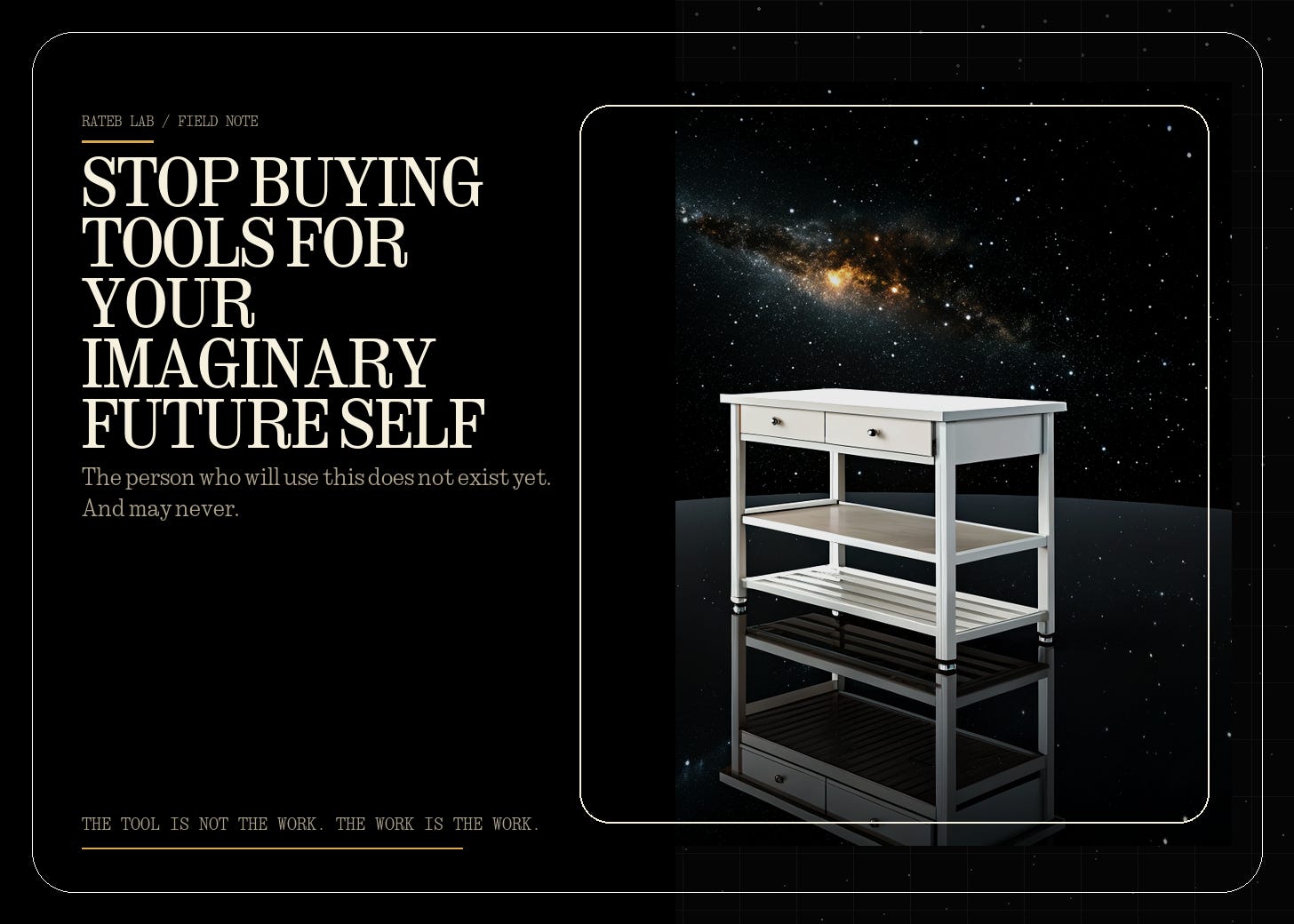
Most of the time, the tool quietly becomes expensive furniture.
The daily difference test
At 9:36, the video gives the most useful detail for creators.
In daily editing, grading, and exports, the difference between the machines is almost invisible.
The M3 Max did not struggle.
The M5 Max does not struggle either.
The gap appears in benchmarks, but the daily workflow does not feel transformed.
This is where many tech purchases collapse.
A benchmark can prove one machine is faster.
It cannot prove the upgrade matters to your actual day.
A machine can reduce an export from seven minutes to four minutes.
That matters if you export all day.
It may not matter if you export twice a week and spend most of your time deciding what to make.
A bigger GPU can be meaningful if local compute is your real work.
It may be irrelevant if your bottleneck is writing, taste, offer clarity, editing judgment, distribution, or consistency.
A paid AI tool can be worth every euro if it sits inside a repeated workflow.
It may be waste if it is attached to a fantasy workflow you have not run manually once.
The question is not:
“What is faster?”
The question is:
“What changes in my daily output?”
The identity premium
At 11:04, the creator admits something very human.
Even after learning the lesson, he bought the M5 Max again, while acknowledging that the M5 Pro probably would have covered everything he actually does.
That detail makes the video stronger.
Because the lesson is not delivered from a place of perfect discipline.
It shows how strong identity-based buying is.
The data says one thing.
The story says another.
“I’m the kind of person who needs the Max.”
“I’m serious.”
“I don’t want to be limited.”
“I’ll grow into it.”
That sentence is expensive.
For AI creators, the same pattern shows up everywhere.
“I’m the kind of builder who needs local models.”
“I’m the kind of creator who needs the best camera.”
“I’m the kind of operator who needs the full automation suite.”
“I’m the kind of founder who needs enterprise tooling.”
Maybe.
But identity is not evidence.
A real bottleneck has a paper trail.
The better rule: upgrade on evidence
The alternative is not minimalism.
The alternative is evidence-based upgrading.
You are allowed to buy powerful things.
You just need the work to testify first.
A good upgrade has a trail:
You are exporting videos every day and render time is costing publishing velocity.
You are running local models often enough that cloud inference becomes expensive or operationally annoying.
You are hitting memory pressure during real projects, not hypothetical ones.
Your camera is limiting paid work because clients need specific production quality.
Your SaaS stack saves measurable hours every week.
Your automation tool is attached to a process that already exists manually.
Your AI subscription produces revenue, distribution, learning, or reusable output.
That is different from “I might need it.”
The better question is:
“What evidence says I need this now?”
The bottleneck audit
Before buying, audit the actual bottleneck.
Not the imagined bottleneck.
The actual one.
Ask:
What part of my workflow is slow, painful, expensive, or quality-limiting right now?
How often does this bottleneck happen?
What does it cost me when it happens?
Have I measured it, or am I guessing?
Is the bottleneck caused by the tool, or by my process?
Is there a cheaper workaround?
Would renting, cloud usage, outsourcing, or a temporary subscription solve it first?
If I buy this, what output will increase within 30 days?
What would prove this purchase was unnecessary?
Can I resell it or cancel it easily if I’m wrong?
That last question matters.
Future-proofing often ignores liquidity.
It assumes the future will validate the purchase.
But the future does not owe you that.
So you want exits.
Buy tools that can be resold.
Prefer monthly plans until the workflow is proven.
Avoid annual subscriptions for workflows you have not repeated.
Do not build a cathedral of software around a habit you have not formed.
Keep your stack liquid until your work becomes stable.
Utilization proof
Here is a simple mechanism:
Do not upgrade until you can show utilization proof.
For hardware, that might mean:
CPU, GPU, RAM, or storage limits are repeatedly hit during real work.
Export or processing time is delaying actual shipping.
The machine is crashing, throttling, or blocking paid work.
You can name the exact task that would improve.
For AI tools, that might mean:
You use the tool at least three to five times per week.
It is attached to a recurring workflow.
It saves measurable time or improves measurable output.
You would notice immediately if it disappeared.
You have created something with it that shipped.
For SaaS subscriptions, that might mean:
The manual process already exists.
The tool replaces repeated labor, not imagined labor.
The monthly cost is lower than the value of the time saved.
A free or cheaper tier has already been exhausted.
The workflow survives for at least 30 days before you pay annually.
For cameras and creator gear:
You are already publishing.
You know what visual/audio limitation is hurting the work.
The upgrade solves a specific production constraint.
You have tested cheaper fixes first: lighting, framing, scripting, audio, editing.
The purchase increases consistency, not just aesthetic pride.
The point is not to punish yourself.
The point is to stop confusing potential with need.
Workflow-first purchasing
There is a simple order that saves creators a lot of money:
Prove the workflow manually.
Repeat it enough to find friction.
Measure the friction.
Try the smallest fix.
Upgrade only when the bottleneck persists.
Keep the option to exit.
Most people reverse this.
They buy the stack first, hoping the workflow will appear.
They buy the serious camera, hoping the publishing habit will appear.
They buy the premium AI tool, hoping the business model will appear.
They buy the maxed-out machine, hoping the future workload will appear.
But workflows do not come from tools.
Workflows come from repeated behavior under real constraints.
A tool can amplify a workflow.
It cannot replace one.
A better version of future-proofing
The answer is not to stop thinking about the future.
The answer is to future-proof differently.
Future-proof your skills.
Future-proof your distribution.
Future-proof your ability to learn new tools quickly.
Future-proof your cash position.
Future-proof your taste.
Future-proof your archive.
Future-proof your relationships.
Future-proof your ability to ship without perfect conditions.
These compound better than specs.
A maxed-out machine loses relative status the moment the next chip arrives.
A strong workflow survives the next product cycle.
A clear bottleneck audit survives hype.
A creator with liquidity can adapt.
A creator with unused gear has already spent the option.
Final reflection
The $8,700 M3 Max story is useful because it shows the emotional shape of the mistake.
The machine did not fail.
The logic failed.
The future arrived, as it always does, and made the future-proof purchase feel less permanent than expected.
That is what happens with hardware.
That is what happens with AI tools.
That is what happens with software stacks.
You cannot buy your way out of change.
You can only buy against the work in front of you.
So the next time you feel the pull to max out the configuration, upgrade the plan, buy the rig, add the subscription, or build the perfect automation stack, pause for one question:
Am I buying a solution to a bottleneck, or am I buying relief from uncertainty?
If it is the first, buy well.
If it is the second, wait.
Let the work create the need.
Then upgrade without drama.
That is not underinvesting.
That is respecting the difference between ambition and evidence.