

Most people imagine AI risk as a dramatic event.
A model gets too powerful. A company loses control. A system makes a decision nobody understands. Something breaks in public.
Those risks matter. I do not want to minimize them.
But I keep thinking about a quieter risk because it is already familiar.
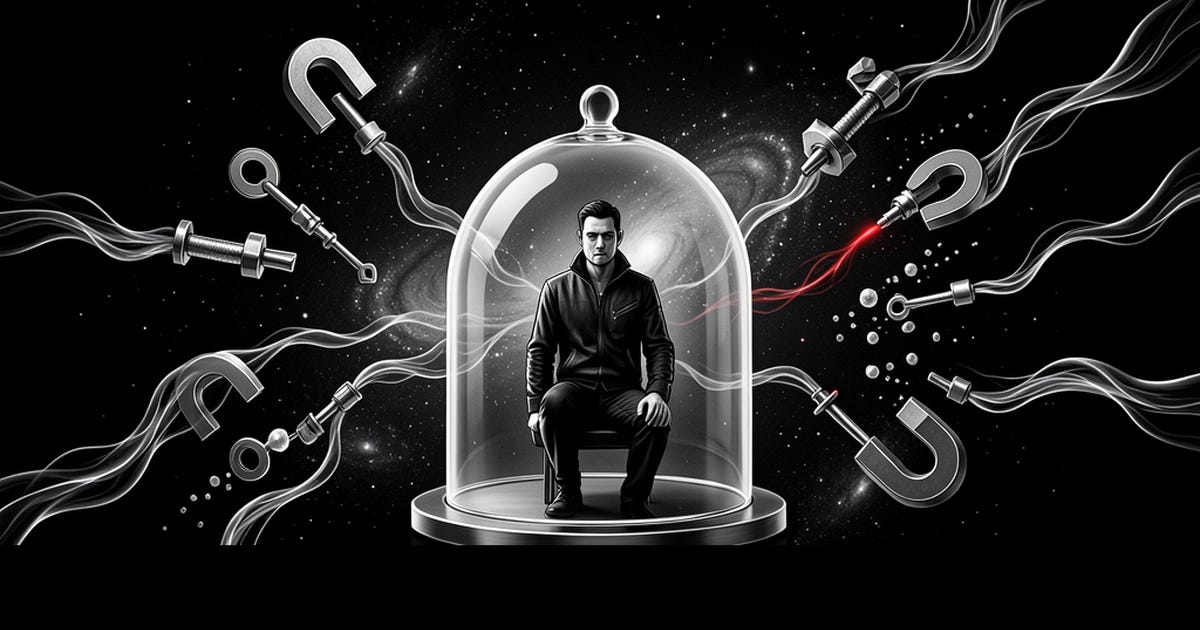
Systems do not need to hate you to shape you. They only need to reward certain behavior long enough.
A feed does not hate your attention. It just learns what keeps you scrolling.
A platform does not hate your patience. It just rewards novelty faster than depth.
A tool does not hate your judgment. It just makes the easiest path feel like the smartest path.
This is the incentive layer. And AI makes it more important, not less.
The wrong map: find the enemy
The simple story says there is an enemy.
The model. The company. The algorithm. The bad actor. The platform. The new tool.
Sometimes there really is a bad actor. Sometimes the company incentive is ugly. Sometimes the tool is designed in a way that deserves criticism.
But if we only look for a villain, we miss the more ordinary mechanism.
A system can manipulate without one evil person sitting there plotting your life.
It can do it through defaults.
Through ranking.
Through convenience.
Through friction in the wrong place and ease in the dangerous place.
Through making the reactive action feel natural and the deliberate action feel slow.
The better map: inspect what the system rewards
The better question is not only: is this tool good or bad?
The better question is: what does this tool train me to repeat?
Does it reward speed over understanding?
Does it reward confidence over checking?
Does it reward novelty over memory?
Does it reward volume over taste?
Does it make me more deliberate, or does it make reaction feel like intelligence?
That question changes the whole conversation.
You stop treating attention like a personal discipline problem only. You start treating attention like part of the system design.
The mechanism: attention becomes the attack surface
In security, an attack surface is the set of places where a system can be touched, probed, tricked, or broken.
In the AI age, attention becomes part of that surface.
Not because every distraction is an attack.
Because attention is where judgment enters the system.
If your attention is fragmented, your review gets weaker. If your review gets weaker, AI output becomes harder to inspect. If AI output is harder to inspect, the fastest answer starts replacing the best answer.
That is how a bad incentive layer compounds.
First it changes what you notice.
Then it changes what you repeat.
Then it changes what feels normal.
Eventually the default becomes invisible.
The field note: discipline is too small a word
I used to think of attention mostly as discipline.
Focus harder. Avoid distractions. Put the phone away. Stop checking things. Be more serious.
There is truth there, but it is incomplete.
Discipline matters, but environment decides how much discipline is required.
If every tool around you is optimized for novelty, interruption, and instant production, then attention is not only a personal virtue. It is an infrastructure problem.
This matters for anyone learning cloud, AI, Linux, or technical work.
Technical learning needs slow attention. You have to sit with an error. You have to read the documentation. You have to compare two options. You have to notice that a command worked for the wrong reason.
If the incentive layer keeps pulling you toward fast confidence, you may feel productive while your judgment gets thinner.
Why this matters for technical learners
Technical learning is vulnerable to bad incentives because progress is hard to feel in the beginning.
A real learning session can feel slow. You read one page of documentation. You misunderstand a concept. You run a command. It fails. You search. You fix one small thing. You end the session with more questions than answers.
A feed feels better than that. A thread gives you a clean lesson in thirty seconds. A tool gives you a fluent answer instantly. A video makes the concept feel easy while someone else is doing the work.
None of those things are automatically bad. I use them too.
The problem starts when the reward loop trains you to prefer the feeling of learning over the friction of learning.
That is why attention is not a side issue. It decides whether the technical work gets deep enough to become yours.
If AI makes the shallow version easier, then protecting attention becomes part of protecting skill.
A small audit for your own incentive layer
Look at one tool you use every day and ask what behavior it rewards. Speed, clarity, depth, checking, novelty, volume, or status.
Change one default that makes you reactive. Move the input, remove the notification, slow the feed, or add a review step.
Before using AI for a task, write what good means. This protects your attention from accepting the first fluent answer.
Keep one slow practice in your day. Reading, lab work, writing, debugging, or note review. Repetition builds the person more than novelty does.
Notice your state after the tool. If you are faster but more scattered, that is a signal.
Final reflection
AI is not automatically the enemy.
But bad incentives are not neutral just because they are invisible.
They shape what we notice, what we repeat, and what we become willing to accept.
The practical move is not panic.
It is to make the incentive layer visible again.
Once you can see what the system rewards, you can decide whether you want to keep training yourself that way.