

A recent documentary about DMT ends with a researcher saying that the world we see is not necessarily the same world that is truly out there. Our brains construct the world we experience.
That sounds abstract until you look at normal life.
A fear appears, and suddenly the future has a shape.
A rejection arrives, and suddenly your identity has a verdict.
A hard technical topic shows up, and suddenly your mind says, this is not for people like me.
Nothing external has been fully proven yet. But internally, the model is already complete. It has scenery. It has emotion. It has a story. It has a conclusion.
That is the scary part.
Not that the mind can hallucinate under extreme conditions.
That the mind is always building.
Your brain is not a camera
The beginner mistake is thinking perception works like a camera.
There is the world outside. There are the eyes. There is the brain. The brain receives the picture.
But that is too simple.
A better frame is that the brain is constantly building a working model. It takes in signals from the outside world, mixes them with memory, emotion, expectation, threat, desire, and pattern recognition, then produces an experience that feels immediate.
Most of the time, this is useful. Without a model, life would be impossible. You could not cross a street, understand a face, learn a command line, sense danger, or choose what matters.
The problem begins when the model gets confused for the world.
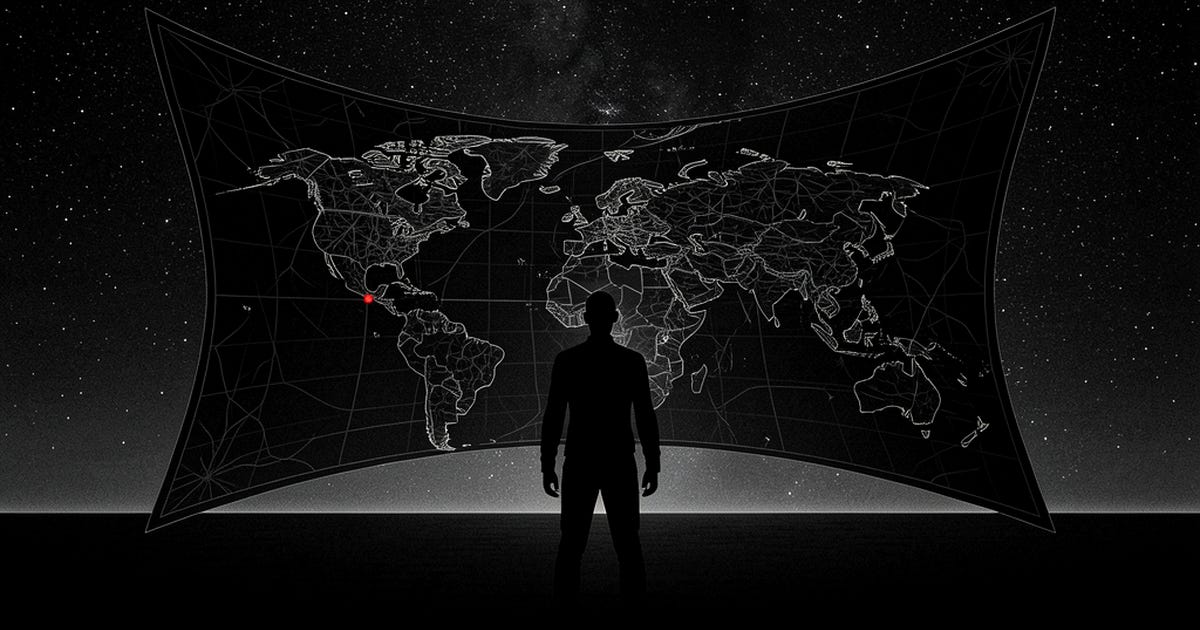
A map is useful because it simplifies reality. But if you forget it is a map, you start defending the simplification as if it were the territory.
This is where the DMT story becomes useful without becoming the point.
DMT can create experiences that feel more vivid than ordinary life: entities, tunnels, cosmic spaces, spiritual encounters, terror, love, beauty, and a sense of crossing some boundary. The documentary is careful not to pretend science has solved all of this. That caution matters.
The practical lesson is smaller and more useful:
If the brain can build a world that convincing under unusual conditions, then I should be more humble about the worlds it builds under ordinary pressure.
Intensity is not evidence
One of the most dangerous things about human experience is that intensity feels like proof.
If a thought is loud, we call it true.
If a fear returns every morning, we call it intuition.
If shame feels heavy, we call it identity.
If a plan feels exciting, we call it destiny.
If a tool feels powerful, we call it strategy.
But intensity is only intensity. It tells you something is activated. It does not tell you whether the model is accurate.
This matters a lot in technical life.
When I am learning cloud, Linux, AWS, or AI workflows, I often notice the same pattern. The hard part is not only the concept. The hard part is the private model that appears around the concept.
This is too much.
I am behind.
Other people understand this faster.
I should have started years ago.
Maybe I am not technical.
Those thoughts can feel like information. But often they are just an old model reacting to uncertainty.
A command fails. A lab breaks. A job application gets ignored. An AI tool gives a confident answer that does not work. The mind rushes to build a world around the event.
The world might say: one command failed.
The model says: you are not built for this.
Those are not the same thing.
More connection is not always more truth
The documentary explains one idea in simple terms: under DMT, normal control and filtering can loosen. Parts of the brain that do not usually communicate as strongly may begin exchanging more signal. The result can feel like a flood of perception.
I do not want to overstate the neuroscience. The useful systems lesson is enough.
A system can become more connected and less reliable at the same time.
This is true in the mind.
It is also true in work.
If every signal talks to every other signal with no filter, you do not automatically get wisdom. You may get noise, false patterns, panic, and strange certainty.
That is why good systems need orchestration.
A cloud architecture needs boundaries.
An AI workflow needs evaluation.
A writing system needs taste.
A learning system needs review.
A nervous system needs recovery.
A human life needs reality checks.
The goal is not to feel everything more intensely. The goal is to build enough structure that signal can become judgment.
This is where I think many people misunderstand self-improvement and AI.
They chase stronger states.
More motivation. More inspiration. More tools. More prompts. More information. More tabs. More intensity.
But intensity without filtering creates a bigger maze.
The better question is not, how do I feel something more strongly?
It is: how do I test what I am feeling before I obey it?
The self is a model too
The most uncomfortable implication is that the self is not as fixed as it feels.
There are facts about us, of course. We have histories, constraints, bodies, skills, mistakes, patterns, and responsibilities.
But the story built around those facts can become outdated.
I see this often in career rebuilding.
Someone has a non-linear background, so the model says: I am late.
Someone struggles with a technical topic, so the model says: I am not technical.
Someone uses AI to learn faster, so the model says: maybe I am cheating.
Someone starts publishing what they learn, so the model says: who do you think you are?
The model speaks with authority because it has been rehearsed for years.
But repetition is not proof.
A self-model can be useful for a season and then become a prison.
This is why human agency is not only about discipline. It is about inspection.
Before I can act differently, I need to notice the model I am acting from.
A simple reality-testing loop
When a thought feels too complete, I want to slow down and test it.
Here is the loop I keep coming back to.
1. Name the model.
Not the event. The model.
The event might be: I failed to understand this AWS concept today.
The model might be: I am not technical enough for this path.
If I cannot name the model, I will obey it unconsciously.
2. Separate signal from story.
Signal: what happened?
Story: what did my mind build around it?
A failed command is signal. A permanent identity verdict is story.
3. Ask what evidence would change the model.
If no evidence could change it, I am not dealing with judgment. I am dealing with a belief that has stopped accepting feedback.
That is dangerous in learning, work, relationships, and AI.
4. Run a small test.
Do not try to solve the whole identity.
Run one lab. Ask one better question. Rebuild one broken command. Explain one concept in plain English. Send one application. Publish one field note. Compare the prediction with the result.
Reality testing needs contact with reality.
5. Update slowly.
The goal is not to flip from fear to confidence in one day.
The goal is to become a person who updates.
That is a quieter form of strength.
The AI version of the same problem
This is also why AI work keeps bringing me back to judgment.
A model can produce something that feels complete before it has earned trust. It can sound fluent, structured, and confident while hiding a wrong assumption. If I accept that output because it feels finished, I am repeating the same human mistake in technical form.
The answer is not to reject the tool.
The answer is to add evaluation.
Ask where the answer came from. Check the command. Read the error. Compare the claim against a real document, a real system, a real test, or a real result.
That habit is not only for machines. It is for me.
If my own mind gives me a confident model under stress, I should treat it the same way I treat a confident AI answer: useful enough to inspect, not trustworthy enough to obey without checking.
The practical lesson
The DMT documentary is strange because it shows the mind at an extreme edge.
But the lesson I took from it is ordinary.
Every day, the brain builds a world.
Some of those worlds help us act.
Some help us learn.
Some protect us.
Some trap us.
The work is not to distrust the mind. That would become its own prison.
The work is to respect the mind enough to test it.
A thought can be useful without being final.
A fear can be protective without being accurate.
A self-image can be familiar without being true.
A model can guide you without becoming your world.
That is the discipline I want more of in my own life: not blind confidence, not endless doubt, but contact.
Contact with the command that failed.
Contact with the conversation I am avoiding.
Contact with the evidence I have not checked.
Contact with the work that will tell me whether the model is real.
The map in my head matters.
But it is still a map.
And if I want more agency under uncertainty, I have to keep walking back to the world.