

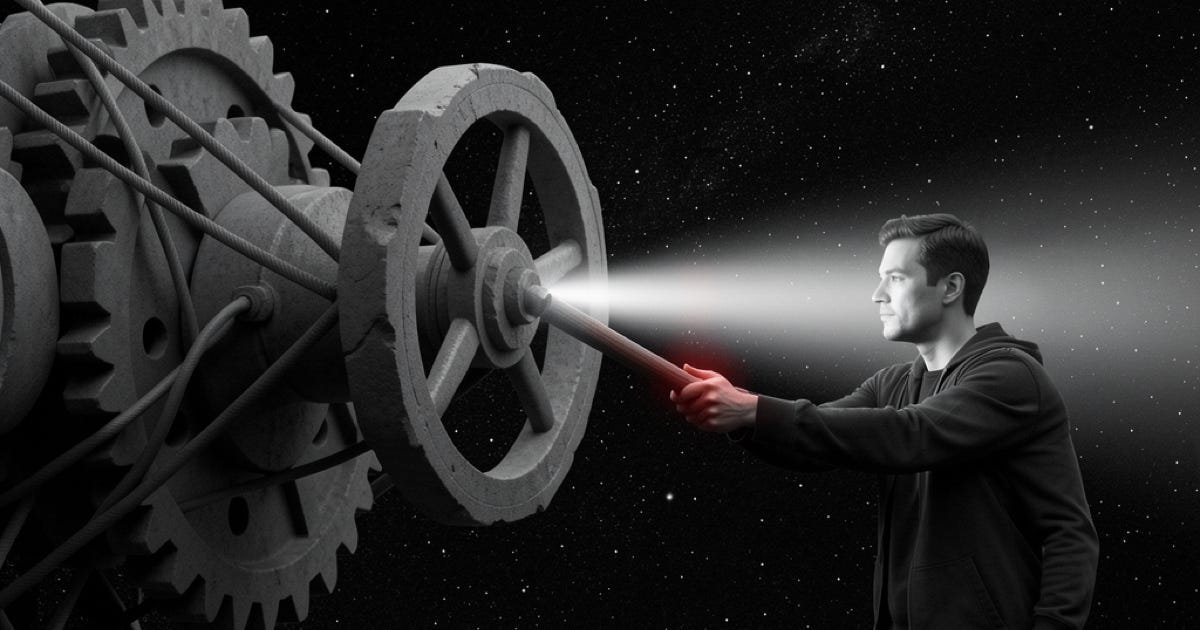
Men and women can differ on average without every person fitting the average. Biology can influence us without excusing us. The mature position is harder than denial and harder than destiny.
I have become suspicious of any argument about men and women that demands I choose between two bad options.
The first option says there are no meaningful psychological differences between the sexes, or that noticing them is automatically dangerous.
The second says the differences explain everything, define every individual, and justify whatever behavior follows.
I do not believe either one.
The first asks me to distrust uncomfortable patterns before I examine them. The second asks me to surrender judgment to those patterns after I notice them.
One turns equality into sameness. The other turns nature into destiny.
Both positions remove something important from the individual.
For me, the more useful position is also the more demanding one:
Men and women can differ on average without every man or woman fitting the average. Biology can influence behavior without issuing moral instructions. Culture can shape an inherited tendency without creating it from nothing. Understanding an impulse can make us more responsible for governing it, not less.
That is the position I want to explore, especially as a man.
Not because men need another story that flatters us.
Because we need a model that asks more of us.
The map is not the person
The first distinction is simple, but public arguments constantly destroy it.
A group average is not an individual diagnosis.
Imagine two distributions that overlap heavily, with one average sitting a little higher than the other. The difference can be real at the population level while telling you very little about the two people standing in front of you.
That matters.
If men are, on average, more physically aggressive or more willing to take certain risks, it does not follow that every man is aggressive or that a particular woman is less willing to take risks than a particular man.
If women are, on average, more interested in people and men more interested in things, it does not tell you what career one specific person should choose.
The overlap is not an inconvenience. It is part of the truth.
Averages can help explain broad patterns. They become destructive when we use them as scripts for individuals.
This is where two ideas that look opposed actually belong together.
We should be able to study average differences honestly.
And we should let people be themselves.
Those principles do not cancel each other. They protect each other.
Good science prevents us from pretending every pattern is imaginary. Individual freedom prevents us from turning a pattern into a cage.
Equality is a moral claim, not a sameness claim
I care about equality because people have equal human worth, not because every measurable trait must have the same average in every group.
Those are different claims.
Equal dignity does not require identical psychology.
Equal legal rights do not require identical preferences.
Equal opportunity does not guarantee identical outcomes.
And a difference in outcomes does not, by itself, tell us whether the cause is discrimination, preference, biology, culture, incentives, chance, or some mixture of them.
That mixture is where reality usually lives.
The history around this topic makes caution necessary. Claims about sex differences have been used to exclude women, protect male power, and dress prejudice in scientific language. That history should make the standard of evidence higher.
But higher standards are not the same as forbidden questions.
If a humane society can survive only by pretending human beings are blank slates, then its moral foundation is weak. Equality should be able to survive reality.
The stronger argument is not that men and women are psychologically interchangeable.
It is that no average difference determines the worth, rights, or permitted life of an individual.
Explanation is not permission
This is the most important distinction for men.
Evolutionary explanations often make people nervous because they sound like excuses.
If jealousy has an evolutionary history, does that justify controlling a partner?
If male aggression has roots in sexual competition, does that excuse violence?
If men evolved a stronger appetite for sexual variety on average, does that make betrayal acceptable?
No.
A cause is not a command.
Understanding why an impulse exists tells us something about the machinery. It does not decide what we should do with it.
Hunger has an evolutionary explanation. That does not mean I should eat everything in front of me.
Anger has a function. That does not mean every angry act is wise.
Status-seeking can motivate effort. It can also turn a man into someone who sacrifices his life to impress people he does not respect.
The point of understanding ancient programming is not to obey it more faithfully.
It is to notice when old machinery is making decisions inside a new environment.
Modern life gives inherited tendencies tools they never evolved to handle: infinite pornography, algorithmic status comparison, dating markets at city scale, public humiliation at global scale, gambling in a pocket, outrage on demand.
A man who refuses to understand his machinery is not freer. He is easier to steer.
Self-knowledge should increase responsibility.
If I know that status can pull me toward stupid risks, I have more reason to build standards before the moment arrives.
If I know jealousy can distort perception, I have more reason to separate a signal from a verdict.
If I know novelty can overpower commitment, I have more reason to choose the kind of man I want to be before temptation chooses for me.
Nature explains part of the pressure.
Character decides the response.
Risk cuts both ways
One of the more uncomfortable arguments in the conversation concerns male variability and risk.
Men often appear more heavily at both ends of certain distributions. More at the spectacular top, and more at the catastrophic bottom. More extreme achievement in some domains, but also more imprisonment, homelessness, violent death, workplace death, addiction, and self-destruction.
People like to tell only half of that story.
Some point to male overrepresentation at the top as evidence of male superiority.
Others point to it only as evidence of privilege.
Both can ignore the price paid across the full distribution.
The same willingness to take risks can produce invention, exploration, entrepreneurship, recklessness, crime, and an early grave. The trait does not arrive with a moral label. Its value depends on the environment, the aim, and the discipline around it.
This matters for how men understand themselves.
Risk is not automatically courage.
Aggression is not automatically strength.
Competitiveness is not automatically competence.
Sexual appetite is not automatically masculinity.
A tendency becomes useful only when it is trained toward something worth building.
The male problem is not that we contain dangerous potential.
The problem is leaving that potential without a worthy direction.
Culture is not the enemy of biology
Another false choice says behavior must come either from biology or culture.
But culture is one of the ways human beings manage biology.
We build institutions, rituals, laws, norms, religions, training systems, and personal commitments because raw impulse is not enough for a good life.
Culture can amplify a tendency, suppress it, redirect it, reward it, punish it, or give it a higher purpose.
A competitive man can become destructive, or he can become excellent.
An aggressive impulse can become violence, or it can become controlled force in defense, sport, discipline, and difficult work.
A desire for status can become vanity, or it can be attached to service, mastery, and responsibility.
Biology provides pressures and possibilities. Culture and character shape the expression.
This is why the debate is not really nature versus nurture.
It is how nature moves through nurture.
Four rules I want to keep
When I hear a claim about men and women, I now want to run four checks.
1. Ask whether the claim concerns an average or an individual
A population pattern is not permission to assume a person fits it.
2. Ask how much the distributions overlap
A real difference can coexist with enormous variation inside each sex.
3. Separate explanation from justification
Knowing why a tendency exists does not tell me whether acting on it is right.
4. Look for both the benefit and the cost
Traits come with tradeoffs. The same tendency can produce achievement in one context and ruin in another.
These rules do not remove disagreement. They make disagreement more honest.
What I want from this as a man
I do not want a theory of sex differences that tells men we are helpless products of evolution.
I also do not want a theory of equality that requires men to pretend we have no inherited tendencies worth understanding.
I want the harder thing.
I want enough honesty to see the machinery and enough discipline not to worship it.
I want to understand why status, sex, competition, risk, jealousy, loyalty, and aggression can carry so much force without pretending that force gets the final vote.
A mature man is not someone without impulses.
He is someone who can place an impulse inside a larger commitment.
The question is not whether nature shaped me.
Of course it did.
The question is whether I will use that knowledge to excuse myself or govern myself.
Nature is an inheritance.
It is not a verdict.
Source
This field note was developed from Chris Williamson’s conversation with evolutionary psychologist Steve Stewart-Williams, “The Uncomfortable Science Of Sex Differences”, Modern Wisdom: