

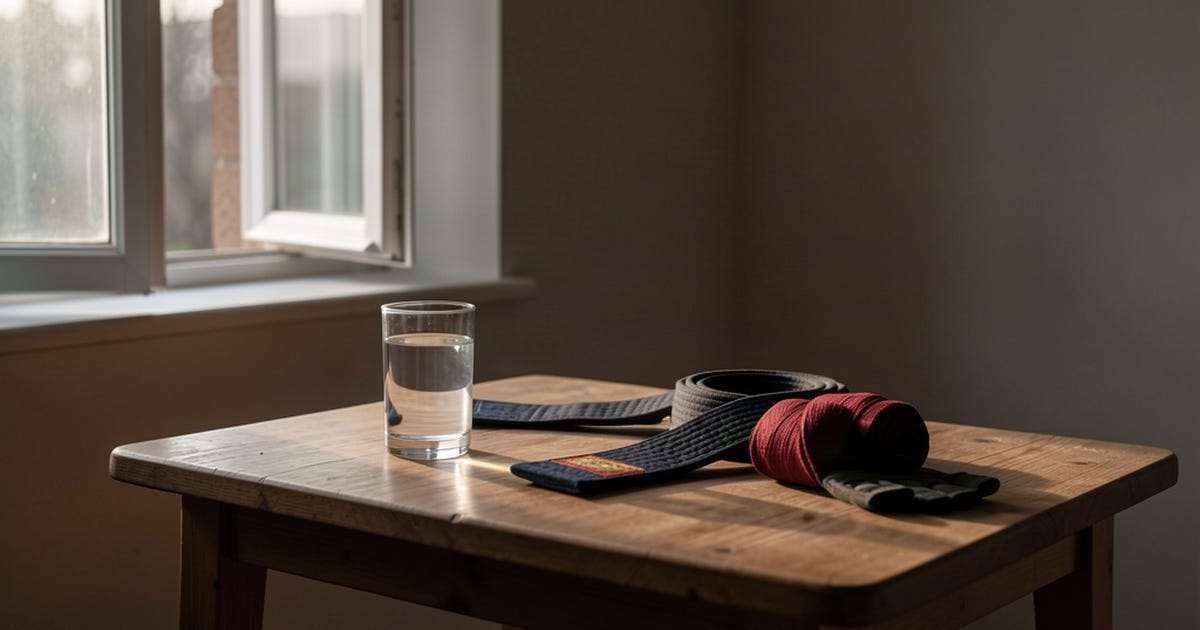
A protocol should make the next good action easier, not replace your judgment.
I like protocols for the same reason I like infrastructure.
They turn a vague intention into something you can repeat.
Drink water. Go outside. Train. Do the difficult work before the easy distractions take over. Make the room darker. Walk after eating. Breathe slowly when your nervous system is running ahead of you.
That is the useful part of the conversation I heard recently with Andrew Huberman. The episode moves through morning cortisol, hydration, light, exercise, cold exposure, willpower, food, breathwork, sleep, effortful work, and post-meal walking.
But the most important lesson is not a list of ten protocols.
It is learning how to use a protocol without becoming obedient to it.
The danger of a good checklist
Health content often turns the body into a dashboard. Cortisol is high or low. Sleep is deep or fragmented. HRV is up or down. Glucose rises too quickly. The solution seems to be another lever, another supplement, another light, another device.
The dashboard is seductive because it gives us the feeling of control.
But a measured body is not necessarily an understood body.
The independent reading linked to the episode makes this distinction visible. Some of the broad principles are well supported, while several stronger causal stories remain uncertain. Morning light clearly matters for circadian timing, but that does not automatically prove every claim about cortisol, immunity, or the exact minute a “window” closes.
That is the standard I want to keep: use the practical action, but do not pretend the explanation is more certain than it is.
The body is where the idea meets reality
I am returning to martial arts, and training has made this obvious again.
You can read about pressure, timing, balance, and composure for years. None of that replaces being tired underneath someone who is trying to pass your guard. The body exposes the gap between an idea you admire and a skill you actually possess.
The same is true of health.
A protocol is not valuable because it sounds scientific. It is valuable when it helps you behave better on an ordinary Tuesday.
That means I would rather keep five boring anchors than collect twenty impressive ones:
Get outside early enough to give the day a clear light signal.
Drink enough to avoid beginning training already dehydrated.
Train regularly, with enough recovery to keep returning.
Do one block of effortful work before spending the day reacting.
Protect a consistent sleep window and make the bedroom support it.
The World Health Organization's baseline is deliberately unglamorous: adults should accumulate 150 to 300 minutes of moderate activity, or the vigorous equivalent, and include muscle-strengthening work. The CDC likewise puts the centre of sleep health somewhere far less exciting than a supplement stack: most adults need at least seven hours, with regular timing and a suitable sleep environment.
The fundamentals are not less advanced because they are familiar.
They are difficult because they keep asking to be repeated.
Discipline without self-punishment
There is also a healthier way to think about discipline.
It is not domination of the body. It is a relationship with the body that becomes more honest over time.
Martial arts has given me a better model of masculinity than the online versions built around rage, status, or permanent aggression. A good training room contains effort, humility, boundaries, and connection. You learn to apply pressure without becoming cruel. You learn to stay present without pretending you are invulnerable.
That is close to what a good protocol should do.
It should help you meet reality more clearly, not help you escape into a more sophisticated form of control.
A small experiment is better than a perfect system
For the next two weeks, I would test a minimum viable protocol rather than attempting a total life redesign:
Morning outdoor light, without staring directly at the sun.
A normal meal pattern with enough protein and food to support training.
A short walk after one substantial meal when the day allows it. Research suggests that post-meal movement can reduce acute glucose excursions, but that is a useful behaviour, not a replacement for medical care.
Five minutes of slow, exhale-focused breathing when stress is high. A randomized study found that brief daily breathwork, especially cyclic sighing, showed promise for mood and physiological arousal.
One difficult work block before opening every low-friction input.
A dark, cool, boring sleep environment.
Then observe what actually changes: training quality, energy, sleep continuity, mood, and the ability to do difficult work.
Not everything has to be measured with a wearable. A notebook is often enough.
The point is not to prove that a protocol works in the abstract. The point is to find out whether it helps this person, in this life, under these constraints.
Keep the protocol, lose the mythology
I am interested in health systems, but I do not want to become a collector of health rituals.
The best protocol is usually the one that survives a busy week. It does not require a perfect morning, a laboratory, or a new identity. It gives you a next action and leaves enough room for judgment.
Go outside. Train. Eat in a way that supports the work. Walk. Breathe. Do something difficult. Sleep enough. Repeat.
Then change the system when reality teaches you something.
The protocol is scaffolding.
The point is becoming more capable of living without needing the scaffolding to feel certain.