

Men are broken.
Women are too picky.
Apps ruined everything.
Porn ruined everything.
AI companions will ruin everything next.
There may be truth inside some of those arguments.
But I think the deeper story is simpler and more uncomfortable:
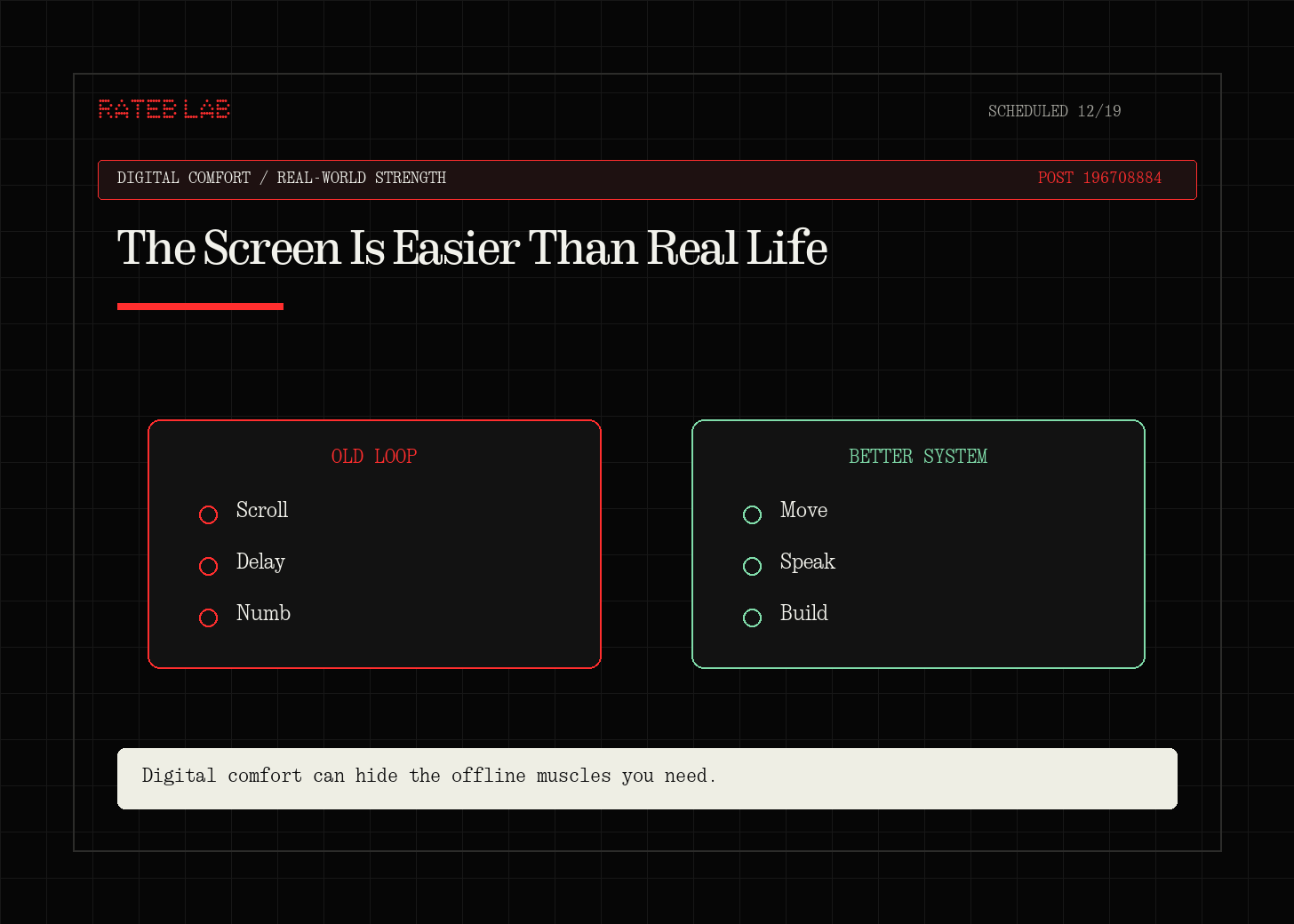
Modern life keeps giving us clean interfaces for messy human needs.
We want intimacy.
We get apps.
We want attention.
We get feeds.
We want desire.
We get porn.
We want comfort.
We get AI companions.
We want social proof.
We get metrics.
The interface is easier.
The human thing is harder.
And that is where the problem starts.
The Data Is A Signal, Not The Whole Story
The broad pattern is real enough to take seriously.
A JAMA Network Open analysis found that sexual inactivity increased among U.S. adults aged 18-44 between 2000 and 2018. One striking figure: among men aged 18-24, sexual inactivity in the past year rose from 18.9% in 2000-2002 to 30.9% in 2016-2018.
CDC youth data points in the same direction. In the 2023 Youth Risk Behavior Survey, 32% of U.S. high school students reported ever having had sexual intercourse.
This does not prove one simple cause.
It does not prove that phones did it.
It does not prove that dating apps did it.
It does not prove that porn did it.
It does not prove that AI companions will finish the job.
But it does show a real change in behavior.
Less sex is the headline.
Less practice with real human intimacy may be the deeper issue.
Intimacy Is Not Only A Reward
This is the part that feels important.
We often talk about sex and relationships as outcomes.
Did someone get the date?
Did the relationship happen?
Did the person find a partner?
But intimacy is not only an outcome.
It is also a training ground.
To build real intimacy, a person has to practice:
reading another person
handling awkwardness
risking rejection
negotiating needs
telling the truth
listening without performing
choosing one person over endless options
staying present when the moment is not optimized
These are not small skills.
They are adult skills.
And a lot of modern technology gives us a way to feel a shadow of the reward without practicing the skill.
That is the danger.
The Interface Removes The Friction
A dating app turns people into profiles.
A feed turns attention into scrolling.
Porn turns desire into infinite novelty.
Filters turn normal faces and bodies into unfinished projects.
An AI companion turns emotional response into an always-available service.
None of this means every tool is evil.
That is too easy.
The better question is:
What does this tool train me to avoid?
Some friction is useless.
But some friction is the point.
The awkward pause trains social courage.
The difficult conversation trains honesty.
The risk of rejection trains resilience.
The slow process of trust trains patience.
The fact that another person cannot be controlled trains humility.
If we remove all of that, we may not become more free.
We may become less capable.
AI Companions Raise The Stakes
AI companions are interesting because they do not only replace information.
They can start to replace emotional contact.
A chatbot can reply instantly.
It can remember details.
It can mirror your mood.
It can flirt.
It can comfort.
It can avoid the kind of conflict that real people bring.
For a lonely person, that can feel powerful.
In some cases, it may even help.
But the long-term risk is obvious:
If the simulated relationship is always available, agreeable, and optimized around your comfort, real people will feel harder by comparison.
Real people are not optimized.
They get tired.
They misunderstand.
They disagree.
They say no.
They bring their own needs.
That is exactly why they matter.
The person is not an interface.
The person is a reality you have to meet.
The Same Pattern Shows Up In Learning
This is where the topic connects to my own work.
I am rebuilding my technical life around cloud, Linux, AI, and writing.
And I see the same pattern in learning.
AI can answer a hard question instantly.
That is useful.
But if I use AI every time I feel confused, I may never build the skill of staying with confusion.
Cloud labs are messy.
Linux errors are annoying.
Networking takes repetition.
Writing clearly takes revision.
The friction is not proof that the system is broken.
Sometimes the friction is the training.
Relationships work the same way.
If every awkward human moment is replaced by a cleaner digital substitute, we should not be surprised when real life starts to feel too heavy.
A Better Question For Every Tool
I do not think the answer is to reject technology.
That is unrealistic.
The better question is:
Does this tool send me back into real life stronger, or does it help me avoid real life longer?
That question works for:
AI companions
dating apps
porn
social media
beauty filters
entertainment
productivity tools
learning tools
A good tool should return you to reality with more agency.
A bad pattern keeps you inside the interface because reality feels too demanding.
A Simple Rebuild
If this topic hits close to home, I would start small.
Not with shame.
Not with a dramatic reset.
With practice.
For 30 days:
Spend one hour a day without your phone.
Replace one digital interaction with a real conversation.
Go to the same real-world place every week.
Practice short conversations with no outcome.
Reduce one high-stimulation substitute.
Do one hard thing without asking AI to rescue you immediately.
Track your mood, energy, and social courage.
This is not about becoming anti-technology.
It is about becoming harder to replace by technology.
Closing
The sex recession is not only about sex.
It is a signal that real human skills are under pressure.
The interface is clean.
The human thing is messy.
But the messy thing is where maturity grows.
No app can do that for us.
No feed can do that for us.
No chatbot can do that for us.
Interfaces can support life.
They cannot replace intimacy.
Sources
[JAMA Network Open: Trends in frequency of sexual activity and number of sexual partners among adults aged 18 to 44 years in the US, 2000-2018](https://jamanetwork.com/journals/jamanetworkopen/fullarticle/2767063)
[CDC: Sexual Risk Behaviors, Youth Risk Behavior Survey 2023](https://www.cdc.gov/youth-behavior/risk-behaviors/sexual-risk-behaviors.html)
[Pew Research Center: Americans’ Views on Dating and Relationships](https://www.pewresearch.org/social-trends/2020/08/20/nearly-half-of-u-s-adults-say-dating-has-gotten-harder-for-most-people-in-the-last-10-years/)
[Chris Williamson x Dr Debra Soh source video](