

Opening
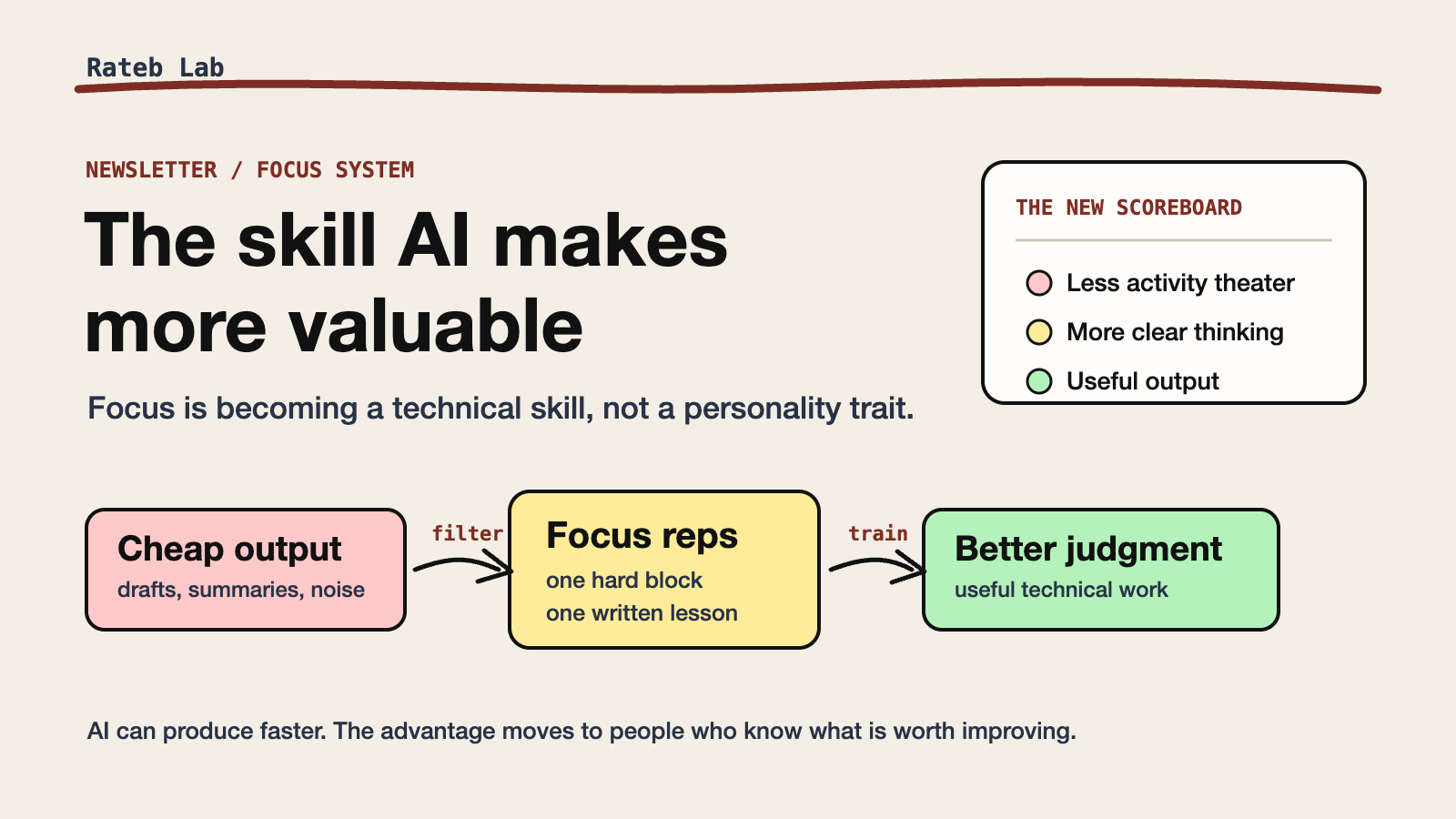
AI made it easier to create more.
More drafts. More summaries. More meeting notes. More slide decks. More Slack replies. More posts. More half-finished documents that look useful from far away.
But there is a problem.
More output is not the same as better work.
Cal Newport made this point clearly in his recent Modern Wisdom conversation with Chris Williamson. The big workplace problem is not only distraction anymore. It is distraction plus AI-generated "workslop."
Work that looks like work.
Work that creates motion.
Work that moves through tools, channels, and inboxes.
But work that does not always create value.
This matters if you are learning cloud, AI, Linux, software, networking, or any hard technical skill.
Because AI can now help you produce faster.
But it cannot do the hard part for you:
choosing the right problem
staying with the problem long enough
noticing when the answer is weak
building the judgment to know what matters
doing the boring reps that make skill real
That means focus is no longer just a productivity topic.
Focus is becoming a technical skill.
The Wrong Scoreboard
A lot of modern work rewards visible activity.
Fast replies.
Busy calendars.
Long message threads.
Documents that keep moving from person to person.
This creates a strange scoreboard. The person who answers every message quickly looks productive. The person who disappears for two hours to solve a hard problem can look quiet.
But the market does not reward activity forever.
It eventually rewards useful output.
For a cloud learner, useful output might be:
a working VPC lab
a clear troubleshooting note
a small automation script
a clean architecture diagram
a GitHub project that proves you understand the basics
a blog post that explains what broke and how you fixed it
For a creator, useful output might be:
one clear essay
one sharp visual
one useful tutorial
one honest build log
one idea that helps someone make a better decision
AI can help with all of this.
But AI can also make the wrong scoreboard worse.
It can help you create more things that look done before you have done the thinking.
The New Advantage
If everyone can generate a first draft, the first draft stops being impressive.
The advantage moves to the person who can improve the draft.
That means the valuable person is not the one who uses AI to avoid thinking.
It is the one who uses AI to increase the amount of good thinking they can do.
That is a different relationship with the tool.
Weak AI use:
"Write this for me."
"Summarize this so I do not have to understand it."
"Make it sound professional."
"Give me the answer."
Strong AI use:
"Test my reasoning."
"Show me what I missed."
"Give me counterarguments."
"Turn this into a checklist I can verify."
"Help me compare these two designs."
"Ask me questions before giving advice."
The first mode produces more output.
The second mode builds better judgment.
Cognitive Strain Is Not a Bug
One of the best ideas from the episode is simple:
Hard thinking feels hard because it is training.
A weightlifter expects the weight to feel heavy.
A runner expects the lungs to burn.
A technical learner should expect real understanding to feel uncomfortable.
That discomfort is not always a sign that something is wrong.
Sometimes it is the sign that the right circuit is being trained.
When I study cloud or Linux, the easy path is to ask AI for the answer and move on.
The better path is slower:
Try to explain the problem in my own words.
Make a guess.
Check the docs.
Run the command or lab.
Notice where my mental model breaks.
Ask AI to test the gap.
Write the lesson down.
That loop takes longer.
But it leaves something behind.
It builds skill instead of only producing a response.
A Better Focus System
The practical lesson is not "stop using AI."
That would be too simple.
The lesson is to protect the work that AI cannot replace.
Here is a simple system.
1. Pick the real output before opening the tools
Before opening ChatGPT, Slack, Notion, Gmail, YouTube, or any course platform, write one sentence:
What am I trying to produce?
Examples:
"I am creating a diagram of how security groups differ from NACLs."
"I am fixing one Terraform error and writing the cause."
"I am drafting one newsletter section about AI workslop."
"I am reviewing one AWS service and extracting three project ideas."
If you do not define the output, the tools will define the day.
2. Split thinking from communication
Do not mix deep work and message checking.
Use separate blocks.
Thinking block:
one task
one document
one lab
no inbox
no Slack
no feed
Communication block:
answer messages
schedule meetings
triage admin
update people
Most people lose focus because they keep treating communication as a background process.
It is not background.
It is a separate mode of work.
3. Use AI as a coach, not an escape hatch
Bad prompt:
Explain VPC peering.
Better prompt:
I am learning AWS networking. My current understanding is: - VPC peering connects two VPCs privately. - It is not transitive. - Route tables must be updated. Quiz me with 5 scenario questions. After I answer, point out gaps in my mental model. Do not give me the answers first.
The goal is not to get the answer faster.
The goal is to become the kind of person who can recognize a good answer.
4. Measure deep work like reps
Do not only measure hours studied.
Measure focus reps.
A focus rep is one clean block where you stayed with one hard thing.
Start small:
25 minutes of reading
30 minutes of lab work
45 minutes of writing
60 minutes of architecture practice
Then record:
What did I try?
What broke?
What did I learn?
What will I do next?
This turns focus into training.
5. Read pages every day
Newport compares reading pages to physical steps.
That is useful.
You do not need a heroic reading habit.
You need daily cognitive steps.
For technical learners, this can be:
10 pages from a book
one official docs page
one RFC section
one AWS whitepaper section
one high-quality technical article
The point is not to collect information.
The point is to keep the mind capable of staying with long, structured thought.
The Practical Takeaway
AI will keep getting better.
That does not make focus less important.
It makes focus more important.
When tools can produce more drafts, the scarce skill is knowing which draft is worth improving.
When tools can summarize more sources, the scarce skill is knowing what the sources actually mean.
When tools can generate more code, the scarce skill is knowing how to test, debug, and maintain the system.
When tools can create more noise, the scarce skill is building a mind that can stay with signal.
So the question is not:
"How do I use AI to do less thinking?"
The better question is:
"How do I use AI while becoming a stronger thinker?"
That is the work.
And for anyone learning cloud, AI, Linux, or software in public, it might become one of the biggest advantages available.