

I keep noticing the same failure in AI conversations.
Someone sees a new agent tool, opens a blank workspace, and asks it to "run the business," "manage my inbox," or "find me opportunities."
Then the result is vague, strange, or quietly wrong.
The tool gets blamed. The prompt gets rewritten. Another tool is bought.
But the real problem usually arrived before the model saw a single word.
There was no job.
There was only a wish.
That distinction matters because the most valuable AI skill is not prompt writing. It is delegation design.
A good prompt can make a model sound useful for one moment. A useful workflow has to do more. It needs to know what it is trying to achieve, what information it can use, what it is allowed to change, what good work looks like, and when it should stop and ask for help.
That is not magic. It is management.
Start with work that deserves automation
Not every annoying task needs an agent.
That is the first thing worth saying, because AI makes every workflow look automatable from a distance.
A task is a good candidate when three things are true.
First, it happens often enough to matter. If you do it once a quarter, building and maintaining a system may cost more than simply doing the task well.
Second, the work has rules. Not perfect rules, but enough structure that you can explain how a good decision is made. An inbox triage process can have sender priorities, urgency signals, labels, examples of good replies, and clear escalation criteria. That is different from asking a tool to "handle my relationships" or "make the best business decisions."
Third, there is a return on time. The point is not to remove every two-minute task. The point is to remove a repeated piece of work that keeps pulling attention away from something more valuable.
This is a useful filter because it protects you from building automation as identity theater.
You do not need an agent because agents are the new thing. You need one when a repeated workflow is already real enough to deserve a better system.
Before building anything, ask:
Does this happen every week?
Can I describe the inputs, choices, and desired output?
Will the time saved repay the time required to build, test, and maintain it?
If the answer is no, a simple chat, template, checklist, or manual habit may be the better tool.
That is not falling behind.
It is good judgment.
A chatbot gives an answer. A workflow carries responsibility.
The simplest difference is this.
A chat helps when you are still thinking.
A workflow helps when you already know enough about the work to hand off part of it.
With chat, you ask a question, receive a response, and decide what happens next. That can be incredibly valuable. It can turn confusion into a draft, a plan, an explanation, or a first pass.
But a reliable agentic workflow has a larger job.
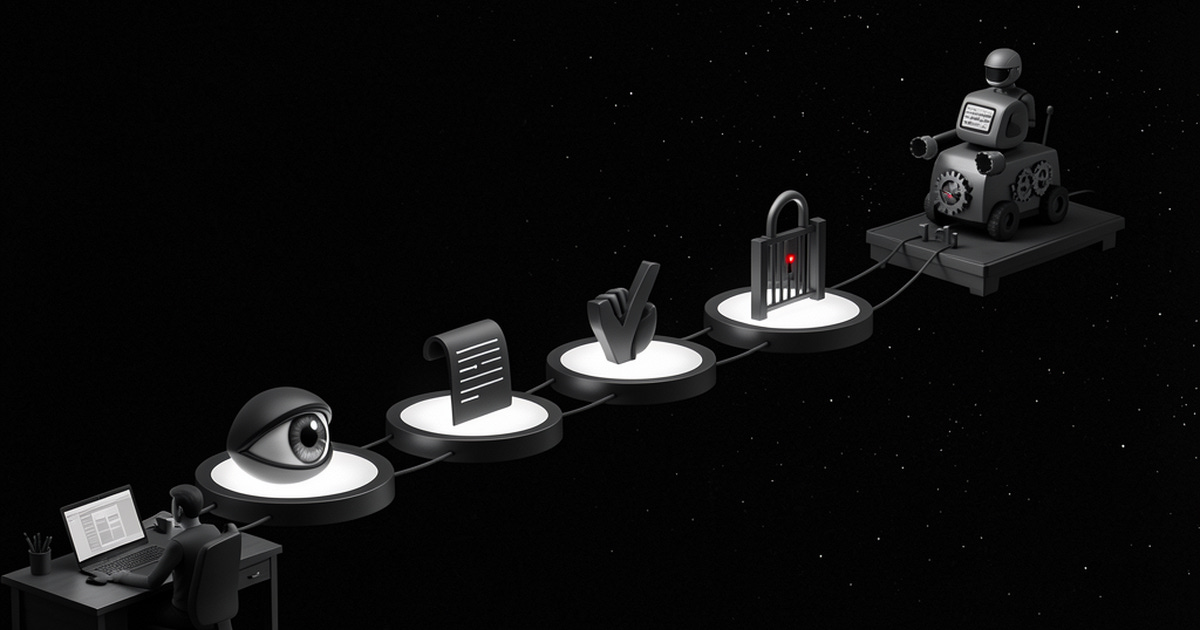
It receives an outcome, gathers the relevant context, takes a bounded action, checks the result, and reports or escalates what needs human judgment.
The important word is bounded.
People often describe an AI agent as an employee. I understand the metaphor, but it can make people careless. An employee has judgment, legal responsibility, a relationship with the company, and a lived understanding of consequences. A software workflow has permissions, instructions, tools, and failure modes.
Treating those as the same is how people give a system more authority than it has earned.
A better comparison is a junior operator with a very clear desk.
The desk contains only what is needed for the current job: the playbook, the approved examples, the necessary tools, the current queue, and a clear rule for when to stop.
The desk should not contain your entire life.
The work is not the prompt
A prompt is only one part of the system.
The real work happens before and after it.
Before it, you define the outcome.
Not "manage my inbox."
Something closer to: "By 9 a.m., every new email is categorized, routine replies are drafted in my voice, and anything urgent or uncertain is flagged for me."
That is a definition of done. You can see it. You can review it. You can tell when it failed.
Then you provide the context that makes a good decision possible.
Who matters most?
What does urgent mean?
Which messages should never receive an automatic reply?
What does your writing actually sound like?
What examples show the difference between a normal request, a sensitive request, and something that needs escalation?
This is where many AI workflows become disappointing. People ask for intelligence but provide no operating context.
Then they are surprised when the system behaves like a stranger.
Good context is not dumping every document you own into a chat window. That creates noise, stale instructions, and false confidence. Good context is the smallest useful set of rules, examples, current information, and constraints for one job.
Then comes the part people skip because it is less exciting: authority.
What can the workflow do without you?
Can it classify?
Can it draft?
Can it archive?
Can it forward something internally?
Can it send a message externally?
Can it touch money, contracts, customer records, or calendar commitments?
Each answer should be explicit.
The more consequential the action, the higher the review standard should be.
One job. One lane.
The temptation is to build one impressive machine that does everything.
Research the topic. Write the post. Design the visual. Schedule the meeting. Send the invoice. Review the code. Reply to the customer.
That sounds efficient until something goes wrong and nobody can tell where the error began.
A better system separates roles.
One workflow gathers information.
Another turns approved information into a draft.
Another checks a draft against a rubric.
Another prepares a report for a human decision.
A manager layer can coordinate those pieces, but it should not pretend to be the specialist in every lane.
This is not only about model quality. It is about keeping context clean.
When one system tries to remember every policy, every user preference, every tool, every current task, and every exception, it becomes hard to evaluate. It may still produce confident language. That does not mean it is operating with clarity.
Small lanes make failure visible.
They also make improvement possible.
If the research step is weak, improve research. If the draft is off-voice, improve the style guide. If the review misses something, improve the rubric. You do not need to rebuild a giant black box every time one piece behaves badly.
Trust is a rollout, not a feeling
The hard part is not building the first version.
The hard part is deciding when to let it act.
Trust should be earned in stages.
Start with observation. Let the workflow sort, summarize, or recommend while you compare its output to your own judgment.
Then let it draft. Correct the drafts and turn recurring corrections into clearer rules or examples.
Then allow low-risk actions with clear limits. Labeling a routine notification is not the same as sending a client email. Preparing a report is not the same as moving money.
Only after a workflow has shown reliable behavior should it run on a schedule without direct supervision.
Even then, the goal is not blind autonomy. The goal is quiet reliability with visible escalation.
A good system tells you what happened, what it could not decide, and what needs your attention.
That is how it buys back time without asking you to surrender judgment.
The skill that compounds
The future of work will contain more AI. That part is obvious.
The useful question is what kind of person becomes more valuable inside that change.
I do not think the answer is someone who can produce the longest prompt or collect the most tools.
It is someone who can look at messy work and make it legible.
They can identify a real outcome.
They can separate repeatable work from judgment-heavy work.
They can write the rules without confusing rules for wisdom.
They can give a system enough context without drowning it.
They can build guardrails, review the result, and know when the human should stay in the loop.
That is not a small skill.
It is the difference between using AI for occasional help and building a system you can responsibly rely on.
Before you build your first agent, do not ask what it can do.
Ask what job you can explain clearly enough to delegate without lying to yourself about the risk.
That is where the real work begins.