

I used to think growing on X was mostly about clever posts.
Better hooks.
Better timing.
Better templates.
More consistency.
Those things matter.
But they are not the real system.
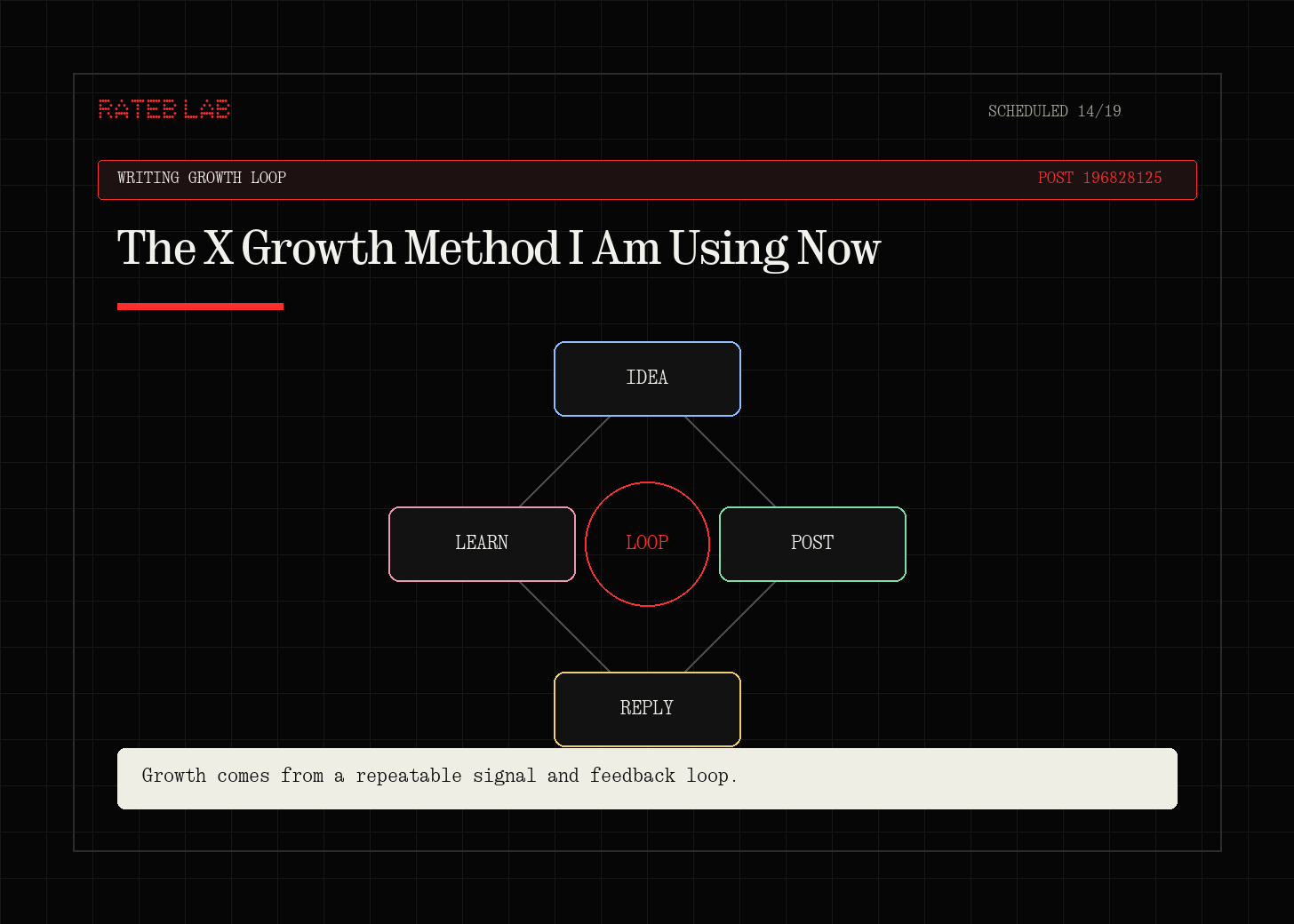
The real system is a loop.
You make your profile clear. You publish useful ideas. You reply to people like a human. You watch what gets a real response. You turn the best ideas into deeper notes, newsletters, visuals, and offers. Then you bring those lessons back to the timeline.
That is the method I am using now.
Not because I think I have mastered X.
Because I want to grow in public while building technical skill, writing skill, and a direct audience at the same time.
X Is Not The Business
The first mistake is treating X like the whole game.
It is not.
X is the attention layer.
It helps you test ideas, meet people, find language, build trust, and learn what your audience actually cares about.
But you do not own the platform.
The algorithm can change. Reach can drop. Accounts can get limited. A post can perform for reasons you do not fully understand.
So the goal is not just followers.
The goal is a system that turns attention into trust.
For me, that means:
X for testing ideas and meeting people.
Substack for deeper thinking and owned audience.
Obsidian for the source system.
Visuals for making ideas easier to understand.
Offers later, only after the audience and problem are clear.
That is a healthier game.
The Profile Has One Job
A profile should answer three questions fast:
Who are you?
What do you help me understand?
Why should I remember you?
My current direction is simple:
AI-era technical leverage: cloud, Linux, automation, and clear thinking.
That gives the account a shape.
It tells people this is not random motivation, not generic AI hype, and not a personal diary with no promise.
It is a public learning account about becoming technically useful in the AI age.
That matters because every post is judged inside the frame of the profile.
If the profile is unclear, even good posts leak energy.
If the profile is clear, each useful post strengthens the account.
Content Needs A Job
Posting every day is not enough.
Every post needs a job.
Some posts are for reach.
They compress one useful idea into a line people can repeat.
Some posts are for trust.
They show the work behind the idea: a lab, a mistake, a note, a rejection, a diagram, a lesson.
Some posts are for connection.
They invite replies, questions, corrections, and conversations.
Some posts are for conversion.
They point serious readers toward a deeper newsletter, a useful resource, or eventually an offer.
Most accounts fail because every post is trying to do every job.
That makes the writing confusing.
A one-line thought should not carry a heavy call to action.
A thread can carry a deeper link.
A reply should usually be useful by itself.
The job decides the shape.
The Infinite Content Wheel
The best part of this method is that you do not need endless new ideas.
You need better loops.
A question can become a post.
A post can become a thread.
A thread can become a newsletter.
A newsletter can become a carousel.
A reader comment can become the next post.
A repeated objection can become a lead magnet.
A lead magnet can reveal the first offer.
That is the infinite content wheel.
The point is not to recycle lazy content.
The point is to let proven ideas earn more depth.
If an idea gets replies, saves, shares, or thoughtful disagreement, that is a signal.
Not a command.
A signal.
It means the idea touched something real.
Then the job is to make the idea clearer, more useful, and more complete.
Replies Are Public Content
Networking on X is not begging bigger accounts for attention.
It is showing up with useful context.
A good reply can do one of five things:
Add a concrete example.
Make the idea simpler.
Offer a respectful correction.
Ask a sharper question.
Connect the idea to a real experience.
That is public content.
People see how you think before they ever visit your profile.
This matters more than most beginners realize.
A reply is not a small action.
It is a small proof of judgment.
The Thought Museum
I am also building a Thought Museum.
That is just a simple library of things worth reusing:
hooks that made me stop scrolling
strong opening lines
useful questions
objections from readers
phrases that explain my niche clearly
post structures that worked
my own best-performing posts
replies that started good conversations
newsletter ideas that keep coming back
This is not for copying people.
It is for studying patterns.
If you want to write better, expose yourself to better writing and collect what works.
Then translate it into your own world.
For me, that world is cloud learning, AI tools, Linux, automation, career transition, and clear thinking.
The Owned Channel
The email list matters because X is rented land.
A follower is useful.
An email subscriber is more serious.
They gave you permission to reach them outside the feed.
That changes the relationship.
The newsletter is where I can slow down.
On X, the idea has to be compressed.
On Substack, I can explain the model, show the system, add the mistakes, and make the reader leave with something practical.
That is why the newsletter is the anchor.
The social posts should point to the deeper essay only when the link belongs there.
Not every post needs a CTA.
Trust compounds better when the ask is earned.
The Weekly Operating System
Here is the simple system I am using:
1. Clarify the profile.
Keep the promise obvious. AI-era technical leverage. Cloud, Linux, automation, and clear thinking.
2. Publish daily idea tests.
One idea per post. No heavy CTA unless the post naturally points to a deeper piece.
3. Reply every day.
Not to farm engagement. To make friends, learn faster, and show judgment in public.
4. Save signals.
Track posts, replies, objections, questions, and phrases that create real response.
5. Expand winners.
Turn the strongest ideas into threads, newsletters, diagrams, carousels, and future lead magnets.
6. Move serious readers to Substack.
Use the newsletter for deeper maps, not shallow reposts.
7. Review weekly.
Look at what worked, what felt fake, what created good replies, and what should be repeated with a better angle.
The Real Goal
The goal is not to become a content machine.
The goal is to become a clearer thinker in public.
For my path, X is useful because it forces clarity.
If I cannot explain a cloud concept simply, I probably do not understand it yet.
If I cannot turn a lesson into a useful post, the lesson is still too vague.
If nobody responds, I need to ask whether the idea is unclear, unhelpful, badly timed, or simply not important to the people I am trying to serve.
That feedback is valuable.
But only if I use it without becoming addicted to it.
That is the balance.
Use the algorithm as feedback.
Do not let it become your identity.
Build the audience.
But build the skill underneath it.
That is the X growth method I am using now.
A public learning engine.
Not a slot machine.