

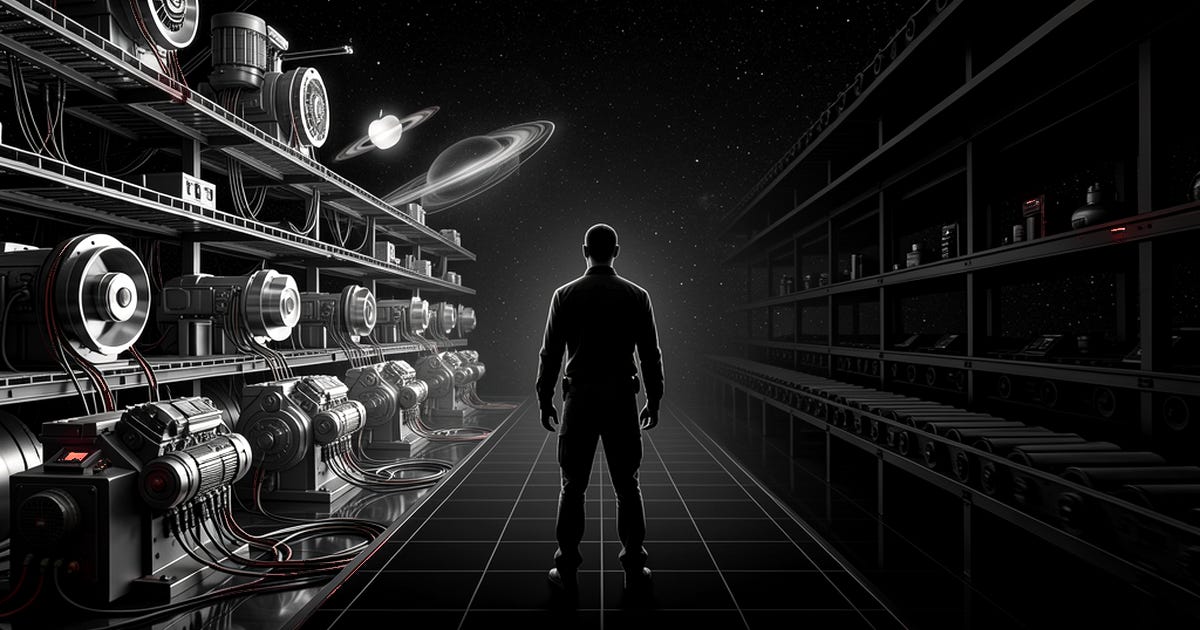
The same pattern keeps appearing
I keep coming back to one uncomfortable idea.
A tool can make you more capable.
It can also make you more dependent.
The difference is not the tool itself. The difference is whether you can operate the system around it.
That is the thread connecting a lot of what I have been thinking about lately: free models, AI agents, cloud infrastructure, content workflows, giant companies, private markets, and the feeling many people have that the future is being built somewhere above their head.
At first, those look like separate topics.
One conversation is about who owns the machines.
Another is about why a free model is not enough.
Another is about agent systems like Hermes and why a model needs tools, memory, skills, review gates, and receipts before it becomes useful in real work.
But underneath all of them is the same spine.
Tools are not freedom unless you can operate the system around them.
The wrong map
The wrong map says access equals power.
If I get the model, I have the advantage.
If I get the app, I have the leverage.
If I get the automation, I have the system.
If I get close to the machine, I am no longer managed by it.
This feels true because access is visible. You can open the app. You can ask the model. You can use the platform. You can subscribe to the tool. You can generate the output.
But access is only the first layer.
A person can have access to a powerful model and still have no repeatable workflow.
A person can use a cloud platform and still not understand how requests, permissions, logs, costs, and failures move through the system.
A person can rely on social platforms for distribution and still have no direct relationship with the people who read their work.
A person can automate tasks and still create a machine they no longer understand.
That is the trap.
You can be surrounded by powerful tools and still be managed by the environment those tools live inside.
The better map
The better map starts with a different question.
Not: what tool do I have?
But: what operating layer surrounds the tool?
For an AI model, that layer might include files, terminal access, browser access, memory, skills, schedules, project context, approval gates, and logs.
For a content system, it might include source capture, synthesis, writing standards, visual rules, platform adaptation, publishing checks, and distribution records.
For a cloud learner, it might include labs, diagrams, commands, failure notes, cost checks, documentation, and visible proof.
For a career rebuild, it might include projects, applications, follow-ups, notes, learning loops, public work, and feedback.
The tool gives you capability.
The operating layer turns capability into repeatable agency.
That is the part most people skip because it is less glamorous than the tool itself. It is quieter. It looks like folders, checklists, rules, logs, notes, records, small scripts, review gates, and boring receipts.
But that quiet layer is where leverage compounds.
Free is not the same as useful
Free models are a good example.
A frontier-level model becoming cheaper or easier to access is genuinely important. It lowers the barrier. It gives more people a chance to build, learn, test, write, code, and reason with better tools.
But it does not automatically make everyone powerful.
If the model sits inside a blank chat tab, it still needs the human to bring context, tools, memory, goals, standards, and follow-through every time.
That can help for one task.
It does not become a system.
A model without tools can advise.
A model without memory repeats old mistakes.
A model without skills needs to be retrained through prompts.
A model without review gates becomes risky.
A model without receipts sounds productive but leaves you unsure what actually happened.
That is why the model race is only part of the story.
The deeper race is operating systems around intelligence.
Not operating systems in the narrow computer sense. Operating systems in the practical work sense: the environment that lets intelligence touch real tasks safely, remember useful lessons, verify results, and improve the next run.
Ownership is not only legal ownership
When people hear ownership, they often think of equity.
Equity matters. If you own part of a productive machine, you participate in the upside.
But there is another kind of ownership that starts earlier.
Operational ownership.
You own more of a tool when you can inspect it.
You own more of a workflow when you can explain it.
You own more of an AI system when you can change the inputs, review the outputs, audit the actions, and improve the procedure.
You own more of a cloud setup when you understand what broke and why.
You own more of your media when you have notes, email capture, direct audience trust, and distribution habits outside the feed.
This kind of ownership does not require being rich.
It requires becoming less mystified.
That is a practical place to start.
You may not own the giant machine. But you can learn one layer deeply enough to stop being a passive passenger inside it.
Safety needs architecture, not only trust
There is a reason review gates matter so much.
Powerful tools need boundaries.
But there is a difference between safety as architecture and safety as a moat.
Safety as architecture gives people better ways to inspect, limit, test, verify, and recover.
Safety as a moat says: trust the owner, stay inside the approved path, and do not ask too many questions about the machinery.
The first version increases agency.
The second version centralizes permission.
This matters in AI because the easy story is that smarter systems require fewer people to touch the stack.
Maybe some layers do need stricter control.
But if every layer becomes sealed, ordinary builders and learners become consumers of intelligence rather than operators of it.
A healthier path is more specific.
Give the tool rails.
Give the human review.
Give the workflow receipts.
Give the builder enough access to learn, audit, and improve the system without pretending every person needs unlimited control.
That is the middle path between reckless autonomy and passive dependency.
The practical operating layer
If I had to turn this into a simple map, I would start with seven layers.
1. Input
What begins the workflow?
A note, article, video, question, support ticket, lab result, application, meeting, or error message.
If the input is vague, the whole system becomes vague.
2. Context
What does the system need to know before acting?
The goal, audience, folder, constraints, prior work, examples, credentials, risks, and definition of done.
3. Tools
What can it touch?
Files, browser, terminal, APIs, calendar, messages, images, documents, or cloud resources.
Access should be useful, not maximal.
4. Procedure
What steps should happen repeatedly?
This is where skills, checklists, templates, and saved workflows matter. A procedure is a way of teaching the system what worked last time.
5. Review gate
Where does the human stay responsible?
Anything public, expensive, destructive, private, legal, financial, or identity-sensitive needs a clear approval point.
6. Receipt
How do you know it worked?
A file path, URL, test result, screenshot, task ID, log, read-back, or status record turns output into evidence.
7. Learning loop
What improves after the run?
A stable preference becomes memory. A repeated procedure becomes a skill. A failure becomes a better check. Temporary task state gets left behind.
That is an operating system.
Not a giant platform.
A working loop you can trust.
The career lesson
For technical self-rebuilders, this is where the idea becomes personal.
It is easy to feel late when the models are huge, the companies are huge, and the infrastructure is huge.
But huge systems always create edges.
They create integration problems.
They create support problems.
They create education gaps.
They create trust problems.
They create workflow problems.
They create a need for people who can explain the machine in plain English and make it useful inside normal work.
That is where a learner can move.
Not by pretending to be a senior expert overnight.
Not by chasing every tool release.
Not by collecting courses until confidence appears.
By choosing one layer and learning it deeply enough to operate it.
Cloud is a layer.
Linux is a layer.
AI workflows are a layer.
Automation is a layer.
Writing is a layer.
Evaluation is a layer.
Documentation is a layer.
Distribution is a layer.
Every layer you understand gives you more agency around the machine.
A small build to start with
The practical move is not to design a giant personal operating system this weekend.
That is how people turn agency into clutter.
Start with one repeated workflow.
Pick something you already do badly by hand.
Maybe it is saving study notes.
Maybe it is turning a lab into a portfolio entry.
Maybe it is checking job applications.
Maybe it is turning a raw source into a draft.
Maybe it is reviewing expenses, tasks, or weekly priorities.
Then ask:
What is the input?
What context does it need?
What tools should it use?
What procedure should it follow?
Where do I review?
What receipt proves it worked?
What lesson should survive?
That is how you stop worshiping tools and start building capability.
Final reflection
The future will keep offering stronger tools.
Smarter models. Cheaper inference. Better agents. Bigger platforms. More automation.
The temptation will be to keep asking which tool is best.
But the more useful question is simpler.
Can I operate the layer around it?
Because a tool can help you think, write, build, automate, learn, and distribute.
But if the system around the tool belongs entirely to someone else, changes without your understanding, hides its failures, and gives you no way to inspect or improve the loop, then your freedom is thinner than it looks.
Do not only collect tools.
Build the workbench.
Learn the layer.
Keep the receipts.
Design the review gates.
Turn repeated work into a system you understand.
That is where agency starts.