

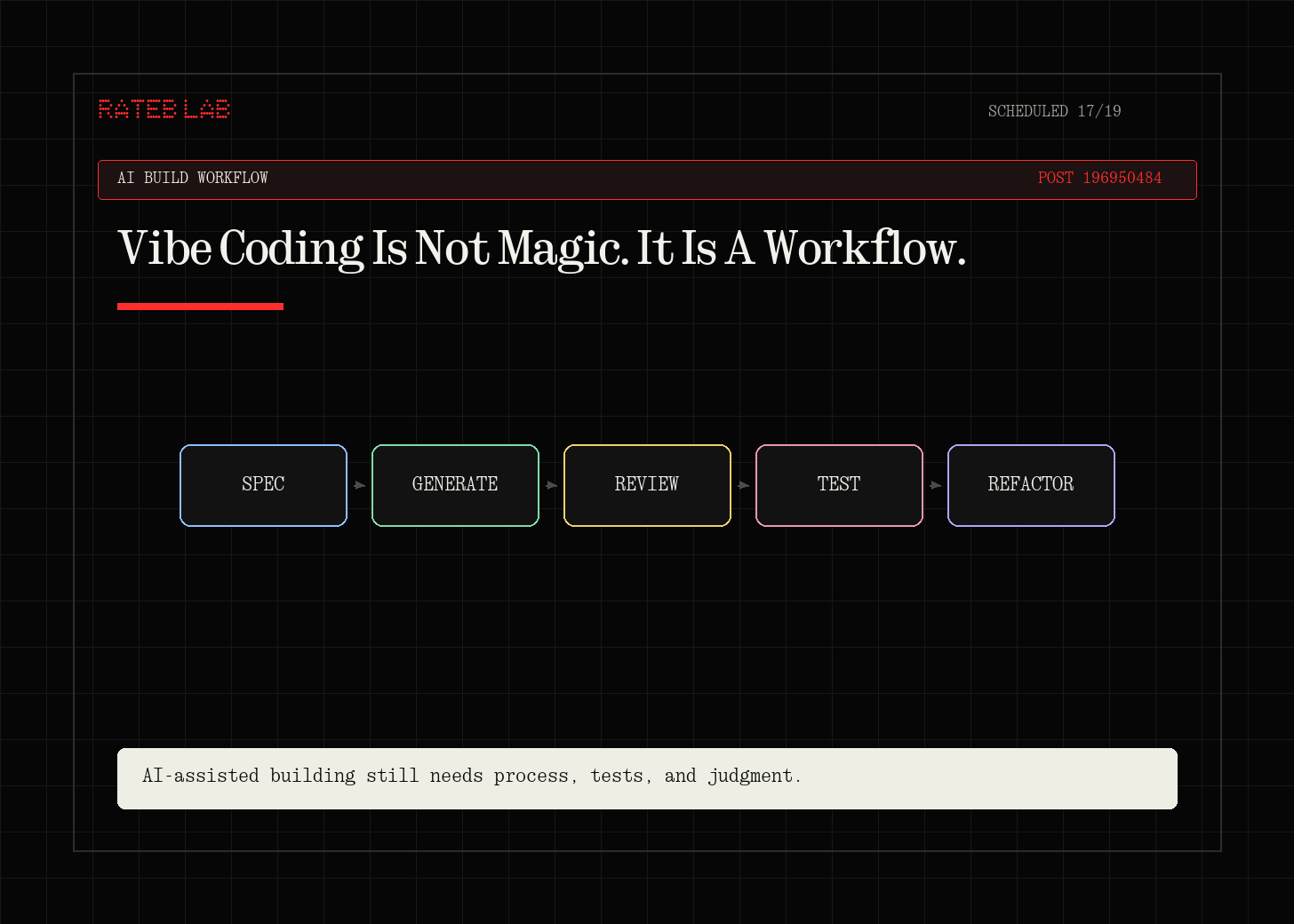
Vibe coding sounds like magic from the outside.
You type an idea into Codex.
The agent writes the files.
A few minutes later, an app opens in your browser.
For a beginner, that can feel unreal.
But the fastest way to understand vibe coding is to remove the mystery.
An app is not a cloud of magic.
It is a folder of files.
Codex edits those files.
Your computer runs them locally.
GitHub saves versions of them.
Firebase can store the users, data, and files.
Vercel can put the app on the internet.
Once that map clicks, the whole thing becomes less intimidating.
You are not asking AI to perform a miracle.
You are asking an agent to work inside a software system.
The Beginner Mistake
The beginner mistake is thinking vibe coding means:
I do not need to understand anything.
The better model is:
I need to understand enough to direct the agent well.
You do not need to know every React hook, Firebase rule, or Swift file on day one.
But you do need to know what kind of problem you are asking the agent to solve.
If the app loses data after refresh, that is probably a storage problem.
If Google sign-in fails, that is probably authentication or an authorized-domain issue.
If an uploaded screenshot fails, that might be a storage permission rule.
If a deployed app works locally but not online, that might be an environment variable or domain problem.
This is where AI changes the learning path.
Before, a beginner had to learn a lot of syntax before building anything useful.
Now, a beginner can build earlier.
But they still need to learn the system.
The Map
Build a small web app locally.
Change it through prompts.
Save the code to GitHub.
Add a real backend with authentication, database, and storage.
Deploy it to the internet.
Turn it into a desktop app with Electron.
Build an iOS version with Swift and Xcode.
That path teaches more than a single app.
It teaches the shape of modern software.
The important part is not only that the agent writes most of the code.
The important part is that the human learns how to inspect, test, explain errors, and steer.
The New Beginner Skill
This is the new beginner loop:
Describe the product clearly.
Give the agent the right context.
Test the result like a user.
Copy useful error logs.
Ask for focused fixes.
Save the work.
Deploy the work.
Repeat.
That is not fake engineering.
It is a new entrance into engineering.
The bar has moved.
Typing code from memory matters less at the beginning.
Understanding systems matters more.
What Still Matters
The people who win with vibe coding will not be the people who blindly ask AI for apps.
They will be the people who build taste, judgment, and enough technical understanding to know what to ask for next.
That is the part I want to learn.
Not just how to make the agent write code.
How to become the kind of person who can direct agents toward useful software.