

AI made coding easier.
It did not remove engineering.
That is the difference most people are missing.
Vibe coding feels magical because it removes the scariest part of software for many people: the blank editor, the syntax, the setup, the error messages, the strange folders, the package files, the terminal.
You describe what you want.
The AI writes code.
You run it.
Something appears on the screen.
For a non-technical person, that moment can feel like crossing a border.
One day you are a person with an idea.
The next day you have an app.
The magic is real
This is not only hype.
In the source note I am using for this piece, the examples are practical.
Jamie Grove runs a boutique warehouse in Upper Tract, West Virginia. With AI coding tools, he built software for warehouse batching, order grouping, inventory tracking, and custom client workflows.
That kind of software would normally be expensive, rigid, or too slow for a small business.
For him, the value was not "AI wrote code."
The value was: a small business could build custom automation without waiting for a full engineering team.
Cynthia Chen, a product designer at Block, built Dog-e-dex, an app for collecting dog encounters, after years of not knowing how to start. Semafor reported that she built it with Claude in her spare time and got it live on the App Store.
That is the real promise.
Vibe coding lowers the cost of starting.
It lets people test ideas that would have stayed trapped in their notebooks.
It makes software feel more like conversation.
And that matters.
But "it works" is not the same as "it is engineered"
This is where the story gets dangerous.
A prototype that works once is not the same thing as software you can trust.
There is a difference between:
a tool you use for yourself
a demo you show a friend
an internal workflow with low risk
a system that handles money, customer data, inventory, security, or production operations
The first one can be messy.
The last one cannot.
Adi Osmani from Google Cloud AI made the cleanest distinction in the Bloomberg segment: vibe coding is exploratory, but engineering needs requirements, testing, quality gates, user needs, consistency, and ownership.
That is the sentence that should sit above every AI coding tool.
AI can generate the code.
It cannot remove responsibility.
If the software fails, users do not care whether the broken code came from a human or an AI.
They care whether the system helped them, protected their data, and behaved reliably.
The new bottleneck is judgment
Before AI coding tools, a lot of people were blocked by syntax.
Now the bottleneck is moving.
The hard part is becoming:
What should this system actually do?
What should it refuse to do?
What data can it access?
What happens when it is wrong?
How do we test it?
How do we know the answer is correct?
Who owns the final outcome?
That is software engineering.
Not typing.
Not asking for "a dashboard with a clean UI."
Not celebrating that the app finally runs.
Engineering is the discipline of turning a messy human need into a system that behaves well under pressure.
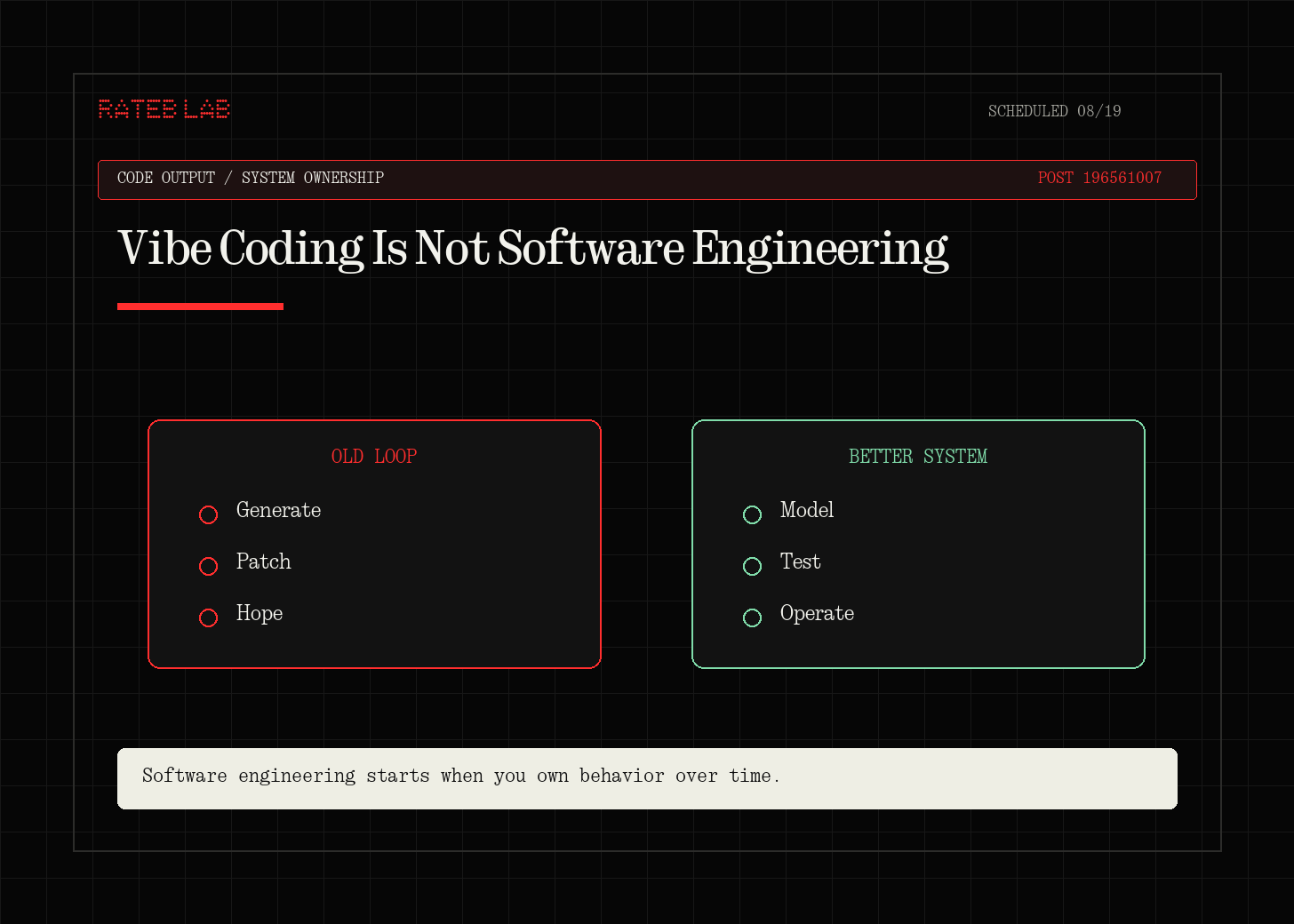
Vibe coding gives you the first draft.
Engineering decides whether that draft deserves to live.
AI changes the engineer's job
The future engineer may write fewer lines by hand.
But that does not make the engineer less important.
It changes what the engineer is paid to notice.
The engineer becomes more like:
requirements owner
system designer
AI agent manager
code reviewer
tester
security thinker
quality gate
user advocate
This matches what we are already seeing in research.
MIT Sloan summarized work on more than 187,000 GitHub developers and found that Copilot access increased time spent on core coding and reduced project management activity.
That is a structural change.
AI is not only making developers faster at the same job.
It is changing the shape of the job.
Some coordination work shrinks.
Some implementation work expands.
Some review work becomes more important.
And if AI agents keep improving, the engineer's role moves even more toward managing a small virtual team of coding assistants.
That sounds powerful.
It also sounds risky if the human does not know what good work looks like.
The junior developer problem
There is another uncomfortable piece.
Stanford Digital Economy Lab published a working paper using ADP payroll data. The authors found that early-career workers aged 22 to 25 in the most AI-exposed jobs saw a 16 percent relative employment decline after controlling for firm-level shocks.
The paper also says employment for software developers aged 22 to 25 declined nearly 20 percent compared with its late-2022 peak.
That should worry the industry.
Not because junior developers are useless.
Because junior developers are the future senior developers.
If companies use AI to cut entry-level hiring, they may save money in the short term and damage their own talent pipeline in the long term.
The better model is reverse mentoring.
Junior people often learn new tools quickly.
Senior people understand systems, users, tradeoffs, failures, and industry judgment.
The healthy team lets both sides teach.
Juniors bring AI-native workflows.
Seniors bring taste, architecture, and scar tissue.
That combination is much stronger than pretending AI can replace the apprenticeship layer.
A simple mental model
Here is the model I am keeping:
Vibe coding = getting to the first working version / Software engineering = deciding what deserves to ship
Use vibe coding for:
prototypes
personal tools
small internal automations
learning
idea testing
boring glue code
early product sketches
Use engineering discipline for:
production systems
customer data
payments
security-sensitive work
infrastructure
shared codebases
long-term software
anything users depend on
The line is not about whether AI was involved.
The line is about risk.
The more serious the risk, the more serious the engineering process must be.
What I would do as a learner
If you are learning cloud, Linux, software, or AI tools right now, I would not ignore vibe coding.
Use it.
But do not use it as an excuse to stop learning.
Use AI to build small things faster.
Then slow down and ask:
Can I explain what this code does?
Can I run it locally?
Can I test the important paths?
Can I read the logs?
Can I recover if it breaks?
Can I remove permissions it does not need?
Can I describe the tradeoff I made?
That is where real skill grows.
Not from blindly accepting generated code.
From using AI as a faster feedback loop while still building your own judgment.
The future is not no engineers
The future is not everyone becomes a professional software engineer.
It is also not that software engineers disappear.
The more likely future is stranger:
More people will build software.
More software will exist.
More code will be generated.
More fragile systems will appear.
And the people who understand quality will become more important, not less.
Because when software becomes easier to create, trust becomes harder to maintain.
That is the real shift.
AI made coding easier.
Engineering is what keeps easy code from becoming expensive failure.
---
Sources
Bloomberg video transcript mirrored on Dailymotion: https://www.dailymotion.com/video/xa7vb7u
Semafor on Cynthia Chen and Dog-e-dex: https://www.semafor.com/article/06/03/2025/how-vibe-coding-is-tipping-silicon-valleys-scales-of-power
MIT IDE on GitHub Copilot and developer work patterns: https://ide.mit.edu/insights/beyond-productivity-genai-and-the-changing-nature-of-work/
MIT Sloan summary of the same research: https://mitsloan.mit.edu/ideas-made-to-matter/generative-ai-changes-how-employees-spend-their-time
Stanford Digital Economy Lab working paper: https://digitaleconomy.stanford.edu/publication/canaries-in-the-coal-mine-six-facts-about-the-recent-employment-effects-of-artificial-intelligence/
Tom's Guide explainer on Karpathy's vibe coding term: https://www.tomsguide.com/ai/vibe-coding