

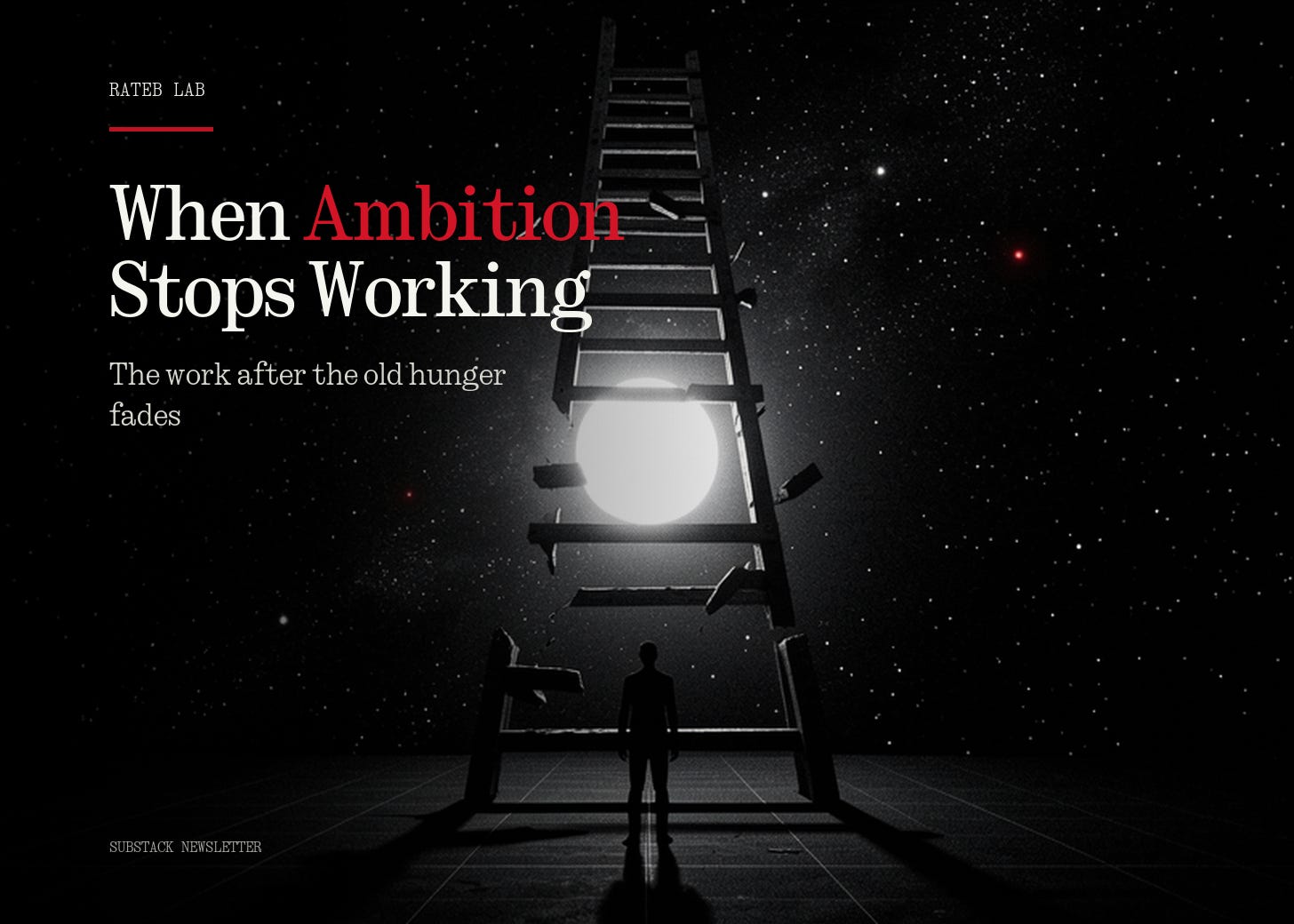
The strange quiet after chasing something for a long time
There is a phase in rebuilding yourself that nobody explains well.
At the beginning, ambition is useful.
It gets you to open the course when you are tired. It gets you to apply for the role after another rejection. It gets you to learn the command line, write the post, build the small system, fix the broken workflow, and keep showing up when nobody is clapping.
For a while, ambition feels like proof that you are alive.
Then something strange can happen.
The same goals are still there, but they do not hit the same way.
The certificate still matters, but it no longer feels like salvation. The job title still matters, but it no longer explains your whole future. The follower count, the project, the public proof, the next milestone, the next improvement loop. All of it may still be useful. But the old hunger around it starts to feel noisy.
That is the uncomfortable part.
Because when you have used ambition to survive, the quiet can feel like danger.
The wrong map
The first interpretation is usually harsh.
Maybe I am becoming lazy.
Maybe I lost my edge.
Maybe I need a stronger routine, a harder goal, a bigger threat, a new productivity system, a new app, a new identity.
That reaction makes sense. Most of us learned to trust pressure more than clarity.
Pressure is easy to measure. You feel it in your chest. You can turn it into output. You can mistake it for seriousness.
But pressure is not the same as direction.
And strain is not the same as discipline.
The dangerous mistake is treating every loss of old hunger as a personal failure.
Sometimes the old fuel is not disappearing because the work is over.
Sometimes it is disappearing because the work needs a cleaner reason.
The better map
I listened to a conversation with David Deida where he talks about a stage he calls the “Man of Zero.”
The useful idea for me was not the label. It was the pattern underneath it.
A person can reach a point where the old games stop feeding them. The drive for achievement, conquest, status, or constant becoming loses some of its emotional charge.
That can look like emptiness from the outside.
But it is not automatically apathy.
Apathy says, “nothing matters.”
Presence says, “the old noise does not own me in the same way.”
That distinction matters for anyone rebuilding technical skill in the AI age.
Because this path can easily become one more identity trap.
Learn cloud so you can prove you are not behind.
Learn AI so you can prove you are not replaceable.
Write online so you can prove you are not invisible.
Build systems so you can prove you are finally in control.
There is nothing wrong with wanting progress. I still want progress.
But if the whole system is built on proving your worth, every task becomes heavier than it needs to be.
Keep the skill, drop the strain
One idea from the episode stayed with me:
Your skills can remain even when your old interest in the game declines.
That is a useful reframe.
If the old emotional charge fades, you do not have to throw away the competence you built.
You can still write. You can still learn Linux. You can still study AWS. You can still build agents, workflows, notes, automations, and public proof.
But the inner posture can change.
Less desperate. Less performative. Less dependent on every output becoming evidence that you are finally enough.
This is where technical learning becomes more mature.
The beginner stage is often powered by urgency.
The next stage has to be powered by craft.
Urgency says, “I need this to fix me.”
Craft says, “this is worth doing well.”
That is a very different nervous system.
Why this matters in the AI age
AI makes this tension sharper.
When tools can generate faster than you can think, it is easy to respond by becoming more frantic.
More prompts. More drafts. More automations. More output. More proof that you are keeping up.
But the people who become truly useful with AI will not only be the people who produce the most.
They will be the people who can steer.
They can notice what matters. They can check the output. They can decide what should not be automated. They can stay calm enough to see the system instead of reacting to every shiny tool.
That requires a different kind of ambition.
Not the ambition to be seen as impressive.
The ambition to become accurate, useful, and harder to fool.
A simple audit
When the old hunger fades, I think the useful move is not panic.
It is an audit.
Ask three questions.
What skill is still worth keeping?
Do not confuse fatigue with uselessness. Some skills are still valuable even when the identity story around them is tired.
What strain can be removed?
Look for the places where the work became a courtroom. The post, the lab, the application, the project, the newsletter. Where did it become proof of your worth instead of practice?
What remains true when nobody rewards it quickly?
This question cuts through a lot of noise.
If a skill only matters when it gets applause next week, maybe it was mostly status.
If it still matters without immediate applause, it may be part of your real path.
My field note
I keep thinking about this because technical rebuilding has two layers.
There is the visible layer: courses, labs, projects, writing, job applications, tools, dashboards, automations.
Then there is the invisible layer: why you are doing it, what you are trying to prove, what fear is steering the system, and whether your work still belongs to you.
I do not want to become less ambitious.
I want to become less possessed by ambition.
That is the difference.
The goal is not to stop building.
The goal is to build without turning every step into a threat.
Practical next move
Pick one project you are currently avoiding or overloading with pressure.
Then write two lists.
First list: what is the actual useful skill inside this?
Second list: what identity pressure did I attach to it?
Keep the first list.
Question the second.
That is a small way to keep the ladder without worshiping it.
Final reflection
Ambition is not bad.
For many of us, it was the first honest fuel we had.
But starter fuel is not meant to become the whole engine.
At some point, the work has to become quieter and more truthful.
Not because you stopped caring.
Because you finally want the work to come from a cleaner place.