

The old beginner map for cybersecurity was simple:
Learn some tools. Watch alerts. Scan systems. Write reports. Move slowly toward deeper work.
That path is getting weaker.
Not because cybersecurity is becoming useless. The opposite is happening. Software is everywhere. Cloud is everywhere. AI is everywhere. The attack surface is getting bigger.
But the entry-level layer of the work is changing fast.
AI is very good at the parts of security that look like pattern recognition:
reading logs
scanning code
comparing configs
summarizing alerts
writing evidence
matching a known weakness to a known fix
Those things still matter. But they are no longer enough to be a strong career foundation.
The better question is not, "Will AI replace cybersecurity?"
The better question is:
What kind of security work becomes more valuable when AI can scan faster than humans?
My current answer is simple:
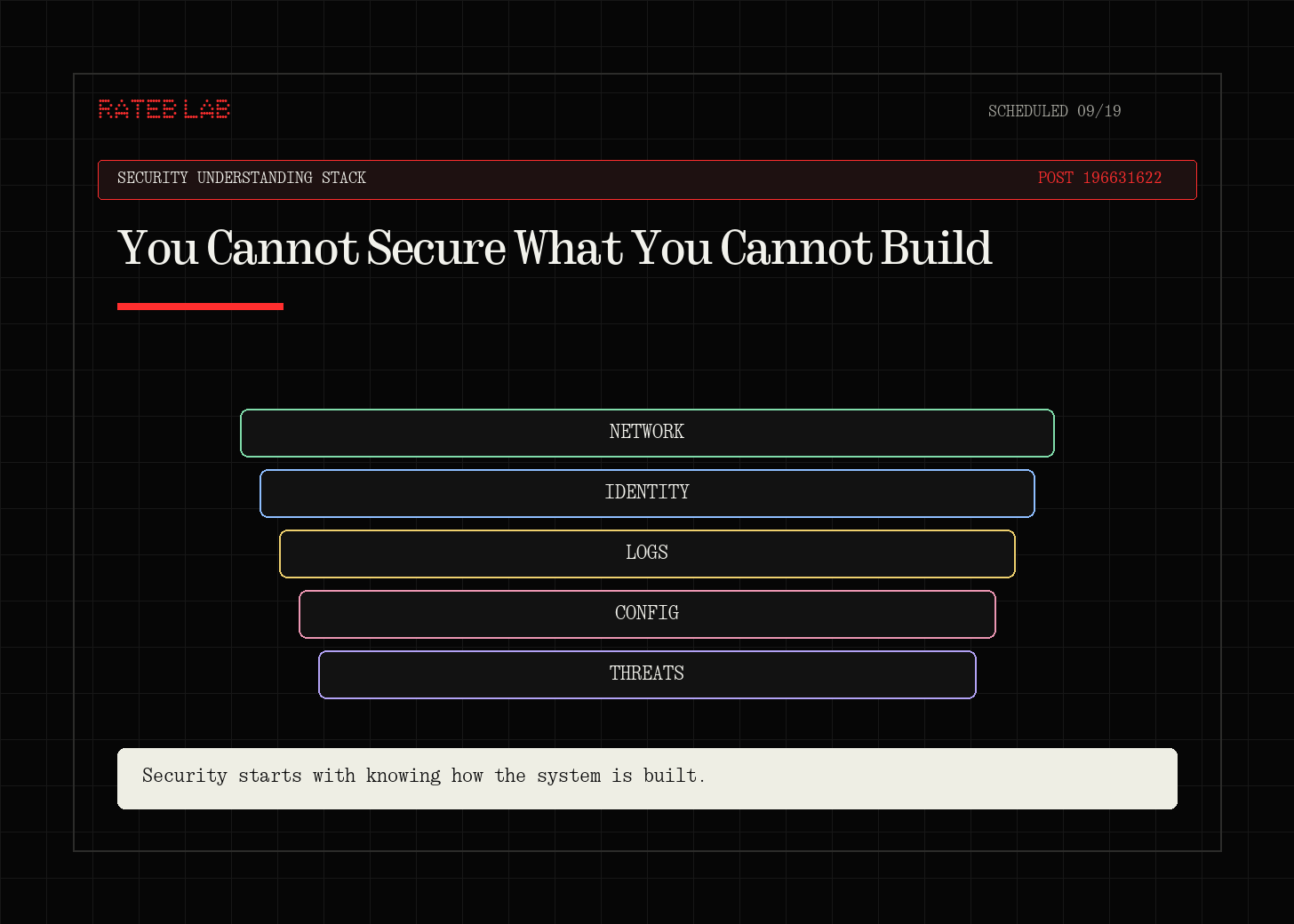
You cannot secure what you cannot build.
The Wrong Mental Model
A lot of beginners think security is a separate layer.
First someone builds the system.
Then the security person comes later and finds what is wrong.
That model worked better when software moved slower and teams had more time. But AI changes the speed of both sides.
Attackers can move faster.
Defenders can scan faster.
Tools can produce more alerts, more tickets, more findings, and more reports.
But the hard part is not only finding a weakness.
The hard part is understanding the system well enough to fix the weakness without breaking something else.
That requires building knowledge.
What AI Compresses First
AI will not remove every security role.
But it will put pressure on work that is mostly:
monitoring
triage
compliance evidence
report writing
simple vulnerability scanning
repeatable incident workflows
first-pass threat analysis
This is not an insult to that work. It is necessary work.
But it is also work with clear inputs, clear patterns, and repeatable outputs. That is exactly where AI improves quickly.
The danger for a beginner is building an identity around the surface layer of security:
"I know the dashboard."
"I know the scanner."
"I know the checklist."
Those are useful, but they are not enough.
The deeper skill is knowing what the dashboard is looking at.
The server.
The network.
The identity policy.
The storage permission.
The deployment pipeline.
The logs.
The backup plan.
The failure mode.
The real system.
The Better Mental Model
Cybersecurity is not separate from engineering.
Cybersecurity is engineering under hostile conditions.
That sentence changes the learning path.
If you want to become useful in AI-era security, do not only learn how to find problems.
Learn how systems are made.
Learn how Linux works.
Learn how packets move.
Learn how IAM permissions fail.
Learn how cloud services talk to each other.
Learn how deployments break.
Learn how logs become evidence.
Learn how backups are tested.
Learn how a bad default becomes a real incident.
Then security stops being a checklist. It becomes judgment.
The Builder Stack
If I were starting from zero and wanted a security-relevant path, I would not start with every security tool.
I would build this base:
1. Linux
Use the terminal daily. Understand users, permissions, processes, services, logs, SSH, packages, and basic hardening.
2. Networking
Learn IP, DNS, ports, routing, firewalls, TLS, HTTP, VPNs, and how traffic actually reaches an application.
3. Cloud fundamentals
Pick AWS, Azure, or GCP and learn the core building blocks: compute, storage, networking, IAM, monitoring, and cost.
4. Identity and access
Most cloud security problems are not movie-style hacking. They are boring permission mistakes that become serious.
5. Deployment and operations
Build something. Deploy it. Break it. Read the logs. Fix it. Add monitoring. Restore from backup.
6. Security inside the build
Add least privilege, secret handling, patching, network boundaries, logging, vulnerability scanning, and incident notes to the project.
That is a much stronger portfolio than saying, "I watched another security course."
A Practical Project
Here is a simple project that teaches more than a passive course:
Build a small web app on a cloud VM.
Then secure it step by step.
Add:
SSH key login only
a firewall rule
automatic security updates
a reverse proxy
HTTPS
basic logs
cloud monitoring
least-privilege IAM
backup and restore test
a short incident response note
Then write the whole thing down:
What I built.
What could go wrong.
What I changed.
How I verified it.
What I still do not understand.
That last line matters. Honest gaps are better than fake confidence.
Why This Matters For AI
AI is pushing more work into agents, APIs, cloud services, and automated systems.
That means the important security questions move closer to infrastructure:
Who can call this tool?
Where are the credentials stored?
What can the agent access?
What happens when it makes a bad request?
Where are the logs?
Can we roll back?
Can we isolate the damage?
Can someone explain the architecture without guessing?
The people who can answer those questions will matter.
Not because they memorized every tool.
Because they understand the system.
Closing
The AI-era career move is not to panic.
It is to move closer to the machine.
Closer to Linux.
Closer to networking.
Closer to cloud.
Closer to IAM.
Closer to logs.
Closer to real systems that need to work when nobody is watching.
Security is not going away.
But shallow security work will get squeezed.
The durable path is simple:
Build the system.
Operate the system.
Then learn how to secure it.
That is where AI makes the beginner path harder, but the serious path clearer.