

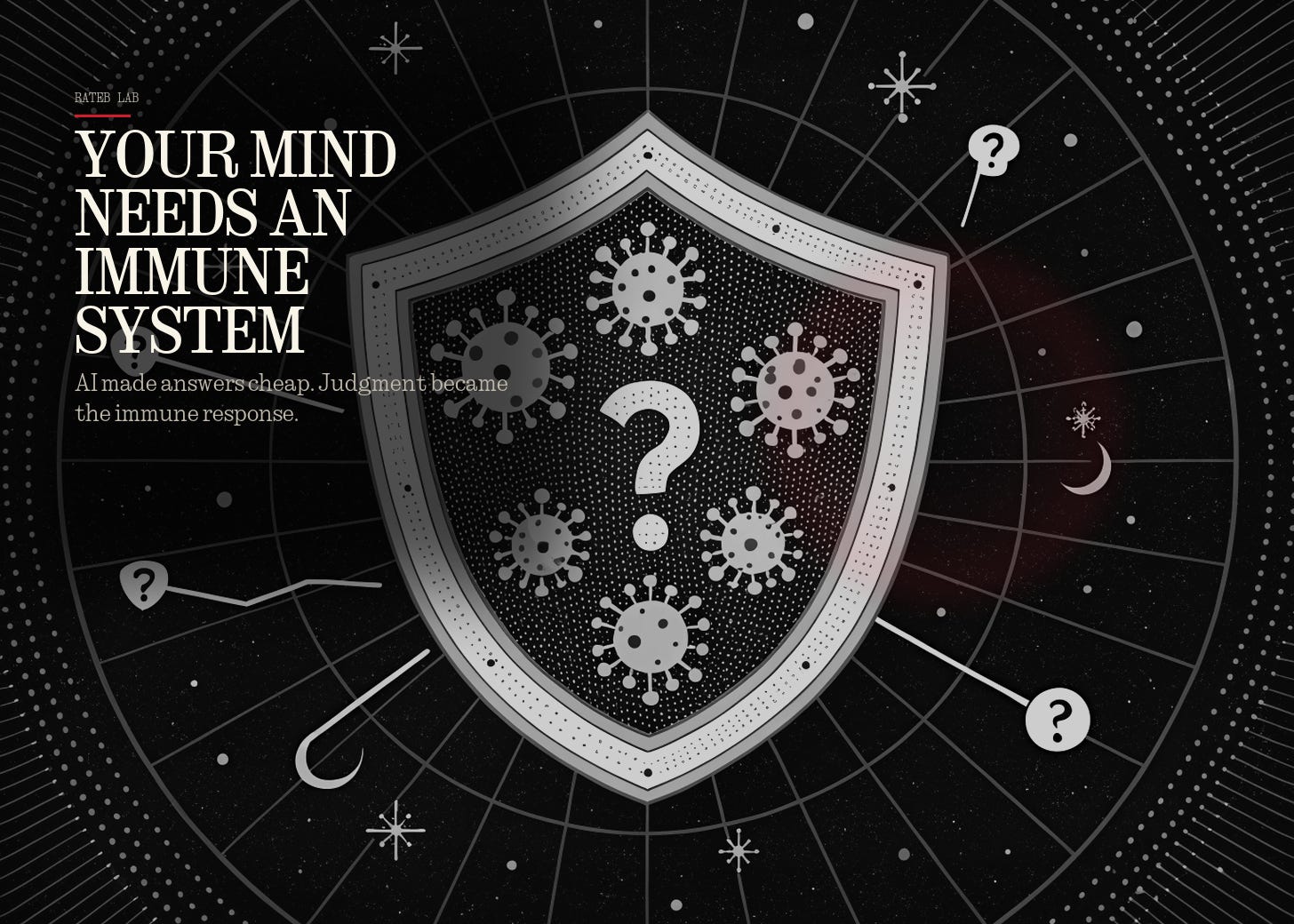
AI made answers cheap.
That sounds like good news.
But cheap answers create a new problem: bad ideas now arrive faster, cleaner, and more confidently than before.
The hard skill is no longer finding information.
The hard skill is knowing what to let into your head.
The Simple Map
Your mind needs an immune system.
Not a wall.
A system.
The goal is not to reject every new idea. That turns you rigid.
The goal is to test ideas before you build your life, work, or identity around them.
Here is the map I am using:
Notice the claim.
Separate emotion from evidence.
Ask what would prove it wrong.
Look for more than one source.
Act only as far as the evidence allows.
That is the mental version of a safe technical workflow.
You do not give a script full production access because it sounds confident.
You do not give an idea full access to your life because it feels good.
Why This Matters More Now
Before AI, a weak idea had to travel through people.
Now a weak idea can be rewritten, summarized, expanded, translated, formatted, and distributed in minutes.
That does not make AI bad.
It makes judgment scarce.
A model can explain a topic in a calm voice and still be wrong.
A thread can sound sharp and still be empty.
A political tribe can give you belonging and still train you to stop thinking.
A productivity system can look clean and still hide avoidance.
The old question was:
Where can I find information?
The new question is:
What should I trust enough to use?
Bad Ideas Behave Like Bad Inputs
In technical work, bad input creates bad output.
A broken config file can crash a service.
A wrong permission can expose data.
A missing check can delete the wrong thing.
The same is true in thinking.
A bad idea can become a filter.
Once it becomes a filter, you stop seeing reality directly. You start seeing what the idea allows you to see.
This is why source material from Gad Saad’s The Parasitic Mind is useful even if you do not share every political angle in the book.
The strongest practical lesson is simple:
Bad ideas do not only give you wrong opinions.
They can damage the process you use to form opinions.
That is the dangerous part.
Thinking And Feeling Both Matter
One mistake is to pretend emotion is useless.
It is not.
Emotion tells you what matters.
But emotion is not always the right tool for deciding what is true.
If a server is down, panic does not diagnose the issue.
You need logs.
If an AI answer sounds convincing, relief does not make it correct.
You need checks.
If a claim offends you, offense does not prove it false.
You need evidence.
The skill is not becoming emotionless.
The skill is using the right mode for the right job.
Feeling can tell you, “pay attention.”
Evidence must tell you, “believe this.”
The Evidence Loop
The best idea in the source is the habit of building truth from converging evidence.
One example is not enough.
One study is not enough.
One anecdote is not enough.
One AI answer is definitely not enough.
The better question is:
Do different kinds of evidence point in the same direction?
For technical learning, that looks like this:
The documentation says it should work.
The command output confirms it did work.
The logs show no hidden failure.
A small test reproduces the result.
You can explain the mechanism in your own words.
Now you are not just trusting a claim.
You are building a small evidence network.
That is how you protect yourself from confident nonsense.
A Practical Mental Firewall
Here is the checklist I want to use before I believe, share, or build on an idea:
What is the exact claim?
What would I expect to see if it were true?
What would I expect to see if it were false?
Am I reacting to evidence or identity?
Have I checked at least two independent sources?
Can I explain the idea without using the source’s language?
What is the smallest real-world test?
This is not only for politics or philosophy.
It is for AI prompts.
It is for cloud labs.
It is for career advice.
It is for investing in a course.
It is for choosing what kind of person you are becoming.
The Real Skill
The AI age rewards people who can move fast.
But it will punish people who believe fast.
The edge is not being the loudest.
The edge is being harder to manipulate.
Harder to impress with jargon.
Harder to trap with tribal stories.
Harder to rush into sharing what you have not checked.
Harder to fool with polished answers.
That is not cynicism.
That is intellectual self-respect.
What I Am Taking From This
I do not want my writing system to only produce more content.
I want it to improve my judgment.
Every source should pass through a filter:
What is true here?
What is useful here?
What is overclaimed here?
What can I test in my own work?
What should I leave behind?
That is the difference between consuming ideas and compiling knowledge.
And in an age where machines can generate endless answers, the person with the better evidence loop wins.
Sources
Gad Saad, The Parasitic Mind.