

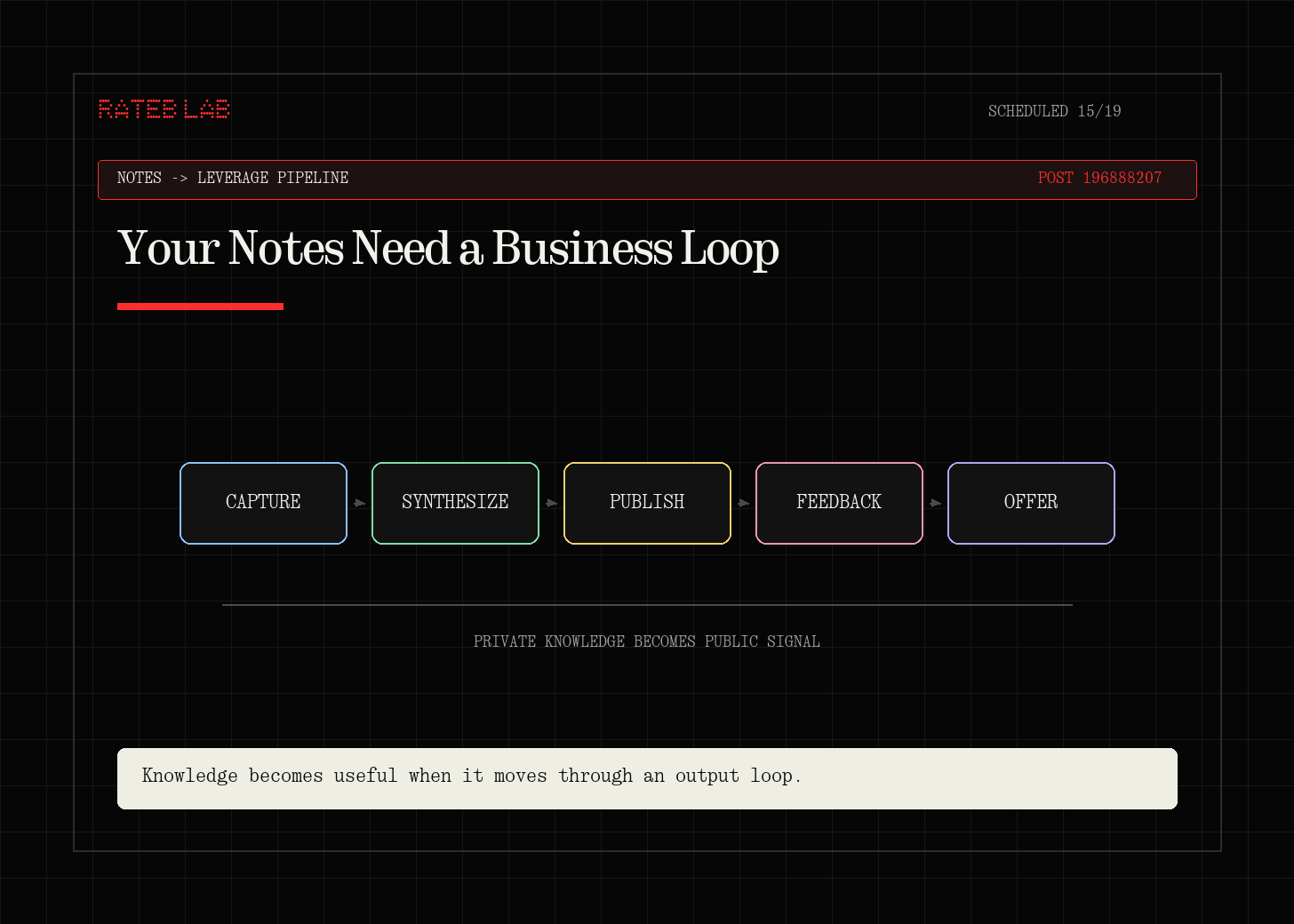
I studied Digital Economics and translated the useful parts into my own system: notes, writing, distribution, feedback, and future offers.
I used to treat notes like a place to store what I was learning.
A course note went into Obsidian.
A PDF highlight went into Obsidian.
A transcript became a summary.
A good idea became another page.
That feels productive.
But it is not leverage yet.
The deeper lesson I took from studying Digital Economics is simple:
Your notes are not an asset until they move through a loop.
Not a complicated creator dashboard.
Not a perfect second brain.
Not a folder full of clever frameworks.
A loop.
Capture.
Synthesize.
Publish.
Distribute.
Validate.
Turn the repeated signal into an offer, a product, a better lesson, or a clearer system.
That is the part I care about.
Because my goal is not to become a motivational creator. My goal is to become technically useful in the AI age and turn the climb into proof, trust, and opportunity.
The Course Is Not The System
The mistake with any course is thinking the system lives inside the course.
It does not.
The system has to survive contact with your real life.
For me, that means cloud learning, Linux, AWS labs, AI tools, career rebuilding in Germany, rejection, interview preparation, Obsidian notes, and writing in public while I am still becoming better.
So I do not want to copy a Notion dashboard or another creator’s workflow.
I want the first principles.
What is the job of the dashboard?
It should help me see what I know, what I am building, what I have published, what people respond to, and what problem keeps coming back.
In my setup, that means Obsidian is the command center.
Not because Obsidian is magic.
Because it gives me a place to connect learning, projects, writing, visuals, audience signals, and offer ideas without losing the thread.
A Note Has To Earn A Job
Most notes are passive.
They sit there.
They make you feel smarter.
They create the illusion that learning is happening because a page exists.
The better question is:
What job does this note have?
A note can become an atomic idea.
A post.
A newsletter section.
A visual.
A lead magnet.
A product module.
An offer angle.
A sales email.
A better question for the next lab.
If a useful note never becomes anything, the system is leaking.
That does not mean every thought should be published.
It means strong notes should not die in storage.
For example, if I learn an AWS concept, I can turn it into:
• a simple explanation for beginners
• a diagram of the system
• a mistake I made in the lab
• a LinkedIn post about proof of work
• a Substack lesson about technical judgment
• an offer idea around helping learners escape tutorial hell
Same source. Different jobs.
Content Is Proof, Not Performance
This is the part I want to keep reminding myself.
Content should not only say what I think.
It should show what I am doing.
A cloud lab becomes proof.
A rejected application becomes a field note.
A broken automation becomes a lesson.
An Obsidian workflow becomes a map.
A course becomes a system I adapt and test.
That is different from pretending to be finished.
The better position is public apprenticeship.
I am learning, building, documenting, and improving in public.
That gives the content a spine.
It is not random inspiration.
It is not generic AI hype.
It is not fake expertise.
It is evidence of a person becoming more useful.
The APAG Shape
The writing system I am keeping is simple.
Attention: make the right person care.
Perspective: change how they see the problem.
Advantage: show what improves with the new model.
Gamify: make the next step feel doable.
For this essay, the attention is the uncomfortable truth that notes alone do nothing.
The perspective is that Obsidian should not be an archive. It should be a creator-business command center.
The advantage is that one source can become many useful assets without becoming copy-paste content.
The gamified step is the weekly loop.
Pick one strong source.
Extract five atomic ideas.
Publish one short post.
Build one deeper essay.
Turn the clearest part into a visual.
Track what people respond to.
Save one offer angle.
Repeat.
The Distribution Loop
I do not want X, LinkedIn, Bluesky, and Substack to become four separate jobs.
That is how creators burn out.
The better model is source-first.
Obsidian holds the source.
Substack creates depth.
X tests compression and sharpness.
Bluesky tests cleaner conversation.
LinkedIn turns the idea into professional proof.
Canva or diagrams make the system visible.
The platform is not the strategy.
The loop is the strategy.
Offers Come From Repeated Signals
The offer part is where many people jump too fast.
They build a product before they understand the problem.
The course reminded me that offers should grow from repeated pain, repeated questions, and repeated proof that I can help.
For my current stage, the offer is not the first move.
The first move is proof.
Public labs.
Public notes.
Useful diagrams.
Clear explanations.
A better Obsidian system.
Real feedback.
Then, if the same problem keeps appearing, I can test a small offer.
Not a huge course.
A minimum viable offer.
Maybe a technical learning system audit.
Maybe an Obsidian-to-output setup.
Maybe a public-learning sprint for cloud beginners.
But the offer should come from evidence, not fantasy.
My Current Rule
Here is the rule I am taking forward:
Every serious source must leave behind at least one public asset and one future asset.
A public asset can be a post, essay, visual, thread, or carousel.
A future asset can be an offer angle, product module, lead magnet, or sales email idea.
That one rule changes the meaning of studying.
Studying is no longer passive consumption.
It becomes raw material for skill, reputation, and usefulness.
That is the real Digital Economics lesson for my setup.
Not copy the dashboard.
Build the loop.
And let the loop turn learning into leverage.
If you are building technical skill in the AI age, I am documenting the same path in public: cloud, Linux, automation, Obsidian, and clear thinking. Subscribe to Rateb Lab for the deeper maps.